

Pakistani refinery seeks used complex to upgrade operations

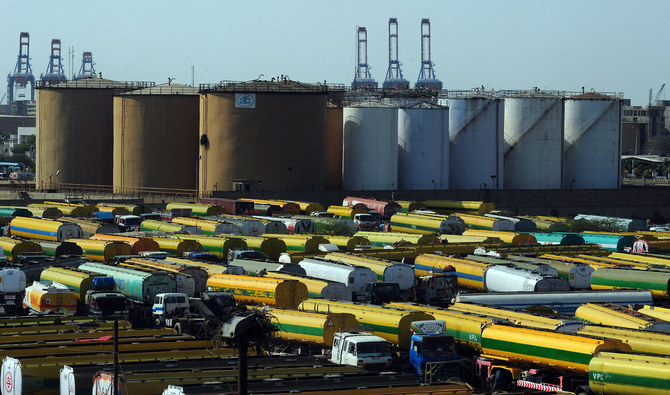
An overview shows tankers parked outside a local oil refinery in the Pakistan's port city of Karachi, Pakistan, on February 22, 2011. (AFP/File)
Short Url
Updated 09 April 2021
Follow

Pakistani refinery seeks used complex to upgrade operations

  • Offers from interested bidders have been invited with a closing date of April 23
  • If the purchase goes ahead, Pakistan Refinery Limited could double its capacity to 100,000 barrels per day

ISLAMABAD: Pakistan Refinery Limited (PRL) is looking to buy a second-hand refinery complex to upgrade its operations and increase output to help meet rising demand for petroleum products as the country emerges from a pandemic-driven slump.

The South Asian country currently has five refineries with a total capacity of 417,000 barrels per day (bpd), according to Pakistan's 2020 economic survey, the largest of which stands at 150,000 bpd.

If the purchase goes ahead PRL could double its capacity to 100,000 bpd.

The company this week sought offers to purchase a second-hand refinery complex for relocation to Pakistan, according to an advertisement placed in international media.

It said it was undertaking an upgrade and potential expansion project to produce Euro V specification and high-speed diesel oil. For this purpose, it intends to purchase a pre-owned refinery complex with one or more conversion units, which should have a 50,000 to 100,000 bpd throughput design.

Offers from interested bidders have been invited with a closing date of April 23.

Pakistan's total refining capacity is 19.37 million tons per year, according to the Economic Survey, while the country consumes 19.68 million tons of petroleum products annually.

The government says refinery capacity is not being fully utilized on account of financial as well as technical problems, and is supplying only 11.59 million tons per year, with the rest of the country's needs imported.

The finance ministry, in a report last month, said that import volumes of petroleum crude increased by 13.8 percent in the first eight months of the 2020-21 financial year. Import volumes of petroleum products increased by 27.7 percent in the same period.


ADB, Pakistan sign over $300 million agreements to undertake climate resilience initiatives

Updated 30 December 2025
Follow

ADB, Pakistan sign over $300 million agreements to undertake climate resilience initiatives

  • Pakistan ranks among nations most vulnerable to climate change and has seen erratic changes in weather patterns
  • The projects in Sindh and Punjab will restore nature-based coastal defenses and enhance agricultural productivity

ISLAMABAD: The Pakistani government and the Asian Development Bank (ADB) have signed more than $300 million agreements to undertake two major climate resilience initiatives, Pakistan’s Press Information Department (PID) said on Tuesday.

The projects include the Sindh Coastal Resilience Sector Project (SCRP), valued at Rs50.5 billion ($180.5 million), and the Punjab Climate-Resilient and Low-Carbon Agriculture Mechanization Project (PCRLCAMP), totaling Rs34.7 billion ($124 million).

Pakistan ranks among nations most vulnerable to climate change and has seen erratic changes in its weather patterns. In 2022, monsoon floods killed over 1,700 people, displaced another 33 million and caused over $30 billion losses, while another 1,037 people were killed in floods this year.

The South Asian country is ramping up climate resilience efforts, with support from the ADB and World Bank, and investing in climate-resilient infrastructure, particularly in vulnerable areas.

“Both sides expressed their commitment to effectively utilize the financing for successful and timely completion of the two initiatives,” the PID said in a statement.

The Sindh Coastal Resilience Project (SCRP) will promote integrated water resources and flood risk management, restore nature-based coastal defenses, and strengthen institutional and community capacity for strategic action planning, directly benefiting over 3.8 million people in Thatta, Sujawal, and Badin districts, according to ADB.

The Punjab project will enhance agricultural productivity and climate resilience across 30 districts, improving small farmers’ access to climate-smart machinery, introducing circular agriculture practices to reduce residue burning, establishing testing and training facilities, and empowering 15,000 women through skills development and livelihood diversification.

Earlier this month, the ADB also approved $381 million in financing for Pakistan’s Punjab province to modernize agriculture and strengthen education and health services, including concessional loans and grants for farm mechanization, Science, Technology, Engineering and Mathematics (STEM) education, and nursing sector reforms.