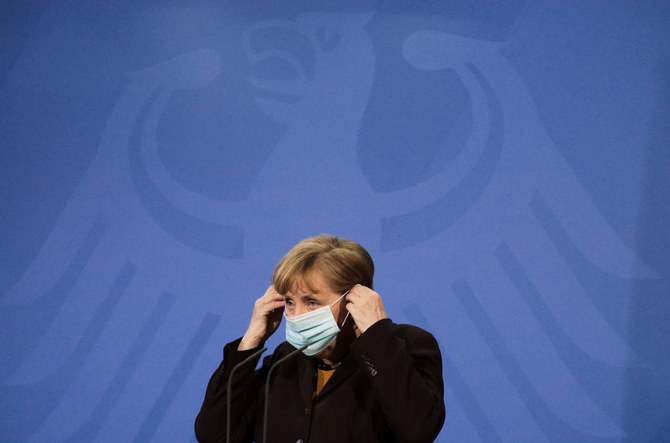
BERLIN — German Chancellor Angela Merkel plans to take control from federal states to impose restrictions on regions with high numbers of coronavirus infections, a government spokeswoman said, in a battle to curb the pandemic’s a third wave.
The federal government plans to introduce draft legislation next week, she said.
Finance Minister Olaf Scholz said this will include compulsory measures in regions with 100 or more new coronavirus cases per 100,000 people over seven days.
Above an incidence of 200, distance learning was planned for schools again, he added.
The incidence figure reached a high near 200 in late December, soon after Germany went from a “lockdown lite” that started in early November, during which schools and stores were open, to a full shutdown.
It last stood at 110.4, according to data from the Robert Koch Institute for infectious diseases.
However, containment measures in Germany vary from region to region due to the country’s decentralized federal system.
In some regions, consumers can go shopping as long as they have a negative COVID-19 test, while stores are closed in others.
Some, like Berlin, have introduced nighttime bans on gatherings, while others, like Saarland, have allowed restaurants and beer gardens to open outdoor seating.
“It makes good sense to regulate this uniformly for the whole of Germany, because then there will be clarity and transparency,” Scholz told reporters.
“In this regard, it is a necessary, real step forward if we expand the infection (protection) law to include a regulation for exactly these cases.”
Merkel and several regional leaders have called for a short, sharp nationwide lockdown while Germany — Europe’s biggest economy and most populous country — tries to vaccinate more people.
“Rules on social distancing, mask mandates, curfews and social distancing should be regulated at a national level,” said Armin Laschet, chairman of Merkel’s Christian Democrats (CDU).
The number of confirmed coronavirus cases increased by 25,464 in a day, which was 3,576 more than a week earlier, data from the RKI showed on Friday.
But the institute cautioned that the figures may be skewed following the long Easter holiday weekend, adding it expected reliable case numbers from around the middle of next week.
A meeting of Merkel and the leaders of Germany’s 16 states scheduled for Monday, at which they were to discuss an extension to COVID restrictions, has been canceled, the government spokeswoman said.
German health minister Jens Spahn warned that nationwide measures were necessary to break the current wave of coronavirus infections as quickly as possible.
He told journalists that there were currently nearly 4,500 coronavirus patients in intensive care in Germany, adding: “If this continues, it will be too much for our health system.”
Germany’s top public health official said a lockdown lasting two-four weeks was necessary to break the third wave.
“Every day in which we don’t act, we lose lives,” Lothar Wieler, president of the RKI, said.


![]()

Merkel to take control from German states in pandemic battle
Short Url
https://arab.news/2sdud
Merkel to take control from German states in pandemic battle
- Containment measures in Germany vary between regions due to decentralized federal system
- Top public health official said a two-four weeks lockdown is necessary to break the third wave


Latest updates


© 2026 SAUDI RESEARCH & PUBLISHING COMPANY, All Rights Reserved And subject to Terms of Use Agreement.