

Saudi participation in Pakistan air drill ‘manifestation’ of growing ties — foreign office 

Air Vice Marshal (Pilot) / Staff Awad Abdullah Al Zahrani, Defence Attache KSA (right) presents a souvenir to Base Commander PAF Base Mushaf, Air Commodore Ali Naeem Zahoor (left) , at an operational air base of the Pakistan Air Force, Pakistan, on April 8, 2021. (Courtesy: Pakistan Air Force)
Short Url
Updated 10 April 2021
Follow

Saudi participation in Pakistan air drill ‘manifestation’ of growing ties — foreign office 

  • ACES Meet 2021-1 officially kicked off in Pakistan last Monday with focus on counterterrorism, maximizing combat readiness of participating nations
  • Saudi air force contingent had around 180 officials, about 50 officials from Egypt, Jordan and Bahrain participated as observers 

ISLAMABAD: A multinational air exercise, “ACES Meet 2021-1,” hosted by Pakistan, concluded on Thursday, with the Pakistan Foreign Office saying on Friday that the participation of the Saudi air force was “yet another manifestation” of growing ties between the two nations.
The two-week exercise had kicked off at an operational air base of the PAF last Monday with the objective to maximize the combat readiness of participating countries through near-realistic and role-oriented air-to-air combat training, with a focus on counterterrorism operations.
“The participation of Saudi Air Force in PAF exercises ACES Meet 21 is yet another manifestation of the fraternal ties between Pakistan and Saudi Arabia,” Zahid Hafeez Chaudhri, the spokesperson of the Pakistani foreign office, told Arab News on Friday. “The two countries have strong economic, political, security and military cooperation at all levels. Relations between the two brotherly countries have continued to grow over time.”
Saudi Arabia and the US brought combat aircraft and fairly large contingents of pilots and technical staff to the exercise. The Royal Saudi Air Force (RSAF) contingent consisted of 180 officials, including pilots and technicians, who arrived with several Tornado multirole combat aircraft and the Lockheed C-130 Hercules. The United States Air Force (USAF) team comprised 70 members, while around 50 officials from Egypt, Jordan and Bahrain were in Pakistan as observers at the multinational air exercise.
“PAF is happy to share its experiences and expertise in the field of Counter-Terrorism Operations with RSAF & USAF,” PAF said in a statement. “At the same time, Exercise ACES Meet has also provided a good opportunity for us for mutual learning … With the successful and meaningful conduct of exercise, we have consolidated our resolve, that we stand by each other as allies and friends.”
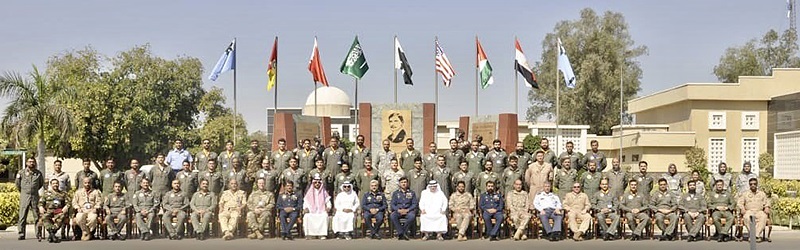


Group photo of participants of air drill ACES Meet 2021-1 at an operational air base of the Pakistan Air Force, Pakistan, on April 8, 2021. (Courtesy: Pakistan Air Force)

Ambassador of Saudi Arabia to Pakistan Nawaf bin Saeed Al-Maliki, who attended the drill’s closing ceremony as guest of honor thanked PAF for arranging the exercise.
“Such exercises increased the comradeship and professional excellence of the participants,” the envoy was quoted as saying.


Pakistan considers shifting imported edible oil transport from roads to rail to improve logistics

Updated 5 sec ago
Follow

Pakistan considers shifting imported edible oil transport from roads to rail to improve logistics

  • The plan includes building a railway station and modern storage facilities at Port Qasim in Karachi
  • Officials say about 100,000 tons of imported edible oil a year could move by rail to major cities

ISLAMABAD: Pakistan is considering transporting imported edible oil from Port Qasim by rail as part of broader logistics reforms aimed at cutting costs, easing traffic congestion in Karachi and improving environmental outcomes, officials said on Tuesday.

The proposal was discussed during a meeting between a delegation from the Ministry of Railways and Federal Minister for Maritime Affairs Muhammad Junaid Anwar Chaudhry, who said the government was examining plans to establish a railway station and modern storage facilities at the port.

Pakistan currently relies heavily on road transport for moving imported edible oil inland, contributing to congestion, higher fuel consumption and logistics bottlenecks in Karachi. Shifting bulk cargo to rail is part of wider efforts to improve port-linked supply chains and reduce transport inefficiencies.

“Under this project, the transportation of edible oil through railways will help save both time and cost,” Chaudhry said, according to an official statement, adding that the initiative would significantly reduce traffic pressure in Karachi.

Chaudhry said trains carrying edible oil would operate from Port Qasim and Keamari to major consumption and industrial centers, including Multan, Lahore, Faisalabad, Hattar and Peshawar.

He said the project envisages shifting around 100,000 tons of edible oil annually from road to rail, which would also support environmental goals through lower fuel use and reduced transport emissions.

“The railway project will support port-related logistics reforms and bring environmental benefits by promoting efficient fuel use and lowering transportation costs,” Chaudhry said.

The statement said the plan also aligned with broader government efforts to modernize freight transport infrastructure and improve coordination between ports and the railway network.