

Houthi actions towards minority groups threaten religious freedoms in Yemen: Minister

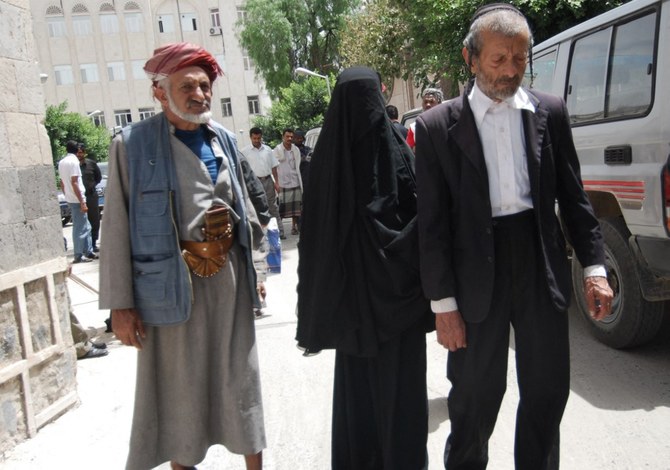
A Yemeni Jew arrives with his son's widow to join a protest outside the ministry of justice in Sanaa on June 28, 2010. (File/AFP)
Short Url
Updated 08 April 2021
Follow

Houthi actions towards minority groups threaten religious freedoms in Yemen: Minister

  • The Houthis have persecuted members of the Jewish community since its insurgency in Saada
  • The minister called on the international community and human rights organizations to pressure the Houthi militia to end its criminal practices against minority groups

DUBAI: The Houthis’ actions towards the Jewish and Baha’i communities reflect the militia’s approach towards minority groups and religious freedoms, Yemen’s information minister Muammar Al-Eryani said.

Houthi practices reflect the dangerous attempts of the militia to undermine the social fabric and the values of coexistence among Yemenis which has “prevailed for thousands of years,” Al-Eryani said in a statement published by state news agency SABA on Wednesday.

The Houthis have persecuted members of the Jewish community since its insurgency in Saada, and forced them out of Yemen, the minister said, referencing militia’s recent deportation of the last three Jewish families in the country.

The actions of the Houthis have also affected the Baha’i community, Al-Eryani said, claiming that the militia group had kidnapped dozens of Baha’i members from their homes – including the sect leader – looted their properties, sentenced them to death and forcibly deported them.

Al-Eryani called on the international community and human rights organizations to pressure the Houthi militia to end its criminal practices against minority groups in areas under its control, and to hold accountable those involved in human rights crimes and violations.


Aid trucks resume crossing Egypt-Gaza border after closure

Updated 2 sec ago
Follow

Aid trucks resume crossing Egypt-Gaza border after closure

  • More than 100 aid trucks crossed the Egyptian side of Gaza’s Rafah border crossing on Tuesday, two sources told AFP
RAFAH: More than 100 aid trucks crossed the Egyptian side of Gaza’s Rafah border crossing on Tuesday, two sources told AFP.
Israel closed all crossings into the Gaza Strip on Saturday, after it launched a joint attack on Iran with the United States.
It agreed to reopen the Kerem Shalom crossing, where trucks from Egypt are inspected, for the “gradual entry of humanitarian aid.”
“More than 100 United Nations aid trucks, including UNICEF’s, entered the Rafah border crossing” on Tuesday, a source at the border told AFP on Wednesday on condition of anonymity.
An official with the Egyptian Red Crescent, which coordinates aid deliveries, said the trucks “went through Rafah to the Kerem Shalom crossing,” where Israeli authorities did not send any back to Egypt — their procedure when aid shipments are rejected.
Both sources said no Palestinians were allowed through the crossing on Tuesday.
The Rafah crossing, the only gateway for Gazans to the outside world that does not pass through Israel, had reopened for a trickle of people on February 2, nearly two years after Israeli forces seized it.
A statement from the Red Crescent on Tuesday said the convoy included hundreds of tons of food, relief supplies and “fuel products to operate hospitals and vital facilities.”
The UN had warned its partners were “forced to ration fuel, prioritize life-saving operations” in the devastated Palestinian territory.
The Red Crescent official said another aid convoy was sent on Wednesday and was waiting to be allowed in.
The October peace deal between Israel and Palestinian militant group Hamas stipulates that 600 aid trucks should be allowed in per day.