

Saudi chef’s passion for cooking burns bright despite challenges of multiple sclerosis

Afnan Aljaadi's passion for cooking helped her overcome her depression. (Supplied)
Short Url
Updated 08 April 2021
Follow

Saudi chef’s passion for cooking burns bright despite challenges of multiple sclerosis

  • One of the main things that helped Aljaadi overcome her depression was her passion for cooking

JEDDAH: Afnan Aljaadi was a freshman in college when she received the life-changing news that she had multiple sclerosis (MS) in 2008. Aljaadi is now one of Saudi Arabia’s leading chefs, specializing in French, Italian, and Asian cuisine. She talked to Arab News about how she has been able to make her dreams come true against the odds.

MS is a medical mystery. Its cause is still unknown, there is no cure yet, and symptoms and progress vary from person to person. It is a relatively rare autoimmune disease that affects the central nervous system including the brain, cerebellum, and spinal cord. According to the American National Multiple Sclerosis Society, there are only 2.3 million people worldwide with a confirmed diagnosis of MS, 1 million of whom are in the US. 

The first symptoms Aljaadi noticed back in 2008 were dizzy spells that would cause her to faint, sensitivity to sunlight, and migraines. Her college work began to suffer and her GPA dropped significantly. Unfortunately, she told Arab News, her college professors thought she was making excuses and faking her symptoms until she had been properly diagnosed.
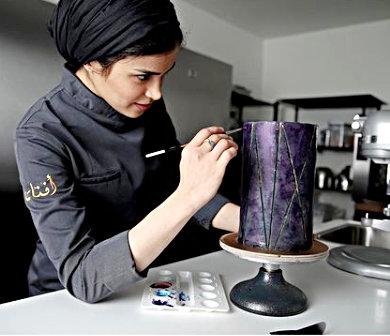


Afnan Aljaadi's passion for cooking helped her overcome her depression. (Supplied) 

After a series of tests and an MRI, she was transferred to a neurologist, who suggested brain and nerve radiation therapy. It took several more tests and visits to other neurologists before her diagnosis was confirmed.

“The disease was very strange. I had never heard of it before, but I am very thankful that I discovered the symptoms (early) and did not lose the ability to move,” Aljaadi said. “I was struggling so much in that first year because society did not accept the changes I was going through. That has turned me into a very reserved person.”

Aljaadi developed further symptoms: The frequency of her fainting increased, the left side of her face felt numb, and her skin became extremely sensitive to cold water. These are not uncommon — the lesions seen when patients with MS undergo an MRI can affect areas of the brain responsible for sensation, meaning many experience a loss of feeling in parts of their bodies, as well as blurred vision, weakness, and “brain fog.”

Like many people diagnosed with a life-altering condition, Aljaadi became depressed. “I went into a spiral of sadness and depression after acknowledging that I had been diagnosed with the disease and was not receptive to it,” she said.

The head of the neurology department at My Clinic in Jeddah, Dr. Rumaiza Hussein Alyafeai, a Saudi neurologist and consultant, and an MS specialist, explained how MS affects the brain and muscle function.

FASTFACT

MS is a medical mystery. Its cause is still unknown, there is no cure yet, and symptoms and progress vary from person to person. It is a relatively rare autoimmune disease that affects the central nervous system including the brain, cerebellum, and spinal cord. According to the American National Multiple Sclerosis Society, there are only 2.3 million people worldwide with a confirmed diagnosis of MS, 1 million of whom are in the US.

“The immune system is not affected in itself, but some immune cells lose track of attacking foreign particles and they start to attack the myelin sheath (an insulating layer around the nerves) in the nervous system, hence the lesions start to appear,” she said.

“Among the most challenging obstacles that patients with MS might face is the lack of knowledge,” she continued. “Autoimmune diseases, in general, are quite difficult to handle as they have a variety of symptoms that make the patients pass through a sometimes overwhelming journey prior to having their diagnosis declared. You might start to see symptoms such as mood swings, depression, euphoria, forgetfulness, and emotional lability.”

One of the main things that helped Aljaadi overcome her depression was her passion for cooking. Having completed her college degree in six years, she started work as an administrator. But she also participated in several cooking competitions, and in 2013 she took part in “Master Chef,” which she credits with opening many doors for her.

She has now received two chef certifications from the acclaimed French-born Monégasque chef Alain Ducasse and French culinary school Le Cordon Bleu, and she is a certified professional pastry chef. She runs her own cake decoration business — @unemeringue (“My inspiration is generated from my passion in art, combined with my pastry skills to create edible art pieces with a unique fine taste,” she said) and has also joined the Middle Eastern food and lifestyle TV channel Fatafeat.
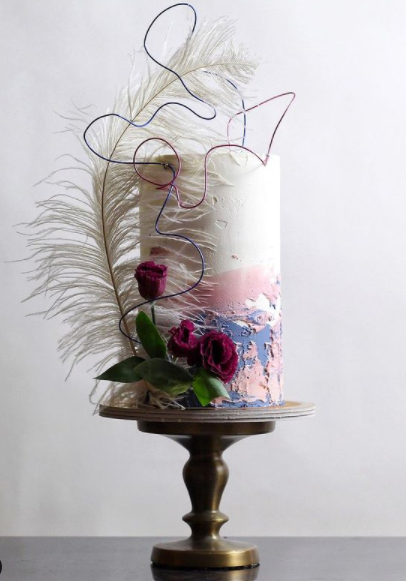
“The most challenging obstacle is losing control of my muscles, especially when I do my daily routine of work in pastries and cooking and all I feel is numbness,” she said. “But I am a survivor. I changed my lifestyle and understood what could hurt me. I’m still fighting it. It’s a matter of adapting and adjusting to a certain healthy lifestyle and habits to maintain a sustainable day-to-day routine.”

Finding the right diet has played an important role in living with her condition, she explained. Every patient’s dietary needs will differ, depending on their blood type and their family’s medical history.

“I follow a gluten-free diet,” Aljaadi said. “I avoid lactose, I increased the amount of vegetables I was eating and reduced my meat intake.” Exercise, especially walking, is also crucial, she added. “Continuing treatment without a healthy lifestyle will not give any satisfactory results.”

But it’s not just her physical well-being that Aljaadi needs to pay attention to, she explained. “Visiting a psychologist — just talking to a (professional) — helped me a lot,” she said. “It improved my confidence and (increased my belief) in Allah’s mercy, with patience and persistence, to accomplish my ambition.”

“Most MS patients are great warriors and heroes of their own unique stories,” Alyafeai said. “They almost always cope well with the disease (with the help of) their neurologists.”

For anyone else with MS, Aljaadi has some advice. “I’d encourage you to let go of your comfort zone to avoid bouts of depression,” she said. “Remember that your persistence is a source of energy for others who are suffering.”



Draped in history, Saudi fashion designers look to the future

Updated 22 February 2026
Follow

Draped in history, Saudi fashion designers look to the future

  • Saudi designers are reimagining the Kingdom’s heritage through modern fashion

RIYADH: The fast-growing fashion industry in Saudi Arabia is looking through the lens of history and heritage to produce clothing draped in the history of traditional garb worn during the time of the Kingdom’s founding.

At the Saudi Cup on Feb. 13, a number of designers showcased their couture inspired by the country’s rich history.

Saudi designer Fahda Al-Battah, one of the minds behind brand Adara by Fa alongside Abeer Al-Moammar, spoke to Arab News about their debut collection “Journey Through Time.”

Saudi designers showcased their couture inspired by the Kingdom’s rich history at the recent Saudi Cup in Riyadh, which is becoming  a hotspot for the latest styles. (Supplied)

The emerging brand’s collection was designed with the intention of displaying the country’s diversity.

The collection’s six pieces each represent a region of the Kingdom, either through motifs, symbolism, or patterns that are hand drawn by Al-Battah and her team.

The first dress is heavily inspired by the Qassim and Al-Ahsa regions, and features illustrated scenes of people collecting dates from palm trees and using them in various ways. “It’s a story, basically,” Al-Battah said.

“Heritage must be preserved and if anything new comes up now, we must create new heritage and not replicate the past,”

Amar Al-Amdar, Saudi designer

Another piece uses the patterns and colors that are prominent in the Southern region as motifs, with a backdrop of lush mountains and colorful architecture.

A drapey blue piece is inspired by the coasts of both Jeddah and the Eastern Province. “It's very fluid, even in design,” she said.

Adara by Fa's debut collection "Journey Through Time" highlights the beauty of Saudi Arabia's various regions. (AN photo by Abdulrahman bin Shalhoub)

Two other pieces are inspired by the central Najd region, the designer said, a dark green ensemble with wing sleeves and another white dress, each elevated with decorative pieces resembling a string of dates.

The hero piece is an extravagant gown that displays every part of Saudi Arabia chronologically along the trim, starting with Najd and meshing into the other regions.

“The last dress has each part of Saudis, any culture and heritage, and it unifies us with the sheila (headscarf), which has King Abdulaziz’s quote, ‘We united on the word of monotheism, and so our hearts and lands united,’ which shows unification of us as a whole region,” she said.

MD29, another brand supported by the Fashion Commission, was inspired by the Saudi spirit of hospitality, taking Saudi coffee as a central element in their latest collection. (AN photo by Abdulrahman bin Shalhoub)

“Saudi is very rich in heritage. So, most of the designers right now are looking for a way to identify themselves in the global market and showcase the beauty of what Saudi has.

“Each designer in Saudi is paving the way in a new field, which makes it very exciting and very creative,” Al-Battah said.

ASL Line, for example, was inspired by the lavender found in the heart of the desert. The soul of the plant was translated into a story through stitching and colorful motifs.

“We don’t look for inspiration from far away … we go back to our land,” according to a post on the brand’s social media account.  

MD29, another brand supported by the Fashion Commission, was inspired by the Saudi spirit of hospitality, taking Saudi coffee as a central element in their latest collection.

“You can see in the collection the color variations from the plant to the grind. This time, they wanted to highlight the character more, not just in the silhouettes, but in the fabrics, in the Arab spirit,” Manal Al-Dawood, founder of the brand, told Arab News.

Through their technique of layering the fabric, the prints used in the collection try to show the journey of coffee beans, from the moment they are planted into the earth to making it to the grinding process.

Saudi designer Amar Al-Amdar shared with Arab News his thoughts on the art scene through his experience of being a prominent figure in the industry.

He said: “We are now in phases of focusing on respecting the identity and culture in Saudi designs across all its regions, of course.

“And that’s a beautiful thing, but an important thing to focus on in this phase is that, in the past, when they were working on creating our pieces and wearing these (traditional) designs, that was considered innovation. That was the new look.

“When there was a swift pause on the development of our clothing, our past became heritage. But heritage must be preserved and if anything new comes up now, we must create new heritage and not replicate the past.”

He did not mince words about the wave of amateur designers that are adapting traditional clothing to use as decorative elements for newer, unconventional designs.

“For example, some of the worst things I’ve seen is taking something like the shemagh (scarf) and incorporating it into pants, or taking the agal (headwear) and making it a belt.

“This mix and crossing is wrong. Long ago, when they designed something for the head, it was intended to serve a purpose. It wasn’t decorative,” he said.

He felt it was important to caution novel fashion designers to innovate for the future and not simply look to the past for inspiration, and not create pieces that use heritage as merely a decorative motif.

“We need to form new paths, some renewal. There was a functionality to things, everything served a purpose in its design.

“But when design only becomes shifting a placement of something, that’s the biggest misuse of the original Saudi design … heritage is made to serve a purpose, so if we want to innovate it, it must have a functionality to it,” he said.