G20 agrees more help for poorest virus-hit nations

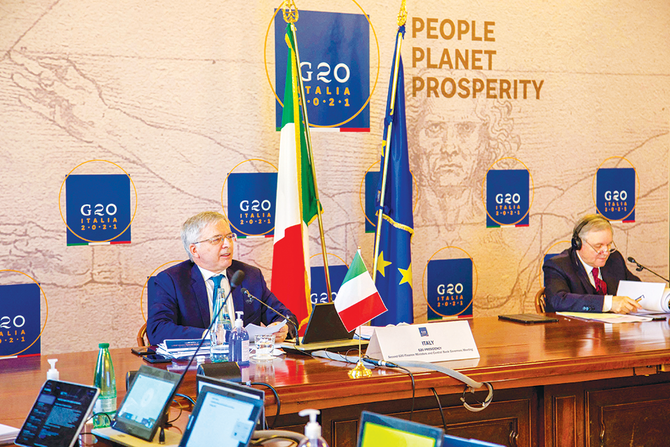
Italy’s Economy Minister Daniele Franco, left, speaks during the 2nd G20 Finance Ministers and Central Bank Governors meeting via videoconferencing in Rome. (AFP)
Short Url
Updated 08 April 2021
Follow

G20 agrees more help for poorest virus-hit nations

  • Debt-service pause for poor nations extended to end of 2021

ROME: World finance chiefs agreed on Wednesday to boost reserves at the International Monetary Fund (IMF) by $650 billion and extend a debt-servicing freeze to help developing countries deal with the coronavirus disease (COVID-19) pandemic, according to a Group of 20 communique.

Finance ministers and central bank governors from the world’s 20 biggest economies also revived a pledge to fight trade protectionism — a reference that had been dropped since 2017 at the insistence of former US President Donald Trump’s administration.

The communique also sharpened language on tackling climate change, a topic watered down in G20 statements during the Trump era, and showed progress in moving toward adoption of a global minimum corporate income tax by July following work in the Organization for Economic Co-operation and Development (OECD).

“We will further step up our support to vulnerable countries as they address the challenges associated with the COVID-19 pandemic,” the G20 said, reiterating they would keep fiscal and other economic support in place for as long as necessary.

“We call on the IMF to make a comprehensive proposal for a new Special Drawing Rights (SDR) general allocation of $650 billion to meet the long-term global need to supplement reserve assets.”

Expanding the IMF’s reserves, or SDRs, would boost liquidity for all members, without adding to the debt burden of the roughly 30 countries already in or facing debt distress, finance officials and economists said.

The G20 also agreed to a final extension to the end of 2021 of the Debt Service Suspension Initiative, meant to free cash in developing countries to fight COVID-19.

In a joint statement on Wednesday, Mexico and Argentina urged greater debt relief for middle-income countries, saying it could prevent a debt crisis emerging on the back of the pandemic.

But Italy, which holds the G20 presidency, said there was no discussion of extending the common debt framework to those countries.

The G20 also backed equitable access to COVID-19 vaccines and encouraged efforts to rapidly step up the production and distribution of shots, without which there would be no stable and lasting recovery.

IMF officials on Wednesday endorsed US President Joe Biden’s plan to raise corporate income taxes and negotiate a global minimum tax, adding that companies and rich individuals who have prospered during the pandemic could afford to pay more.

The G20 expects a deal by July on where large multinational companies, including digital giants like Google, Amazon or Facebook, should be taxed and at what minimum rate.



GCC chambers plan Gulf Guarantee project to boost intra-regional trade

Updated 16 February 2026
Follow

GCC chambers plan Gulf Guarantee project to boost intra-regional trade

DAMMAM: The Federation of GCC Chambers, in cooperation with the Customs Union Authority, intends to launch the Gulf Guarantee Project to provide a unified mechanism for exports and trade transactions and to enhance the efficiency of intra-GCC trade, which reached about $146 billion by the end of 2024, Saleh Al-Sharqi, Secretary-General of the federation, told Al-Eqtisadiah.  

Al-Sharqi said, on the sidelines of his meeting with media representatives at the federation’s headquarters in Dammam, that the initiative represents a qualitative leap in supporting intra-GCC trade by facilitating transit movement through a single point, contributing to cost reduction, accelerating the flow of goods, and enhancing the reliability of trade operations among Gulf markets.   

Saleh Al-Sharqi, Secretary-General of the Federation of GCC Chambers. Al-Eqtisadiah

He explained that the federation recently launched a package of strategic initiatives, including the Tawasul initiative aimed at strengthening communication among Gulf business owners and supporting the building of trade and investment partnerships, in addition to the Gulf Business Facilitation initiative, which seeks to address challenges facing Gulf investors and traders, simplify procedures, and improve the business environment across member states.    

He noted that these initiatives fall within an integrated vision to address obstacles hindering investment and intra-regional trade flows by developing regulatory frameworks, activating communication channels between the public and private sectors, and supporting Gulf economic integration in line with the objectives of the Gulf Common Market.    

In a related context, the Secretary-General affirmed the direction of GCC countries to leverage artificial intelligence technologies to support trade and investment flows, stressing the importance of establishing a unified Gulf committee for artificial intelligence to coordinate efforts and exchange expertise among member states. He said the federation will support this direction in the coming phase, drawing on leading international experiences, particularly the Chinese experience in this field.    

Regarding the recently announced electric railway project between Riyadh and Doha, Al-Sharqi revealed that technical and advisory committees are working to complete the necessary studies for the project, confirming that it will positively impact passenger and freight movement between the two countries, enhance Gulf logistical integration, and support regional supply chains.  

On investment opportunities available to Gulf nationals in the Syrian market, he said the federation is coordinating with private sector representatives in Syria to overcome obstacles that may face the flow of Gulf investments, in addition to working to provide adequate guarantees to protect these investments and ensure a stable and attractive investment environment.  

In response to a question from Al-Eqtisadiah about the impact of tariffs imposed by the US on imports of iron, steel, and aluminum, he said that economic and technical committees in GCC countries are continuously monitoring the repercussions of these tariffs on the Gulf private sector, assessing their effects, and taking the necessary measures to protect it from any potential negative impacts.    

Al-Sharqi also pointed to the launch of two specialized committees in the transport and logistics sectors and in real estate activities, given their pivotal role and active contribution to Gulf gross domestic product, stressing that developing these two sectors is a fundamental pillar for enhancing economic diversification and increasing the competitiveness of GCC economies.    

He added that during the past year the federation held more than 40 meetings and official engagements with Gulf and international entities, participated in nine regional and international events to strengthen the presence of the Gulf private sector on the global stage, and signed 12 agreements and memoranda of understanding with Gulf, regional, and international entities to open new horizons for economic and investment cooperation.    

During the same year, the federation launched four digital platforms to support the Gulf private sector, bringing the total number of its digital platforms to eight serving the business community across member states.    

The Secretary-General affirmed that the federation will continue working with relevant economic entities to unify procedures and regulations, reduce non-tariff barriers, and accelerate mutual recognition of products and standard specifications, in a way that enhances the competitiveness of the Gulf economy and supports the growth of intra-GCC trade.