EMA confirms clots as ‘very rare’ AstraZeneca side effect

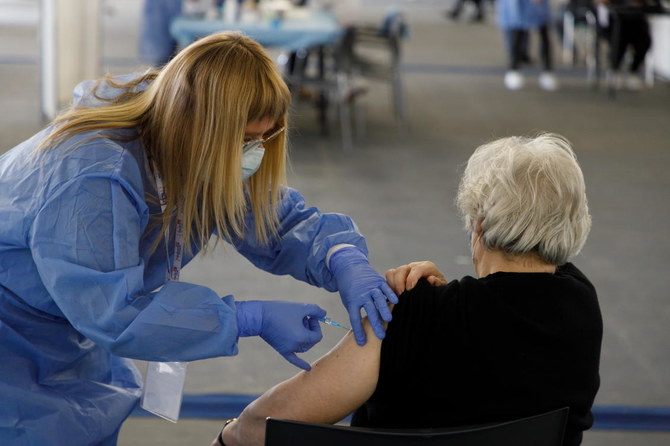
A woman receives an injection with a dose of AstraZeneca COVID-19 vaccine, at a centre in Zagreb Fair hall, amid the outbreak of coronavirus disease (COVID-19), Croatia, April 7, 2021. (Reuters)
Short Url
Updated 07 April 2021
Follow

EMA confirms clots as ‘very rare’ AstraZeneca side effect

  • No specific risk factors, including age, have been identified for thrombosis with the AstraZeneca shot,
  • The UK’s drug regulator said people under 30 will be offered another product due to the rare blood clot risk

THE HAGUE: The EU’s drug regulator said Wednesday that blood clots should be listed as a “very rare” side effect of the AstraZeneca coronavirus vaccine but that the jab’s benefits continue to outweigh the risks.
No specific risk factors, including age, have been identified for thrombosis with the AstraZeneca shot, which could stem from an immune response, the European Medicines Agency (EMA) said.
The watchdog’s findings come after several countries halted the use of the vaccine following dozens of cases of people with clots in blood vessels draining from the brain after receiving jabs, some of them fatal.
“EMA’s safety committee has concluded today that unusual blood clots with low blood platelets should be listed as very rare side effects” of the AstraZeneca jab, the Amsterdam-based watchdog said in a statement.
But it stressed that it believed people should continue to take the vaccine as part of the battle against the disease.
“The safety committee has confirmed that the benefits of the AstraZeneca vaccine in preventing Covid-19 overall outweigh the risk of side effects,” EMA chief Emer Cooke told a news conference.
“It is saving lives.”
Despite the fact that many of the cases have been reported in women under 55, prompting a number of countries to restrict the vaccine’s use to older people, the regulator said it had not been able to pinpoint those at risk.
“Specific risk factors such as age, gender or medical history have not been able to be confirmed, as the rare events are seen in all ages,” Cooke said.
“A plausible explanation for these rare side effects is an immune response to the vaccine.”
The United Kingdom’s drug regulator says the AstraZeneca vaccine has huge benefits but people under 30 will be offered another product due to a rare blood clot risk.
The Medicines and Healthcare Products Regulatory Agency said that while it is studying the possible connection between AstraZeneca’s coronavirus vaccine and rare blood clots, the Pfizer and Moderna vaccines should be offered to people in that age group.


Macron pushes back against Trump’s tariff threats, calls for stronger European sovereignty at Davos

Updated 5 sec ago
Follow

Macron pushes back against Trump’s tariff threats, calls for stronger European sovereignty at Davos

  • French president calls for stronger European sovereignty and fair trade rules, signaling Europe will not bow to economic coercion amid US tariff threats 

LONDON: French President Emmanuel Macron warned about global power and economic governance, implicitly challenging US President Donald Trump’s trade and diplomatic approach, at the World Economic Forum in Davos on Tuesday.

Without naming Trump, Macron described a world sliding toward a “law of the strongest,” where cooperation is replaced by coercion and economic pressure becomes a tool of dominance.

His comments come as Europe faces renewed threats of tariffs and coercive measures from Washington following the fallout over Greenland and other trade disputes.

Macron, wearing sunglasses on stage, warned political and business leaders of a world under pressure, marked by rising instability, weakened international law, and faltering global institutions.

“We are destroying the systems that help us solve shared problems,” he said, warning that uncontrolled competition, especially in trade, puts collective governance at risk.

In recent days, Trump has threatened punitive tariffs on European exports, including a 200 percent levy on French wine, after Macron refused to join the “Board of Peace” for Gaza.

Trump also announced a 10 percent tariff on exports from Britain and EU countries unless Washington secured a deal to purchase Greenland from Denmark, a move European officials have privately called economic blackmail.

Macron rejected what he described as “vassalization and bloc politics,” warning that submitting to the strongest power would lead to subordination rather than security.

He also criticized trade practices that demand “maximum concessions” while undermining European export interests, suggesting that competition today is increasingly about power rather than efficiency or innovation.

Macron also said that Europe has long been uniquely exposed by its commitment to open markets while others protect their industries.

“Protection does not mean protectionism,” he said, emphasizing that Europe must enforce a level playing field, strengthen trade defense instruments, and apply the principle of “European preference” where partners fail to respect shared rules.

Macron warned against passive moral posturing, arguing that it would leave Europe “marginalized and powerless” in an increasingly harsh world. His dual strategy calls for stronger European sovereignty alongside effective multilateralism.

The timing of the speech underscored its urgency. Trump recently published private messages from NATO leaders and Macron, following a diplomatic controversy over Greenland.

Macron closed his Davos speech with a clear statement of principles: “We prefer respect to bullying, science to obscurantism, and the rule of law to brutality.”