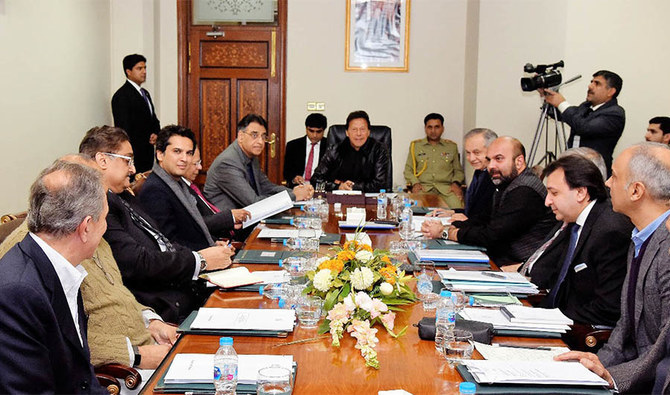

ISLAMABAD: Prime Minister Imran Khan has reconstituted Pakistan’s 25-member Economic Advisory Council (EAC), local media reported on Sunday, breaking from precedent and appointing himself as the chairman of the non-constitutional, independent body that gives economic advice to the government.
In the past, the EAC has been headed by the finance minister of Pakistan. In its new form, Finance Minister Hammad Azhar will be the vice chairman of the council.
The body will include “prominent businessmen, including former finance minister Shaukat Tarin, to ensure availability of best possible professional advice to the government on its economic policies,” Pakistan’s Dawn newspaper reported. “The new EAC has 13 members from private sector and 12 official members.”
Three former finance ministers — Tarin, Dr. Shamshad Akhtar and Dr. Salman Shah — have been included as members. Abid Suleri, executive director at the Sustainable Development Policy Institute, Dr. ljaz Nabi, professor of economics at the Lahore University of Management Sciences, and Syed Salim Raza, former governor of State Bank of Pakistan, have been retained as private members from the previous EAC setup. New members from the private sector include Arif Habib, Asif Qureshi, Farooq Rehmatullah, Mohammad Ali Tabba, Dr. Rashid Amjad, Sultan Allana and Zaid Ali Mohammad, Dawn reported.
Official members of the body include the ministers for energy, planning and development, industries and production, national food security and economic affairs; the adviser on commerce and institutional reform; special assistants on overseas Pakistanis, power and petroleum and revenue; the chairman board of investment; and the governor of the central bank.
“The ultimate goal of the EAC is to promote analytically sound and evidence based reforms and initiatives after taking all stakeholders on board,” Dawn reported. “The Ministry of Finance will be the nodal government agency for the EAC … The reconstitution of the council is aimed at framing an agenda for economic reforms in a non-partisan manner and promoting an active and informed debate that leads to sound policy making, analytical vetting and active monitoring as envisaged by the leadership for sustained institutional reforms and modernization of the public sector, and enhancing public welfare.”