

Pakistanis clash with police at shrine shut over coronavirus

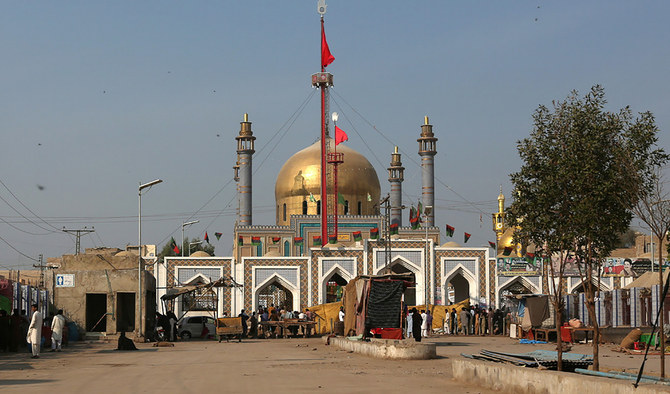
A general view of Lal Shahbaz Qalandar shrine in Sehwan Sharif, Pakistan's southern Sindh province, on February 17, 2017. (REUTERS/File)
Short Url
Updated 02 April 2021
Follow

Pakistanis clash with police at shrine shut over coronavirus

  • Pilgrims broke open the main gate of the shrine of Lal Shahbaz Qalandar, a 13th-century mystic Sufi saint
  • The crowds attacked police and threw stones on Thursday night, injuring some police personnel

KARACHI: Pakistan deployed paramilitary troops early Friday to a shrine closed due to coronavirus restrictions, after hundreds of pilgrims trying to get in clashed with police.

Police said the pilgrims broke open the main gate of the shrine of Lal Shahbaz Qalandar, a 13th-century mystic Sufi saint, located in the town of Sehwan in the southern Sindh province.

The crowds attacked police and threw stones Thursday night, police officer Mohammad Mushtaq said. Several police suffered minor injuries and investigations are ongoing.

Shrines in Pakistan were closed recently as part of measures to help stem the spread of coronavirus. Pakistan on Friday reported over 5,000 new cases in the past 24 hours, the highest single-day infection rate since June 2020.

Pakistan has reported a total of 678,165 infection cases and 14,613 deaths from coronavirus since last year.


Pakistan engages Saudi Arabia, China in bid to ease surging Middle East tensions 

Updated 10 March 2026
Follow

Pakistan engages Saudi Arabia, China in bid to ease surging Middle East tensions 

  • Pakistan’s foreign minister stresses need for de-escalation in conversations with Chinese, Saudi counterparts
  • Tensions in the Middle East continue to remain high as conflict between US, Israel and Iran intensifies

ISLAMABAD: Pakistan’s Deputy Prime Minister Ishaq Dar spoke to the foreign ministers of Saudi Arabia and China on Tuesday, stressing the importance of diplomatic engagement to de-escalate tensions in the Middle East as the Iran war intensifies. 

Pakistan has constantly engaged regional countries in efforts to broker a ceasefire in the Middle East, after the US and Isreal launched coordinated strikes against Iran on Feb. 28. 

Iran launched fresh attacks on Gulf countries on Tuesday morning, where it has targeted US military bases in recent weeks. In addition to firing missiles and drones at Israel and American bases in the region, Iran has also been targeting energy infrastructure which, combined with its stranglehold on the Strait of Hormuz, has sent oil prices soaring worldwide. 

Dar spoke to Saudi Foreign Minister Prince Faisal bin Farhan to discuss developments in the Middle East and ongoing deliberations at the UN Security Council, Pakistan’s foreign office said in a statement. 

“DPM/FM shared Pakistan’s perspective, underscoring the importance of continued coordination and diplomatic engagement to support de-escalation and promote peace and stability across the region and beyond,” the statement said. 

Dar, who also serves as Pakistan’s foreign minister, spoke to Chinese foreign minister Wang Yi over the telephone separately. The two discussed the evolving regional situation and broader global developments.

Dar underscored the need to ease tensions in the Middle East and the wider region during the conversation, the foreign office said. 

Yi appreciated Pakistan’s constructive efforts aimed at promoting de-escalation and stability in the region, it added. 

“The two leaders stressed the importance of de-escalation and emphasized the need to pursue dialogue and diplomacy in accordance with the principles of the UN Charter,” the foreign office’s statement said. 

The conflict in the Middle East has hit Pakistan hard as well, forcing Islamabad to hike petrol and diesel prices by Rs55 per liter last Friday. 

Pakistan’s government has also announced a set of austerity measures, which include closing schools and cutting down on government expenditures, as it evaluates petrol stocks and looks for alternative supply routes.