

Markets jump on Shareek investment package

Saudi Arabia will invest SR12 trillion ($3.2 trillion) in the Kingdom over the coming decade. (Shutterstock)
Short Url
Updated 31 March 2021
Follow

Markets jump on Shareek investment package

  • Riyadh’s Tadawul stock market leaps to five-year high, while oil claws back some of its recent losses
  • Saudi Aramco shares were trading close to an all-time high as the implications of the new Shareek strategy sank in

DUBAI: The financial world has welcomed Saudi Arabia’s ambitious new economic strategy, as analysts digested details of the bold plan to invest SR12 trillion ($3.2 trillion) in the Kingdom over the coming decade.

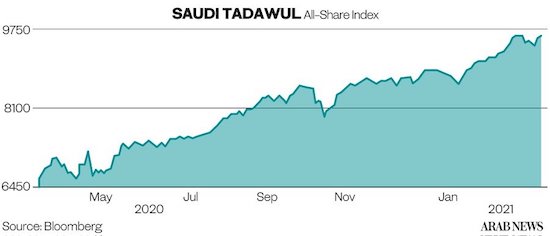
The Tadawul stock market in Riyadh leapt to a five-year high, while Brent crude, the oil benchmark, clawed back some of its recent losses. Saudi Aramco shares were trading close to an all-time high as the implications of the new Shareek strategy sank in.

Crown Prince Mohammed bin Salman announced late on Tuesday night that the Kingdom would boost economic activity by means of a plan to increase private sector investment, as well as via further investment by the Public Investment Fund, the Kingdom’s sovereign wealth fund. There would also be the stimulus from a new national investment strategy to be announced soon.

Economists and business leaders welcomed the strategy. Nasser Saidi, a Middle East economics expert, said the intention was to “jump start” the Saudi economy in the wake of the recession caused by the COVID-19 pandemic.

“This would be a massive increase in investment that will likely modernize and upscale infrastructure, including digital. As proposed, it should be strongly supportive of non-oil growth, increase overall productivity and lead to job creation for Saudi’s young population,” he added.

The plan involves incentives for publicly quoted companies to channel dividend payments into long-term investment in the Saudi economy. Amin Nasser, the chief executive of Saudi Aramco, which pays the biggest dividend on the Tadawul, said that the new strategy would not prevent the company from meeting its dividend pledges.

“We support this initiative, which is very much aligned with Vision 2030. It promotes GDP growth through new investment and will have a multiplier effect for the Saudi economy,” he told CNBC television.

Yousef Al Benyan, chief executive of petrochemicals giant SABIC, 70 percent of which is owned by Aramco, said the strategy would help it double its capacity. “It will enhance the company’s competitive position on the local, regional and global levels,” he said.
Saidi added that the move from dividends to investment could be a positive one: “This switch is likely to increase the efficiency of investment since SABIC, Aramco and other entities would aim to earn a market return on their investment. This would cut waste and inefficiencies, an overall gain to the economy.”

He also highlighted the impact the Shakeel strategy could have on persuading Saudi citizens to invest directly at home. “This revival of investment and successful program would attract back a fraction of the Saudi private wealth held offshore.”

Other financial experts were also impressed by the scale of the plan, which, along with government and consumer spending, amounts to a SR27 trillion stimulus over the coming decade, the biggest economic boost in the Kingdom’s history.

“Saudi Arabia is in a race against time to diversify its economy away from fossil fuels and is taking bold steps. The targets appear ambitious, but aiming high is what may be required at this juncture,” said Tarek Fadlallah, chief executive of Nomura Asset Management in the Middle East.

Fiscal discipline critical as high interest rates persist: Saudi finance minister  

Updated 22 sec ago
Follow

Fiscal discipline critical as high interest rates persist: Saudi finance minister  

RIYADH: Saudi Arabia’s finance minister warned that both advanced and emerging economies risk long-term instability if governments rely on borrowing and optimistic assumptions instead of disciplined fiscal management, as global interest rates are likely to remain elevated for years.  

Speaking during a panel at the annual AlUla Conference for Emerging Market Economies, Mohammed Al-Jadaan said countries are unlikely to see meaningful monetary easing in the near term, underscoring the need to preserve fiscal space and prioritize spending that supports sustainable growth.   

“We are unlikely to see an easing in monetary policy in the few years to come,” he said, adding that while interest rates may come down from current levels, they are “not too much lower” than where they are now, reinforcing the need to focus on fiscal policy.  

Al-Jadaan cautioned that some advanced economies are now repeating mistakes long associated with emerging markets. “Some advanced economies are going through the same struggles because they are falling into the same trap that emerging economies fell into, thinking they could live through it, and unfortunately, it is not sustainable,” he said.  

He said that unless governments treat fiscal policy as a serious balance-sheet issue rather than a cash-flow exercise, they risk falling into the trap of spending whenever they can borrow money, noting that countries can become insolvent even while holding cash if liabilities outpace assets.  

Al-Jadaan emphasized the importance of building fiscal buffers during periods of economic strength. “Where you fail is when you are in good times and fail to build the buffers,” he said, adding that inflated revenue assumptions often lead governments into debt when anticipated income does not materialize.  

The importance of buffers was echoed by Pakistan’s Finance Minister Muhammad Aurangzeb, who said the issue is far from academic for Pakistan. “The bane of our country has been the twin structural deficits, so we need to religiously guard the progress we have made over the last two to three years in terms of successive primary surpluses,” Aurangzeb said.  

He pointed to a sharp improvement in Pakistan’s fiscal position. “We hit about 8 percent fiscal deficit, and we are now at about 5.4 percent, and the current trajectory looks good in terms of bringing it even below 5 percent,” he said, citing gains across revenue, expenditure, and debt management.  

Aurangzeb said recent climate shocks had underscored the value of fiscal space. “Three years back we had a catastrophic flood and had to go into international appeal, but with the fiscal space we had available last year, we could muster our own resources to absorb that shock,” he said, adding that buffers allow governments to respond to exogenous events without destabilizing public finances.  

Both ministers warned against using borrowing as a shortcut to growth. “You don’t finance growth by throwing more money and borrowing more money,” Al-Jadaan said, calling for prioritization and efficiency in spending and treating fiscal space as a strategic asset.  

Al-Jadaan also distinguished between productive and unproductive deficits, warning that “bad deficit is a deficit that is not going to yield any growth and instead yields a liability for the future,” particularly when it finances consumption or recurring operating costs. By contrast, he said investment in infrastructure such as airports, ports, and railroads can act as a catalyst for private sector investment.  

Aurangzeb said Pakistan is pursuing reforms to support that approach, including expanding the tax base and reducing governance leakages. “We were below 10 percent tax to GDP and are now close to 12 percent,” he said, adding that technology and AI-led monitoring are helping curb “leakage and theft,” which he described as a euphemism for corruption.  

He also pointed to progress on debt. “Our debt-to-GDP ratio was about 74 percent and is now down to 70 percent,” Aurangzeb said, noting that greater fiscal discipline could free up resources for sectors such as human capital, agriculture, and information technology.  

Al-Jadaan concluded by warning that even well-intentioned borrowing carries risks. “Even on the good deficit side, markets are brutal,” he said, cautioning that excessive borrowing at a rapid pace can push up funding costs across the wider economy.