

Markets jump on Shareek investment package

Saudi Arabia will invest SR12 trillion ($3.2 trillion) in the Kingdom over the coming decade. (Shutterstock)
Short Url
Updated 31 March 2021
Follow

Markets jump on Shareek investment package

  • Riyadh’s Tadawul stock market leaps to five-year high, while oil claws back some of its recent losses
  • Saudi Aramco shares were trading close to an all-time high as the implications of the new Shareek strategy sank in

DUBAI: The financial world has welcomed Saudi Arabia’s ambitious new economic strategy, as analysts digested details of the bold plan to invest SR12 trillion ($3.2 trillion) in the Kingdom over the coming decade.

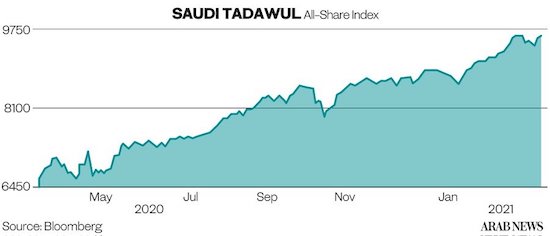
The Tadawul stock market in Riyadh leapt to a five-year high, while Brent crude, the oil benchmark, clawed back some of its recent losses. Saudi Aramco shares were trading close to an all-time high as the implications of the new Shareek strategy sank in.

Crown Prince Mohammed bin Salman announced late on Tuesday night that the Kingdom would boost economic activity by means of a plan to increase private sector investment, as well as via further investment by the Public Investment Fund, the Kingdom’s sovereign wealth fund. There would also be the stimulus from a new national investment strategy to be announced soon.

Economists and business leaders welcomed the strategy. Nasser Saidi, a Middle East economics expert, said the intention was to “jump start” the Saudi economy in the wake of the recession caused by the COVID-19 pandemic.

“This would be a massive increase in investment that will likely modernize and upscale infrastructure, including digital. As proposed, it should be strongly supportive of non-oil growth, increase overall productivity and lead to job creation for Saudi’s young population,” he added.

The plan involves incentives for publicly quoted companies to channel dividend payments into long-term investment in the Saudi economy. Amin Nasser, the chief executive of Saudi Aramco, which pays the biggest dividend on the Tadawul, said that the new strategy would not prevent the company from meeting its dividend pledges.

“We support this initiative, which is very much aligned with Vision 2030. It promotes GDP growth through new investment and will have a multiplier effect for the Saudi economy,” he told CNBC television.

Yousef Al Benyan, chief executive of petrochemicals giant SABIC, 70 percent of which is owned by Aramco, said the strategy would help it double its capacity. “It will enhance the company’s competitive position on the local, regional and global levels,” he said.
Saidi added that the move from dividends to investment could be a positive one: “This switch is likely to increase the efficiency of investment since SABIC, Aramco and other entities would aim to earn a market return on their investment. This would cut waste and inefficiencies, an overall gain to the economy.”

He also highlighted the impact the Shakeel strategy could have on persuading Saudi citizens to invest directly at home. “This revival of investment and successful program would attract back a fraction of the Saudi private wealth held offshore.”

Other financial experts were also impressed by the scale of the plan, which, along with government and consumer spending, amounts to a SR27 trillion stimulus over the coming decade, the biggest economic boost in the Kingdom’s history.

“Saudi Arabia is in a race against time to diversify its economy away from fossil fuels and is taking bold steps. The targets appear ambitious, but aiming high is what may be required at this juncture,” said Tarek Fadlallah, chief executive of Nomura Asset Management in the Middle East.

UAE PMI rises to 11-month high as new orders jump: S&P Global 

Updated 37 sec ago
Follow

UAE PMI rises to 11-month high as new orders jump: S&P Global 

RIYADH: UAE non-oil companies recorded their fastest increase in new orders in nearly two years in January, signaling strengthening private-sector demand, an economic tracker showed. 

According to the latest Purchasing Managers’ Index report released by S&P Global, the Emirates’ PMI reached an 11-month high of 54.9 in January, up from 54.2 in December. 

Any PMI reading above 50 indicates expansion in non-oil business activity, while a reading below 50 signals contraction. 

The sustained growth of the non-oil sector in the UAE mirrors a wider trend across the Middle East and North Africa, where countries are pursuing economic diversification to reduce reliance on crude revenues. 

Saudi Arabia is leading the region in non-oil business activity, with the Kingdom’s PMI reaching 56.3 in January, driven by output growth, improving market conditions, and stronger client demand. 

David Owen, senior economist at S&P Global Market Intelligence, said: “UAE’s non-oil economy started the year on a solid footing, as new orders increased steeply, prompting firms to lift output and sharply expand their purchases.” 

He added: “Stock levels were also boosted as lead times decreased rapidly, allowing companies to reduce some of the strain on business capacity.” 

According to the report, the increase in new order volumes in January was the fastest in 22 months, driven by stronger domestic demand and positive responses to new products and services. 

Survey panellists said rising new business stimulated activity, while some pointed to improving economic conditions, particularly in sectors such as real estate and technology, as drivers of non-oil growth in January. 

S&P Global added that new export orders recorded only a modest rise during the month. 

Despite stronger sales growth, non-oil firms tightened their price margins in response to competition, resulting in only a marginal increase in average selling prices. 

“A steep increase in purchasing activity, the largest in six-and-a-half years, had a strong impact on input prices in January. Cost inflation across the sector climbed to an 18-month high, with firms facing higher charges on a range of materials,” said Owen. 

He added: “Selling prices saw little movement, suggesting that firms are having to absorb higher costs to avoid losing out in a rapidly growing, but competitive, market.” 

Looking ahead, non-oil firms in the UAE expressed optimism, with business expectations rising to their highest level in 15 months, supported by improving demand conditions and expansion plans. 

In the same report, S&P Global said new business growth in Dubai hit a 22-month high in January. 

Businesses in Dubai’s non-oil private sector saw operating conditions strengthen markedly as client spending improved and confidence grew. 

The rate of sales growth among Dubai firms accelerated to its fastest pace since March 2024. 

The upturn prompted faster hiring and renewed stockpiling. Although total activity growth slipped from December, it remained steep overall, the report said, adding that firms’ outlook improved to a four-month high as they projected further increases in client demand.