Suez blockage could ‘take weeks’ to clear

This could lead to a shortage of containers vital for global trade, as well as a “shock” to the global supply chain. (File/AFP)
Short Url
Updated 30 March 2021
Follow

Suez blockage could ‘take weeks’ to clear

  • The 400 meter long Ever Given - owned by Taiwanese company Evergreen Marine Corporation - ran aground on March 23
  • The effects of the blockage are expected to remain a challenge to the shipping industry

It could take weeks to clear the tail-back of ships looking to use the Suez Canal, even as the gigantic container carrier Ever Given resumes its voyage through the world’s business shipping lane, data analysts have calculated.

“We currently expect a delay of at least 10 days to 2 weeks for all vessels reaching Suez henceforth and assuming the stuck container ship is refloated within the next couple of days for the transits to resume,” Ranjith Raja, oil research manager at data group Refinitiv, said.

The 400 meter long Ever Given - owned by Taiwanese company Evergreen Marine Corporation - ran aground on March 23, halting passage through the vital trade route and causing a log-jam of ships in the Mediterranean and the Red Sea.

After the ship was refloated on Monday and was preparing to exit the canal, resuming its voyage to Rotterdam, the effects of the blockage are expected to remain a challenge to the shipping industry, already dealing with volatile market conditions.

“The canal has handled about 100 ships making the transit on a single day according to the 2020 transit data. However, there are limitations due to the size of the ships making the transit and the tidal factors that prevail on the day. Factoring these, it will take weeks to clear the jam that has accumulated till date and not accounting for the additional vessels that would be added for the week,” he added.

Refinitiv calculates that a total of 369 ships are currently waiting on either side of the canal to make the transit once the Ever Given is re-floated and the channel cleared. This accounts for a total of 25 million tons, an increase of 80 percent in the past five days. An estimated 85 ships are currently enroute to join the jam before the end of the month.
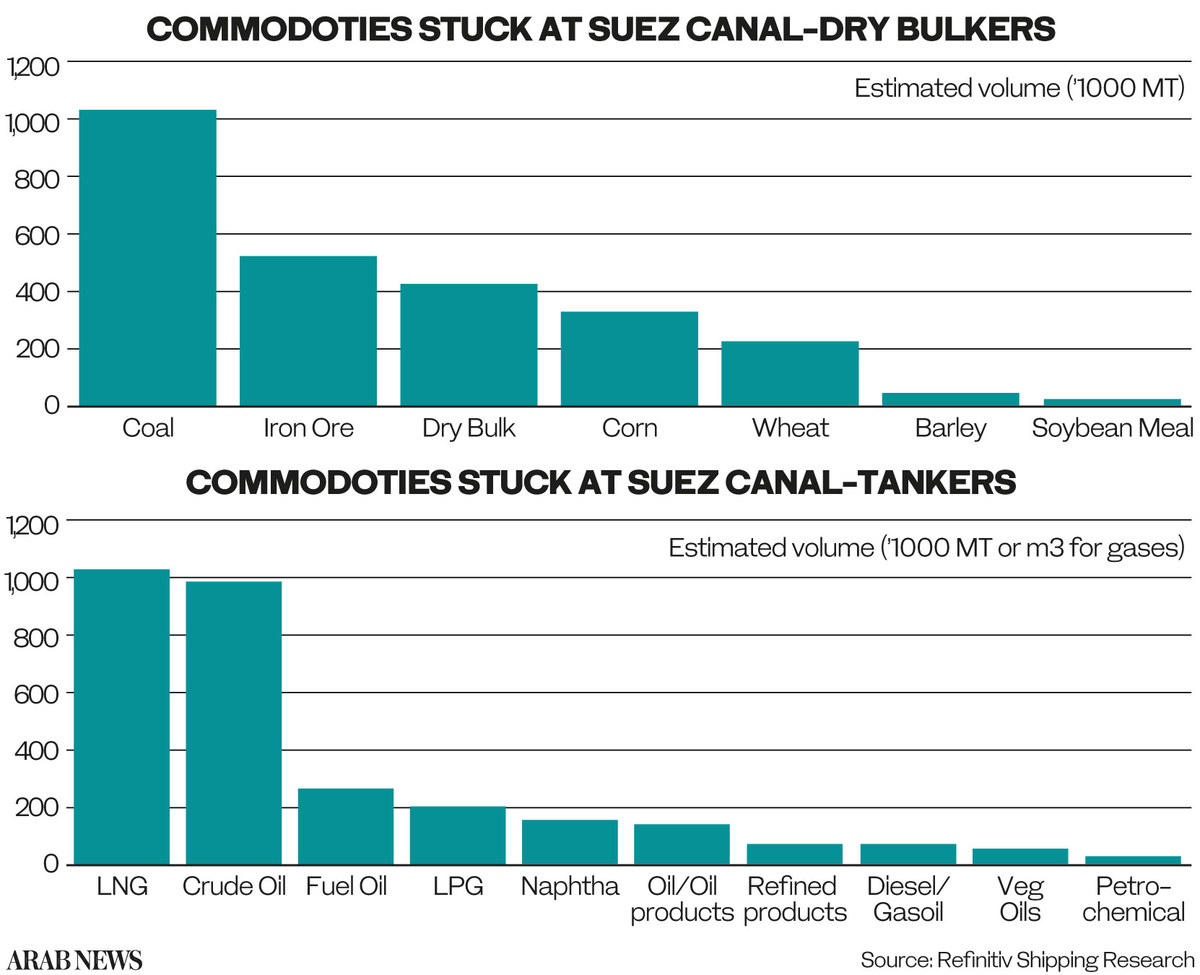
This could lead to a shortage of containers vital for global trade, as well as a “shock” to the global supply chain, especially in industries like manufacturing and car assembly, which relies on the “just in time” supply principle.

“Hence this isolated incident is expected to have subsequent cost implications and delays to the wider consumer goods mainly for the European, Middle East and Asian markets,” Refinitiv said.

The alternative for ships stuck in the canal is to go round the Cape of Good Hope route in southern Africa, which would add significantly to costs and increase security risks from piracy, with a resultant spike in insurance costs.

The impact of this sudden shortage of ships is global, with rates for containers rising on big global routes like Singapore to Rotterdam and from China to the US West Coast.

However, despite some volatility in the price of oil last week when the Ever Given’s problems became apparent, Refinitive does not expect a a major impact on the global crude markets.

“Given the crude oil volumes handled by the Canal and the current scenario of demand and inventory in Asia and in the West, it is unlikely that the blockage in the Suez Canal will have a significant impact on crude oil balances as well as prices,” it said.


Saudi Arabia’s cultural sector is a new economic engine between Riyadh and Paris, says ambassador

Updated 25 January 2026
Follow

Saudi Arabia’s cultural sector is a new economic engine between Riyadh and Paris, says ambassador

RIYADH: Culture has become a fundamental pillar in bilateral relations between France and Saudi Arabia, according to the French Ambassador to the Kingdom, Patrick Maisonnave.

Maisonnave noted its connection to the entertainment and tourism sectors, which makes it a new engine for economic cooperation between Riyadh and Paris.

He told Al-Eqtisadiah during the opening ceremony of La Fabrique in the Jax district of Diriyah that cultural cooperation with Saudi Arabia is an important element for its attractiveness in the coming decades.

La Fabrique is a space dedicated to artistic creativity and cultural exchange, launched as part of a partnership between the Riyadh Art program and the French Institute in Riyadh. 

Running from Jan. 22 until Feb 14, the initiative will provide an open workspace that allows artists to develop and work on their ideas within a collaborative framework.

Launching La Fabrique as a space dedicated to artistic creativity

The ambassador highlighted that the transformation journey in the Kingdom under Vision 2030 has contributed to the emergence of a new generation of young artists and creators, alongside a growing desire in Saudi society to connect with culture and to embrace what is happening globally. 

He affirmed that the relationship between the two countries is “profound, even cultural par excellence,” with interest from the Saudi side in French culture, matched by increasing interest from the French public and cultural institutions unfolding in the Kingdom.

Latest estimates indicate that the culture-based economy represents about 2.3 percent of France’s gross domestic product, equivalent to more than 90 billion euros ($106.4 billion) in annual revenues, according to government data. The sector directly employs more than 600,000 people, making it one of the largest job-creating sectors in the fields of creativity, publishing, cinema, and visual arts.

Saudi Arabia benefiting from French experience in the cultural field

Maisonnave explained that France possesses established cultural institutions, while Saudi Arabia is building a strong cultural sector, which opens the door for cooperation opportunities.

This comes as an extension of the signing of 10 major cultural agreements a year ago between French and Saudi institutions, aiming to enhance cooperation and transfer French expertise and knowledge to contribute to the development of the cultural system in the Kingdom.

He added that experiences like La Fabrique provide an opportunity to meet the new generation of Saudi creators, who have expressed interest in connecting with French institutions and artists in Paris and France.

La Fabrique encompasses a space for multiple contemporary artistic practices, including performance arts, digital and interactive arts, photography, music, and cinema, while providing the public with an opportunity to witness the stages of producing artistic works and interact with the creative process.