

Removal of Arab-American section from California curriculum condemned

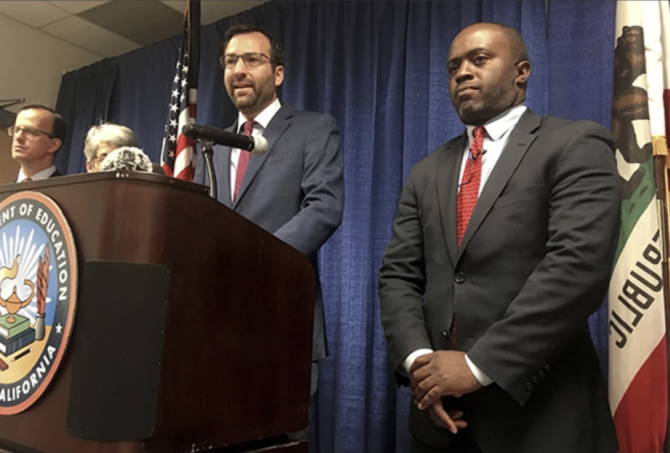
California had commissioned the Ethnic Studies Model Curriculum for high school students, and tasked a group of professional educators and experts in the field to develop it in 2016. (AP/File Photo)
Short Url
Updated 29 March 2021
Follow

Removal of Arab-American section from California curriculum condemned

  • Community leaders blame pressure campaign due to references to Israeli occupation of Palestine
  • Speaking to Arab News, executive director of Arab Resources Center cites ‘institutionalized racism’

ATLANTA: Members of the Arab and Muslim communities in California have vowed to fight a decision by the State Board of Education (SBE) to remove the Arab-American section of the Ethnic Studies Model Curriculum (ESMC) because of its references to the Israeli occupation of Palestine.

Community leaders have accused the SBE of anti-Arab racism and succumbing to pro-Israel and right-wing pressure intended to remove Arab-American and Palestinian narratives.

California had commissioned the ESMC for high school students, and tasked a group of professional educators and experts in the field to develop it in 2016.

The ESMC is designed to focus on Americans who have been left out of history books despite having made significant contributions to civil rights and other struggles.

The Arab-American section of the curriculum was part of Asian-American studies. The section’s removal has infuriated Arab-American organizations and leaders, who have called for the decision to be rescinded.

The Washington-based Arab-American Anti-Discrimination Committee (ADC) called the decision a “broad assault” on Arab-American experiences in the US.

“The erasure Arab Americans face extends to the pages of textbooks, where legislators even removed ‘Arabs’ under a lesson plan on the experiences of minorities post 9-11, while including other minorities impacted by the attacks,” the ADC said in a statement.

“Arab Americans are embedded in American civic society, the civil rights movement, labor movement history, and play an integral part in pushing back against police brutality, discrimination, racial profiling, unwarranted surveillance, and other issues impacting all Americans.”

An estimated 800,000 Arab Americans live in California, and Arabic is the fourth most common language in the state, according to the ADC.

Lara Kiswani, executive director of the Arab Resources Center in San Francisco, told Arab News that the Arab-American section was the only one that was removed from the curriculum. She said the ease with which the SBE removed it is due to “institutionalized racism.” 

Kiswani added that the ESMC was subjected to fierce criticism by a coalition of right-wing and Jewish-American organizations claiming the program was “anti-Semitic” mainly for its critical treatment of the Israeli occupation of Palestine.

She said the charge was rejected by the curriculum’s authors and Arab-American leaders and organizations.

Kiswani expressed concern that the SBE’s decision will eventually criminalize teachers for teaching students about Palestine and other Arab- and Muslim-American issues.

She said the Arab-American community and supportive communities and minorities in California are mobilizing to challenge the legality of the SBE’s decision, and efforts are underway to develop an alternative optional curriculum. 

Dr. Hatem Bazian, chairman of the California-based organization American Muslims for Palestine, told Arab News that the Arab-American community has been subjected to a fierce racist campaign, including by Hindu nationalists in the US who have forged a strategic alliance with the pro-Israel lobby.

“We see the impact of this alliance on the local level with the concerted efforts to empty the curriculum of its Arab and Palestinian narrative,” he said.

Bazian said although the removal of the Arab-American section is a setback for the community, the battle to restore it is ongoing.

Arab News contacted Californian Congressman Darrell Issa, who is of Arab-American heritage, for comment but received no answer by the time this article was published.


Trump says Greenland will ‘work out’ after Denmark fails to bridge gap

Updated 14 sec ago
Follow

Trump says Greenland will ‘work out’ after Denmark fails to bridge gap

  • Trump has appeared emboldened on Greenland — which he views as in the US backyard — since ordering a deadly January 3 attack in Venezuela that removed president Nicolas Maduro

WASHINGTON, United States: US President Donald Trump held open the possibility Wednesday for a resolution on his designs over Greenland after Denmark’s top diplomat said he failed to change the administration’s mind on wanting to conquer the island.
The foreign ministers of Denmark and Greenland, an autonomous territory under Copenhagen’s sovereignty, met at the White House with Vice President JD Vance and Secretary of State Marco Rubio in a meeting the visitors had requested to clear up “misunderstandings” after Trump’s bellicose language toward the fellow NATO member.
Trump, speaking after the meeting which he did not attend, for the first time sounded conciliatory on Greenland, acknowledging Denmark’s interests even if he again said he was not ruling out any options.
“I have a very good relationship with Denmark, and we’ll see how it all works out. I think something will work out,” Trump said without explaining further.
He again said Denmark was powerless if Russia or China wanted to occupy Greenland, but added: “There’s everything we can do.”
Danish Foreign Minister Lars Lokke Rasmussen, speaking after leaving the White House, said a US takeover of Greenland was “absolutely not necessary.”
“We didn’t manage to change the American position. It’s clear that the president has this wish of conquering over Greenland,” Lokke told reporters.
“We therefore still have a fundamental disagreement, but we also agree to disagree.”
He said the issue was “very emotional” for the people of Greenland and Denmark, a steadfast US ally whose troops died alongside Americans in Afghanistan and, controversially, Iraq.
“Ideas that would not respect territorial integrity of the Kingdom of Denmark and the right of self-determination of the Greenlandic people are, of course, totally unacceptable,” Lokke said.
He nonetheless said the tone was “constructive” and said the sides would form a committee that would meet within weeks to see if there was possible headway.
Referring to the British prime minister who trumpeted his diplomacy with Hitler, Lokke said, “I am not a Chamberlain to say “Peace for our time,” but we must seize the opportunities that present themselves.”

Mocking tone

While the talks were underway, the White House posted on X: “Which way, Greenland man?“
The post included a drawing of two dogsleds — one heading toward the White House and a huge US flag, and the other toward Chinese and Russian flags over a lightning-bathed Kremlin and Great Wall of China.
Neither country has claimed Greenland, and Lokke said no Chinese ship had been spotted there in a decade and that there were no major Chinese investments.
Denmark promised ahead of the meeting to ramp up its military presence further in the vast, sparsely populated and strategically located island.
Trump has derided recent Danish efforts to increase security for Greenland as amounting to “two dogsleds.” Denmark says it has invested almost $14 billion in Arctic security.
Denmark also announced immediate military exercises that will include aircraft, vessels and soldiers, with Sweden also participating.
In another show of solidarity with Denmark following Trump’s threats, Germany and France both said Wednesday they will send troops to Greenland. German’s defense ministry said it would send a 13-person team.

Signs of relief

On the quiet streets of the capital Nuuk, red and white Greenlandic flags flew in shop windows, on apartment balconies, and on cars and buses, in a show of national unity during the talks.
Ivaana Egede Larsen, 43, said she felt relief that the meeting appeared to be cordial.
“I am more calm now, and I feel more safe. I had felt very much unsafe lately,” she said.
In Copenhagen, Thomas Fallesen, 56, voiced similar sentiments.
“They are now at least talking together instead of talking through the press. I think it’s a very positive thing,” he said.
Vance, who slammed Denmark as a “bad ally” during an uninvited visit to Greenland last year, is known for a hard edge, which was on display when he publicly berated Ukrainian President Volodymyr Zelensky in the Oval Office last February.
Wednesday’s meeting, however, was closed to the press, meaning there was no on-camera confrontation.
Trump has appeared emboldened on Greenland — which he views as in the US backyard — since ordering a deadly January 3 attack in Venezuela that removed president Nicolas Maduro.