Egyptian president says ‘all mercenaries’ must be removed from Libya

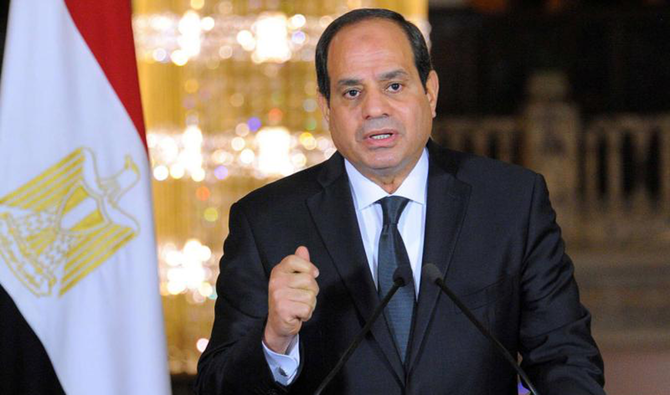
Egyptian President Abdel Fattah El-Sisi. (AFP/File)
Short Url
Updated 30 March 2021
Follow

Egyptian president says ‘all mercenaries’ must be removed from Libya

  • Macron praised the vital role that Egypt was playing in resolving the Libyan crisis

CAIRO: Egyptian President Abdel Fattah El-Sisi stressed the need to clear Libya of mercenaries and undermine illegal foreign interference in Libyan affairs, during a call from French President Emmanuel Macron.

He also said that Egypt was prioritizing the issue of the Grand Ethiopian Renaissance Dam.

He explained the importance of defending the country's historical Nile rights through a comprehensive and binding legal agreement between the three countries involved - Egypt, Sudan and Ethiopia - regarding the rules for filling and operating the dam.

Macron praised the vital role that Egypt was playing in resolving the Libyan crisis and El-Sisi’s personal efforts in the matter.

El-Sisi’s efforts strengthened the political path to solve the Libyan issue, while reinforcing Egypt’s role as a significant aspect in the security and stability of the region and the Middle East, said Macron.

The French president expressed his hope of reaching a solution regarding the Renaissance Dam that would meet the interests of all parties involved.

Macron stressed his country's pride in the extended and close ties linking it with Egypt, as well as his keenness to strengthen those ties.

He also expressed his appreciation for the prominent political role that Egypt played at the regional level in the Arab world, and in African and Mediterranean countries.

Bassam Rady, a spokesman for the Egyptian presidency, said that the call discussed ways to enhance joint bilateral cooperation in many fields, especially the economy and military. This was in addition to the activity of French companies working in various development projects in Egypt.


Survivor recalls ‘chaos’ after suicide bomber struck Islamabad mosque

Updated 5 sec ago
Follow

Survivor recalls ‘chaos’ after suicide bomber struck Islamabad mosque

  • Witnesses say worshippers were bowing in prayer when blast tore through imambargah
  • Authorities blame Daesh network, say attack planned and bomber trained in Afghanistan

ISLAMABAD: Hamza Ali Naqvi was bowing with his hands on his knees during Friday prayers when the first shot rang out. The 21-year-old university student initially mistook the sharp crack for distant fireworks. Seconds later, a second shot, much louder and much closer, resounded through the Qasr-e-Khadijatul Kubra mosque.

“We were prostrating,” Naqvi recalled, his eyes still showing signs of fear as he described the moment the floor beneath him shook from the force of the blast. “I immediately got up, looked around and [saw that] chaos had broken out.”

Friday’s suicide bombing in the Tarlai Kallan area on the outskirts of Islamabad has left 32 people dead and over 150 injured, marking the deadliest assault on the Pakistani capital in nearly two decades. On Saturday, a police officer was killed and four suspects, including an “Afghan Daesh mastermind” behind the attack, were arrested in overnight raids in Peshawar and Nowshera, according to a statement released by Pakistan’s Interior Ministry on social media.

For the survivors, everything else is secondary to the carnage they witnessed in the moments that followed the blast. Naqvi, who had been standing near the door in the fifth or sixth row, said that he stepped over the bodies to reach the epicenter of the explosion.

“When I reached there, I saw a severed head,” he said. “I found out later that it was the head of the attacker.”

“Because people were prostrating, most injuries were to the legs and backs,” he added. “When we lifted the injured, their legs were broken. Those whom I personally helped had broken legs. As we were lifting them, they were screaming and crying.”

Among the screams was the voice of a child, no older than 10, standing over the body of his father, Naqvi recalled as he prayed for the departed souls at the graves of those laid to rest on Saturday.

“I have become an orphan,” he said, quoting the boy who was screaming.

“We were helpless,” he added. “There was nothing we could do.”

While Naqvi was trying to help the injured, 24-year-old Malik Aon Abbas did not survive the attack. Abbas, who had just been engaged and was set to be married later this year, is being hailed as a hero by his family who say he prevented an even higher death toll.

His younger brother, Muntazir Mehdi, said Abbas was in the back rows when two attackers stormed into the mosque. One of them reportedly fled, but the other, already wounded by gunfire from security guards, rushed toward the main congregation.

“The attacker continued firing inside, but my brother abandoned his prayer and caught him,” Mehdi said. “He restrained him and grabbed him. As soon as my brother took hold of him, the attacker detonated himself.”

Mehdi, who shared a deep bond with his brother through their mutual love of religious gatherings and Abbas’s hobby of going live on TikTok, said the family stood between grief and pride.

“Because of my brother, had he, God forbid, not stopped this man, a very major tragedy would have occurred,” Mehdi continued. “He has raised all our heads with pride.”

Pakistan’s interior ministry said on Saturday the attack was carried out by Daesh, with its planning and the bomber’s training being done in Afghanistan.

“The nexus of terrorism under Afghan Taliban patronage remains a serious threat to regional peace,” it said in a social media post, adding that a law enforcement official was killed during the raids carried out to capture the facilitators of the attacker.

Taliban’s Afghan government has denied any role in the attack advising Pakistani authorities to “fulfil their obligations, responsibly review their policies, and adopt a constructive approach based on positive engagement and cooperation.”

For survivors like Naqvi, the horror of that Friday is far from over.

“I went to university, but even there, the same images kept coming back,” he said. “It keeps replaying in my mind. It is difficult to come out of it.”