

Egypt allocates $14bn to develop rail network

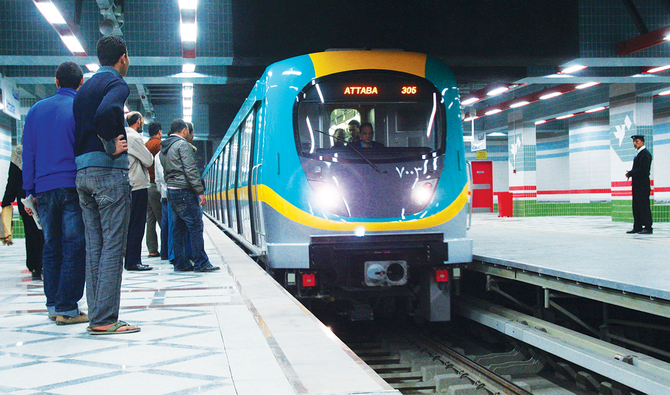
Egypt has one of the largest and oldest railways in the region. An express train will start operating mid-2024 and will contribute to decreasing demand on the existing lines, specifically Upper Egypt lines. (Social media)
Short Url
Updated 29 March 2021
Follow

Egypt allocates $14bn to develop rail network

  • Work underway on developing the main railways using specialized foreign, local firms

CAIRO: Egypt has allocated 225 billion Egyptian pounds ($14.36 billion) to develop its railway network and prevent a repetition of accidents such as the collision of two trains in Upper Egypt on Friday.

Egyptian Minister of Transport Kamel Al-Wazir said that he had held a meeting with officials of the Egyptian National Railways Authority to develop a plan to prevent accidents, indicating that these new funds were allocated for the development of the current railway network.

Al-Wazir explained, in televised statements, that the driver of the train had been at fault, stressing that the prosecution was conducting investigations into the incident.

“We are working to establish a train network at the highest level. We have a problem with the human element on the railways and we are working to secure it at the highest level,” he said.

The Egyptian Public Prosecutor ordered an investigation into the incident, which occurred near the city of Tahta, about 365 km from the capital.

Egyptian presidential spokesman Bassam Radi confirmed that President Abdel Fattah El-Sisi had directed officials to take measures to prevent such incidents from happening again.

He said that the president would be careful not to disrupt the development of the railway network as it supported a large number of citizens, transporting around a million passengers a day.

Egypt has one of the largest and oldest railways in the region, and Egyptians have long complained that governments have failed to impose basic safety measures.

At a previous press conference about the Sohag train collision, Al-Wazir said that the trains operated using electronic safety means, which caused trips and delays about 25 percent of the time.

The minister explained that the development work necessary would require the railway to be completely closed until 2022 for the main lines and until 2024 for other lines, adding that this was rejected by all parties as it would disrupt passengers’ daily commute.

He said that there were three main lines with an area of about 2,000 km: Cairo — Aswan, Cairo — Alexandria, and Cairo — Benha Port Said.

“Work is underway to develop signals on the railway lines. We are working on developing the main railways using specialized international and Egyptian companies, and their development will be completed on June 30, 2022, and these lines will be completely safe, without the intervention of the human factor,” the minister said.

The minister added that the second phase of the development project, which will end in 2024, included 260 tractors, 1,000 cargo vehicles and 200 sleeping vehicles, in addition to the development of the remaining 8,000 km of railway lines, which were suburban lines, and the remaining crossings and stations.

An express train will start operating mid-2024 and will contribute to decreasing demand on the existing lines, specifically Upper Egypt lines.


Real Estate Registry signs 10 agreements at forum in Riyadh

Updated 50 min 48 sec ago
Follow

Real Estate Registry signs 10 agreements at forum in Riyadh

RIYADH: The Real Estate Registry concluded its participation in the Real Estate Future 2026, as a partner of the forum, with a distinguished presence that included the launch of its business portal, the signing of 10 agreements and memoranda of understanding with entities from the public and private sectors, the organization of specialized workshops, and the awarding of the Gold Award at the Real Estate Excellence Awards.

During his participation in the forum, the CEO of the firm, Mohammed Al-Sulaiman, reviewed the latest developments in real estate registration in the Kingdom in a keynote speech, highlighting the pivotal role of the Real Estate Registry in building a unified and reliable system for data. He also announced the launch of the national blockchain infrastructure, which aims to enable the microcoding of real estate assets, enhance transparency, expand investment opportunities, and support innovative ownership models within a reliable regulatory framework.

On the sidelines of the forum, Al-Sulaiman met with Nigeria’s Minister of Housing and Urban Development, Ahmed Dangiwa. During the meeting, they discussed areas of joint cooperation, exchanged experiences and advice on shaping the future of the real estate sector, and reviewed best practices in implementing real estate registration systems that enhance reliability and improve the efficiency of property registration.
efficiency of property registration systems.

The Real Estate Registry’s participation included organizing three specialized workshops that focused on the role of geospatial technologies in identifying ownership, enhancing transparency, and improving the quality of real estate data. 

The workshop “Empowering the Real Estate Registry for the Business Sector” reviewed digital solutions that enable the business sector to manage its real estate assets more efficiently and enhance governance and technical integration. The workshop “From Off-Plan Sales to Title Deed” focused on the journey of documenting real estate ownership and the role of the registry in linking the stages of development and documentation within an integrated digital system.

On the sidelines of the forum, the Real Estate Registry signed 10 agreements and memorandums of understanding, including a deal with Yasmina Information Technology Co. to utilize real estate data in developing smarter insurance solutions that support the real estate sector and enhance service reliability. 

Partnerships were also signed with Haseel, NewTech, and Sahl, as well as HissaTech and Droub, to develop innovative digital solutions in property ownership, fractional ownership, and asset tokenization, as well as real estate finance and investment within a trusted regulatory framework.

Further collaborations included an MoU with ROSHN Group, an agreement with the Saudi Water Authority to enable data integration and quality enhancement, an agreement with the Saudi National Bank, and a partnership with Saudi Post to link the national address with the property registry as a unified geospatial identifier supporting data accuracy and integration.

The registry’s participation was crowned with the Golden Award at the Real Estate Excellence Awards in the category of Excellence in Property Documentation, in recognition of its role in building a model based on transparency, accuracy, and speed, as well as advanced digital technologies and specialized legal expertise, contributing to rights protection and increasing the sector’s attractiveness.

The Real Estate Registry emphasized that its participation reflects its continued role as a key enabler of the real estate sector, a trusted data source, and an active partner in driving digital transformation, enhancing market efficiency, and building investor and financier confidence, in line with Saudi Arabia’s Vision 2030 objectives for a fully integrated and sustainable digital real estate ecosystem.