NARAYANGANJ, Bangladesh: At least a dozen people were reported injured in clashes between police and Islamist demonstrators in Bangladesh on Sunday, the third day of protests against the visit of India’s Hindu-nationalist leader.
Five people died on Friday, and another six the next day, after police shot at demonstrators in several major districts across the Muslim-majority nation of 168 million people.
The protesters – mostly from the hard-line Islamist group Hefazat-e-Islam – were angry at the visit of Indian Prime Minister Narendra Modi as Bangladesh marked 50 years of independence, accusing him of stoking communal violence against Muslims in his country.
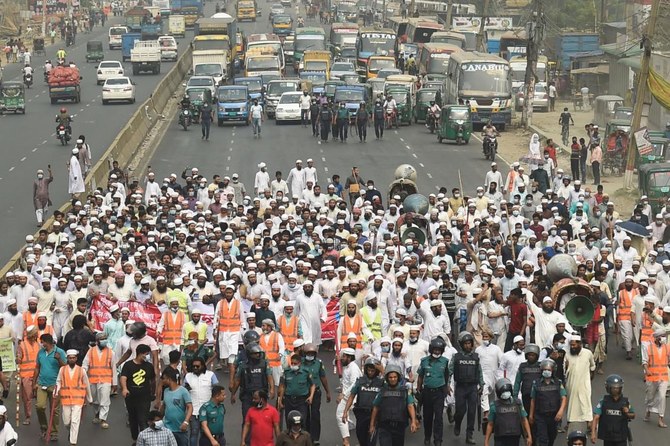
At one new protest in Narayanganj just outside the capital Dhaka, Hefazat supporters chanted “action, action, direct action” as they blocked the key highway linking Dhaka with the port city of Chittagong.
Hundreds of demonstrators burnt furniture and tires on the roads as they chanted anti-Modi slogans and called on authorities to investigate the shootings.
Police fired tear gas and rubber bullets after the protesters barricaded parts of the highway. A police spokesman said they had since left the road.
Prothom Alo, the country’s biggest Bengali-language daily, said at least 15 people were injured in the Narayanganj clashes.
Hefazat spokesman Jakaria Noman Foyezi said thousands of its supporters joined demonstrations at its headquarters at Hathazari outside Chittagong, which is home to a top Islamic seminary.
The Islamist group has a nationwide network, and it has held large protests in the past demanding that Bangladesh introduce blasphemy laws.
Protests were also held in the northeastern city of Sylhet, the eastern district of Brahmanbaria and in Bosila, a Dhaka suburb, but there were no reports of violence, local media reported.
As Bangladesh celebrated independence, human rights groups criticized the government for what they described as growing authoritarianism, including forced disappearances and extrajudicial killings.
Other groups – including students, leftists and other Islamist outfits – had also staged protests against Modi’s visit on Friday and Saturday.

Violence breaks out in fresh Bangladesh protests
https://arab.news/psg46
Violence breaks out in fresh Bangladesh protests
- Hundreds of demonstrators burnt furniture and tires on the roads
- Police fired tear gas and rubber bullets after the protesters barricaded parts of the highway
Britain needs ‘AI stress tests’ for financial services, lawmakers say
- Lawmakers urge AI-specific stress tests for financial firms
LONDON: Britain’s financial watchdogs are not doing enough to stop artificial intelligence from harming consumers or destabilising markets, a cross-party group of lawmakers said on Tuesday, urging regulators to move away from what it called a “wait and see” approach.
In a report on AI in financial services, the Treasury Committee said the Financial Conduct Authority and the Bank of England should start running AI-specific stress tests to help firms prepare for market shocks triggered by automated systems.
The committee also called on the FCA to publish detailed guidance by the end of 2026 on how consumer protection rules apply to AI, and on the extent to which senior managers should be expected to understand the systems they oversee.
“Based on the evidence I’ve seen, I do not feel confident that our financial system is prepared if there was a major AI-related incident and that is worrying,” committee chair Meg Hillier said in a statement.
TECHNOLOGY CARRIES ‘SIGNIFICANT RISKS’
A race among banks to adopt agentic AI, which unlike generative AI can make decisions and take autonomous action, runs new risks for retail customers, the FCA told Reuters late last year.
About three-quarters of UK financial firms now use AI. Companies are deploying the technology across core functions, from processing insurance claims to performing credit assessments.
While the report acknowledged the benefits of AI, it warned the technology also carried “significant risks” including opaque credit decisions, the potential exclusion of vulnerable consumers through algorithmic tailoring, fraud, and the spread of unregulated financial advice through AI chatbots.
Experts contributing to the report also highlighted threats to financial stability, pointing to the reliance on a small group of US tech giants for AI and cloud services. Some also noted that AI-driven trading systems may amplify herding behavior in markets, risking a financial crisis in a worst-case scenario.
An FCA spokesperson said the regulator welcomed the focus on AI and would review the report. The regulator has previously indicated it does not favor AI-specific rules due to the pace of technological change.
The BoE did not respond to a request for comment.
Hillier told Reuters that increasingly sophisticated forms of generative AI were influencing financial decisions. “If something has gone wrong in the system, that could have a very big impact on the consumer,” she said.
Separately, Britain’s finance ministry appointed Starling Bank CIO Harriet Rees and Lloyds Banking Group ‘s Rohit Dhawan as “AI Champions” to help steer AI adoption in financial services.


