BOULDER: The suspect in the Colorado supermarket shooting appeared in court for the first time Thursday, and a defense attorney immediately asked that he receive a mental health evaluation before the case against him proceeds.
Ahmad Al Aliwi Alissa, 21, did not speak during the brief hearing except to say “yes” to a question from the judge, who advised him that he is charged with murder in the attack that killed 10 people, including a Boulder police officer. Alissa is also charged with attempted murder for allegedly shooting at another police officer, who was unhurt.
Boulder County District Attorney Michael Dougherty said authorities planned to file more charges. He did not elaborate.
Alissa did not enter a plea, which will come later in the judicial process. He has been jailed without bail.
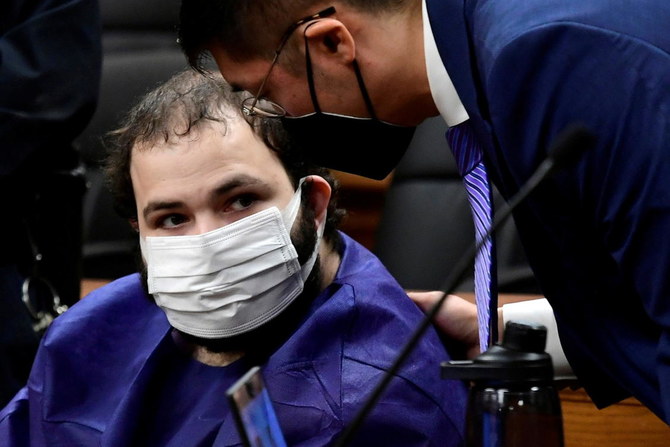
The young man entered court in a wheelchair, presumably because of a gunshot wound to the leg that he suffered Monday in a gunbattle with police. He appeared alert and attentive, moving his knees from side to side, his eyes darting back and forth from his lawyers to the judge. He wore a mask and purple, short-sleeved coveralls.
His attorney, public defender Kathryn Herold, provided no details about his health. At Herold’s request, Alissa’s next hearing will not be scheduled for two to three months to allow the defense to evaluate his mental state and evidence collected by investigators.
“Our position is we cannot do anything until we are able to fully assess Mr. Alissa’s mental illness,” Herold said, adding that the defense cannot begin that assessment until it receives evidence from investigators.
A law enforcement official briefed on the shooting previously said that the suspect’s family told investigators they believed Alissa was suffering from some type of mental illness, including delusions. The official was not authorized to speak publicly and spoke to The Associated Press on condition of anonymity.
About 2,000 people gathered for a vigil Thursday night in the parking lot of a high school less than a mile (1.6 kilometers) from the scene of the shooting. Many held candles and roses while locking arms or embracing at Fairview High School near the base of the snow-covered Rocky Mountain foothills.
After a singer led the crowd in “Amazing Grace,” Nicole LiaBraaten, a local leader of the gun-control group Moms Demand Action, asked everyone to “take a healing breath.”
“Our hearts are broken, and our festering wounds are split open once again. And this time it’s for the whole world to see,” said Liabraaten, whose group helped organize the vigil.
US Rep. Joe Neguse, whose district includes Boulder, told the crowd said he had spoken with some of his Democratic colleagues about how to curb gun violence.
“It does not have to be this way,” he said, prompting cheers.
Alissa’s legal team includes public defender Daniel King, who represented Colorado theater gunman James Holmes, as well as Robert Dear, who is accused of killing three people in a 2015 attack on a Planned Parenthood clinic in Colorado Springs, two cases in which mental illness was a factor.
Depending on what they learn from investigators about Alissa’s mental health, his lawyers could ask the court to order an examination by a psychiatrist or psychologist to determine whether he is competent to stand trial.
If defendants are unable to understand the proceedings and assist their lawyers, proceedings can be delayed to see if treatment, such as medication, can make them ready for trial.
A mentally ill defendant might eventually plead not guilty by reason of insanity, as Holmes did in the 2012 shooting at an Aurora movie theater that left a dozen dead. It would be up to a jury to decide whether the defendant knew right from wrong at the time of the crime — the state’s legal definition of insanity.
During Thursday’s court proceedings, five deputies with black bands of mourning across their badges stood close by. Boulder police tweeted Thursday that they used the handcuffs of the slain officer, Eric Talley, to take the suspect from a hospital to jail earlier this week — and told him so.
Screenshots of what was believed to be Alissa’s Facebook page hint of fears that he was secretly being tracked on his phone and reflect his interest in Islamic teachings, immigration and martial arts. The screenshots and dozens of postings were captured by the online extremist tracking firm SITE Intelligence Group.
In July 2019, Alissa wrote that his phone was being hacked by “racist islamophobic people.” At another point, he wrote that his old high school had likely gotten access to his phone, asking Facebook followers for advice on how to stop it.
Alissa was convicted in 2018 of assaulting a fellow high school student, according to police documents. A former classmate told the AP he was kicked off the wrestling team after yelling he would kill everyone following a loss in a practice match.
After a white supremacist killed 51 people in the 2019 New Zealand mosque massacre, Alissa called the dead “victims of the entire Islamophobia industry that vilified them.” Three months later, he posted a link to a PBS story about how immigrants help the economy, writing, “Why refugees and immigrants are good for America.”
“What Islam is really about,” he wrote in one Facebook post that referred to a list of teachings from the Qur'an, including to “be good to others” and “restrain anger.”
In other posts, he urged followers to give to charity, described abortion as “disgusting” and said that he opposed gay marriage.
“There was no indication on his Facebook account that suggested radical views of any kind, whether it be Islamist, anti-Trump, or anything else,” said Rita Katz, executive director of SITE, which analyzed the postings. “He did mention Islam on his Facebook, but never to any extremity.”
Thursday’s court appearance was the first time Alissa appeared in public since his arrest Monday inside the King Soopers supermarket. He was last seen handcuffed and being led out of the supermarket by police. He had removed all clothing except his shorts before being taken into custody.
According to two law enforcement officials, Alissa was born in Syria in 1999, emigrated to the US as a toddler and later became a US citizen. He would need to be a citizen to buy a gun. The officials were not authorized to speak publicly and spoke to AP on condition of anonymity.
An AR-15-style gun recovered inside the supermarket was believed to have been used in the attack, said a law enforcement official briefed on the shooting who was not authorized to speak publicly and spoke to the AP on condition of anonymity.


![]()

Lawyer: Colorado shooting suspect needs mental health review
Short Url
https://arab.news/jz6u4
Lawyer: Colorado shooting suspect needs mental health review
- Ahmad Al Aliwi Alissa, 21, is charged with murder in the attack that killed 10 people, including a police officer
- Alissa's family told investigators they believed he was suffering from some type of mental illness, including delusions


Latest updates


© 2026 SAUDI RESEARCH & PUBLISHING COMPANY, All Rights Reserved And subject to Terms of Use Agreement.