

Cambridge board agrees to reschedule O Level exams in Pakistan 

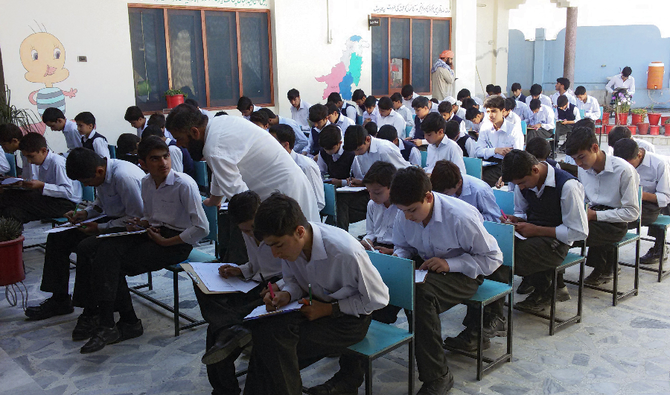
Students sit for a final exam in Swat, Pakistan, on March 29, 2018. (AFP/ File)
Short Url
Updated 26 March 2021
Follow

Cambridge board agrees to reschedule O Level exams in Pakistan 

  • A Level exams to take place as per schedule, education minister announces
  • Educational institutes in COVID-19 hotspot cities to remain closed until April 11

ISLAMABAD: Pakistani education minister Shafqat Mahmood said late on Thursday night that the Cambridge International Examination (CIE) board had agreed to reschedule O level exams in Pakistan to after May 15 in light of a growing number of coronavirus cases.
Earlier this week, Mahmood announced that all education institutions located in areas with high coronavirus positivity rates would remain closed until April 11 as a third wave of the disease builds in the country.
“After detailed discussions, Cambridge has agreed to reschedule ‘O’ level exams to after May 15. Details will be shared later by them,” Mahmood said on Twitter. “However, ‘A’ and ‘As’ level exams will take place as per the original timetable, following all the SOPs. Wishing everyone success in the exams.”

Earlier in the day, Mahmood tweeted: “Educational institutions are closed on the advice of health authorities. Decisions about exams are being made considering what is best for them. Have faith.”

At a press conference on Wednesday, Mahmood said the government was aware that closing schools was affecting children’s education “but we are also concerned about their health.”
The government had already announced a two-week spring break for education institutes in Peshawar, Islamabad and several cities of Punjab province earlier this month to bring the rising number of COVID-19 infections under control.
The break was scheduled to end on March 26, but federal and provincial authorities decided to review the situation as the number of active coronavirus cases doubled in the last three weeks and the positivity ratio shot above eight percent.
In a separate statement on Monday, Mahmood said he was not in favor of shutting down education institutes but the government believed there was a high risk of coronavirus spreading in schools.
“50 million children are linked with education,” he said, “and if someone got infected, the disease would spread.”


Pakistan court directs authorities to form medical board to assess Imran Khan’s eye condition

Updated 11 sec ago
Follow

Pakistan court directs authorities to form medical board to assess Imran Khan’s eye condition

  • Islamabad High Court rejects jailed ex-PM’s request for immediate transfer to private hospital
  • Medical board comprising doctors from PIMS and Shifa to submit report on possible transfer

ISLAMABAD: A Pakistani high court on Thursday directed authorities to form a medical board of government doctors to assess whether jailed former prime minister Imran Khan needs to be transferred to a hospital, his party said, following a rejection of his request to be moved to a private facility for treatment.

The development comes after the Pakistan Institute of Medical Sciences (PIMS) said last week that Khan’s vision had “improved remarkably” since he was given an Anti-VEGF injection amid concerns related to his eyesight.

Anti-VEGF injections are commonly used to treat retinal vein occlusion and other retinal vascular disorders by reducing swelling and abnormal blood vessel growth inside the eye. Prior to the development, the ex-premier had complained of rapid deterioration in vision in one of his eyes.

“The Islamabad High Court has rejected Imran Khan’s request for immediate transfer to Shifa International Hospital,” the Pakistan Tehreek-e-Insaf (PTI) party said in a post on X.

“The court directed that the Chief Commissioner immediately constitute a medical board comprising doctors from PIMS and Shifa Hospital,” it continued. “The medical board will submit a report, on the basis of which the Chief Commissioner will decide whether a hospital transfer is to take place or not.”

The PTI said the court’s decision had raised questions over the judiciary’s independence.

“Delaying a medical emergency and handing it over to administrative discretion is a violation of human rights,” it said. “The issue of Imran Khan’s health is not just about one individual but reflects the entire judicial and state system.”

The 74-year-old cricketer-turned politician has been in prison since August 2023 in cases that he and his party say are politically motivated.

Khan was taken to PIMS for a medical procedure earlier this year, as his party questioned the transparency of the medical update and demanded independent access to his care.

Khan was removed from office in April 2022 through a parliamentary vote of no confidence that he says was orchestrated at the behest of the former administration in Washington by his political rivals with backing from the military. His allegation has been denied by all parties involved.

Since his imprisonment, Khan has faced multiple convictions and ongoing legal proceedings that authorities say follow due process, while his party describes them as efforts to sideline him from politics.