

Saudi exports rebound as plastics lift trade from pandemic lows

A SABIC technician at work. The plastics sector helped lift Saudi exports in January. (Supplied)
Short Url
Updated 25 March 2021
Follow

Saudi exports rebound as plastics lift trade from pandemic lows

  • Plastics and petrochemicals lead exports
  • Global trade rebounds as consumers spend

DUBAI: Non-oil exports from Saudi Arabia rose 15.6 percent year-on-year in January to SR18.9 billion ($5.04 billion) as sales of plastics and chemicals surged.
Total exports slid 13.4 percent to SR71.9 billion as the value of oil exports dropped 20.5 percent to SR13.7 billion, Saudi Arabia’s General Authority for Statistics said in a data release. Brent crude started January 2021 at $52.80 a barrel, down from $68.16 a year earlier.
Plastics exports increased 24.5 percent to SR6.1 billion, while sales of chemicals rose 3.3 percent to SR5.2 billion.
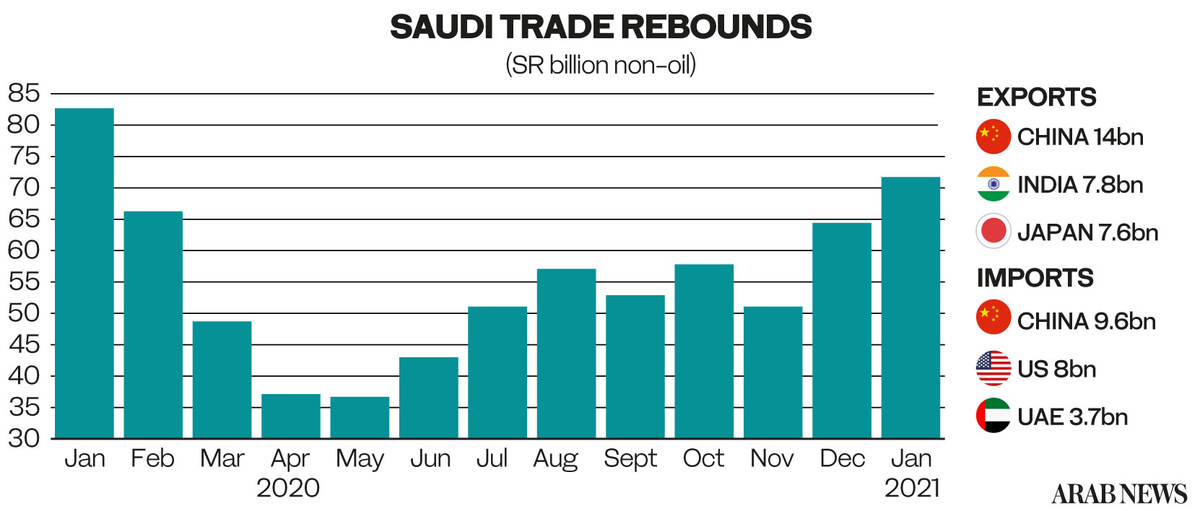

A flurry of recent data has suggested that global trade is rebounding more quickly than anticipated as the rollout of vaccines encourages people to spend, especially in the world's biggest economies.
The Kingdom’s trade surplus narrowed to SR24 billion in January from SR43.3 billion a year earlier as imports jumped 20.7 percent to SR47.9 billion, led by a 525 percent increase in arms and ammunition to SR4.9 billion and a SR17.9 percent gain in base metals to SR4 billion. The biggest category of imports, machinery and mechanical appliances, increased 4 percent to SR9.3 billion.
China was Saudi Arabia’s biggest destination for exports, including oil, in January with SR14 billion of goods, followed by India with SR7.8 billion and Japan with SR7.6 billion. South Korea, the UAE, US, Egypt, Bahrain, Singapore and Belgium round out the top 10 destinations, which collectively account for SR50.2 billion, or 69.8 percent, of exports.
Saudi Arabia imported SR9.6 billion of goods from China in January, the biggest source of imports for the Kingdom followed by the US and UAE with SR8 billion and SR3.7 billion respectively.


Saudi POS stays above $4bn as Ramadan spending lifts home goods

Updated 16 sec ago
Follow

Saudi POS stays above $4bn as Ramadan spending lifts home goods

RIYADH: Saudi point-of-sale transactions remained above $4 billion in the week ending Feb. 14, with spending on furniture and home supplies rising ahead of Ramadan, central bank data showed. 

Overall POS activity totaled SR15.34 billion ($4.09 billion), representing a 4.8 percent week-on-week decrease, while the number of transactions dipped 1.6 percent to 252 million, according to the Saudi Central Bank. 

Spending on furniture and home supplies rose 5.9 percent to SR697.35 million, marking the strongest weekly increase among major retail categories. 

Expenditure on electronics increased 2.9 percent, while spending on construction and building materials rose 1.1 percent.

Sectors that saw declines includes freight transport and courier services, which posted a drop of 5 percent to SR64.86 million.

Pharmacy and medical supplies spending fell 8.2 percent to SR223.81 million, but outlays on medical services rose 5.7 percent to SR539.68 million. 

Food and beverage expenditure decreased 4.3 percent, but the total spend of SR2.57 billion meant it retained the largest share of POS activity.

Restaurants and cafes followed with SR1.73 billion, despite a 4.7 percent decline. Apparel and clothing outlays represented the third-largest share of POS spending during the monitored week, up 0.5 percent to SR1.38 billion.

The Kingdom’s major urban centers mirrored the mixed national changes. Riyadh, which accounted for the largest share of total POS spending, saw a 3.4 percent drop to SR5.32 billion. The number of transactions in the capital reached 80.7 million, down 0.8 percent week on week. 

In Jeddah, transaction values decreased 4.4 percent to SR2.12 billion, while Dammam reported a 3.3 percent decrease to SR746.29 million. 

POS data, tracked weekly by SAMA, provides an indicator of consumer spending trends and the ongoing growth of digital payments in Saudi Arabia.  

The data also highlights the expanding reach of POS infrastructure, extending beyond major retail hubs to smaller cities and service sectors, supporting broader digital inclusion initiatives.  

The growth of digital payment technologies aligns with Saudi Arabia’s Vision 2030 objectives, promoting electronic transactions and contributing to the Kingdom’s broader digital economy.