

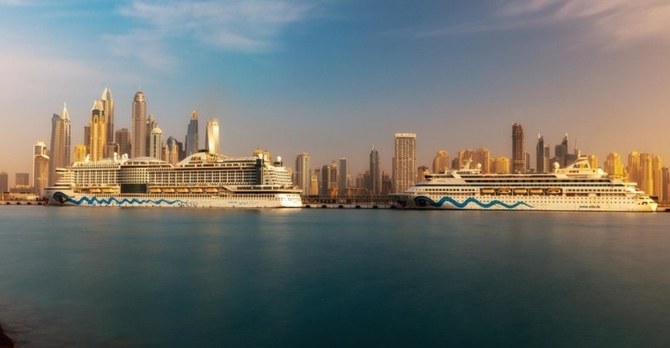
Germany’s AIDA ships first to dock at new Dubai cruise terminals

he cruise line will offer seven-day trips from Dubai between late November this year and mid-April 2022. (Supplied)
Short Url
Updated 21 March 2021
Follow

Germany’s AIDA ships first to dock at new Dubai cruise terminals

  • The two vessels, operated by German cruise line Aida Cruises, arrived at the terminal located at Dubai Harbor
  • The new terminals extend more than 120,000 square meters

DUBAI: Two German cruise ships have become the first to dock at the Dubai Cruise Terminal last week, as the city attempts to revive tourism activity amid COVID-19 pandemic.

The two vessels, operated by German cruise line Aida Cruises, arrived at the terminal located at Dubai Harbor as part of a test run, between the islands of Bluewaters and the Palm Jumeirah.

The new terminals extend more than 120,000 square meters and are located near “popular sights, beautiful beaches and the Burj Al Arab,” the company said in a release.

The harbor also benefits from its proximity to the two international airports in Dubai, Aida Cruises added.

The cruise line will offer seven-day trips from Dubai between late November this year and mid-April 2022.

The new harbor, which has not opened yet, was part of Dubai’s efforts to become a major maritime tourism hub in the region.

The UAE has been one of the most frequent destinations for Aida ships, particularly for German tourists in the winter, since 2006.

In 2018, Carnival Corporation, which owns Aida Cruises, entered into a deal with Dubai-based Shamal Holding to build the terminals.


Saudi mining sector surges with 220% rise in new licenses in 2025 

Updated 26 sec ago
Follow

Saudi mining sector surges with 220% rise in new licenses in 2025 

JEDDAH: Saudi Arabia recorded a 220 percent year-on-year increase in new mining exploitation licenses in 2025, issuing 61 permits, according to a statement from the Ministry of Industry and Mineral Resources. 

This reflects the attractiveness of the Kingdom’s mining investment environment and the ministry’s ongoing efforts to accelerate the exploration and development of mineral resources, which are estimated to be worth more than SR9.4 trillion ($2.5 trillion), the ministry said in a statement. 

Saudi Arabia has designated mining as the third pillar of its industrial economy, a strategy that has seen the sector’s contribution to gross domestic product double, reaching SR136 billion in 2024. 

The industry has attracted over SR170 billion in investments, while exploration spending has surged fivefold since 2020, exceeding SR1.05 billion in 2024 alone. 

Investor interest has skyrocketed, with the number of active exploration companies rising from just six in 2020 to 226 in 2024 — a 38-fold increase — and foreign investors now accounting for 66 percent of total license bidders, reflecting strong international confidence in the Kingdom’s mining potential. 

Jarrah bin Mohammed Al-Jarrah, the ministry’s official spokesperson, explained that the number of mining and small-mine exploitation licenses issued by the ministry in 2025 reached 61 licenses, compared to 19 licenses in the previous year. 

He added: “Total investments in the new licensed projects exceed SR44 billion for the extraction of high-quality mineral ores, including gold and phosphate." 

He noted that the number of valid mining exploitation licenses in the Kingdom reached 275 by the end of 2025, covering an area of 2,160 sq. km. 

He affirmed that the ministry will continue enabling mining investments and facilitating local and international investor participation to maximize sector returns in line with Saudi Vision 2030 targets, positioning mining as a key contributor to economic diversification. 

The ministry’s release emphasized that this reflects the effectiveness of reforms implemented to strengthen the investment environment and regulate the mining sector. 

Last month, Saudi Arabia opened 11 mining sites at the Eastern Province’s Al-Summan Crushers Complex for competitive bidding. The sites, designated for the extraction of aggregates and crusher materials, cover a combined 9 sq. km.