

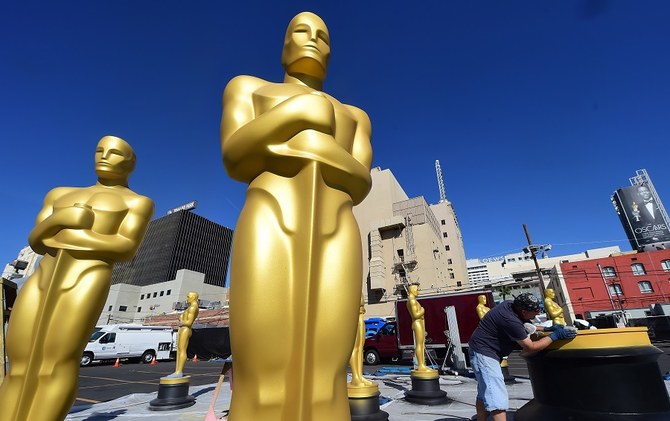

LOS ANGELES: The Oscars ceremony in April will be an intimate, in-person gathering, held without Zoom and limited to nominees, presenters and their guests, the producers said on Thursday. Due to the coronavirus pandemic, the show to hand out the highest honors in the movie industry will be held both at the Union Station in Downtown Los Angeles and the traditional home of the Academy Awards at the Dolby Theatre in Hollywood.
Since the spring of 2020, film fans and industry insiders alike have been looking toward the 93rd Academy Awards with caution and curiosity. With the major disruption to theaters and production, presented by the COVID-19 pandemic, there have been a number of questions surrounding Hollywood's biggest night. Talks of postponing, potential cancellation and temporary changes to the Academy’s rules to allow eligibility for streaming service released films have circulated through the trades and blog posts alike.
“The biggest surprise of the announcement is that there’ll be an Oscars,” said entertainment journalist Jeanne Wolf. “After all there were no movie theaters open, so most people who saw movies at all saw them on the small screen, some maybe even on the telephone. The Oscar committee was worried. Would people connect to the movies? Would they care?”
With the buzz surrounding the announcement it can be assumed that people do care. Picking up the rallying cry of diversity that pervaded the Golden Globes, this year’s Oscars have broken new ground in several regards.
Viola Davis’s Best Actress nomination for “Ma Rainey’s Black Bottom” has made her the most nominated Black actress in Oscar history. It also presents her with the opportunity to be the first Black woman to take home multiple Oscars. In an interview with Variety, Davis referred to this as “a testament to the sheer lack of material there has been out there for artists of color.”
Similarly, the announcement presents a first in the category of Best Directors, as for the first time there are two women nominated.
“It's an unbelievable statistic. There have only been five women nominated as best director. Only one has one,” Wolf told us, referencing “The Hurt Locker” director Kathryn Bigelow. “Chloe Zhao is also an Asian Director and that’s a first. So, women and diversity are really the big stories of these nominations.”
Wolf cites Zhao’s “Nomadland “as the expected frontrunner for Best Picture, citing its suite of previous award show wins, including at the Golden Globes, and some telling names that were not included among the nominees.
“Aaron Sorkin, the writer and director of ‘The Trial of the Chicago 7,’ was not nominated for Best Director. That makes people think it doesn’t have as big a chance for Best Picture.”
Sorkin wasn’t the only surprise snub. While up to ten films can be nominated for Best Picture, the Academy only selected eight, leaving people questioning why expected picks such as “Ma Rainey’s Black Bottom,” “Da 5 Bloods” and “One Night in Miami” didn’t make the cut.
“I was really disappointed that ‘The Mauritanian’ didn’t get more attention,” Wolf said. “Tahar Rahim! What a performance,” she said, referring to the French-Algerian actor, “and I adore Jodie Foster in that film. I don’t know how it got passed by.”
The exclusion of “The Mauritanian” leaves the awards and viewers lacking in Middle Eastern representation. Best International Feature Film and Best Live Action Short Film nominees “The Man Who Sold His Skin” and “The Present” are still listed, ensuring some MENA region recognition on the night of the awards.
The existence of this year’s Academy Awards is proof positive that the academy, the industry and the viewing public have not waned in their appreciation of the art and business of cinema. With that question answered, that leaves us with two remaining: Who will go home a winner on Oscar night and will viewers miss the glamour of previous years?


