

New revelations show how close Libya came to peaceful transition

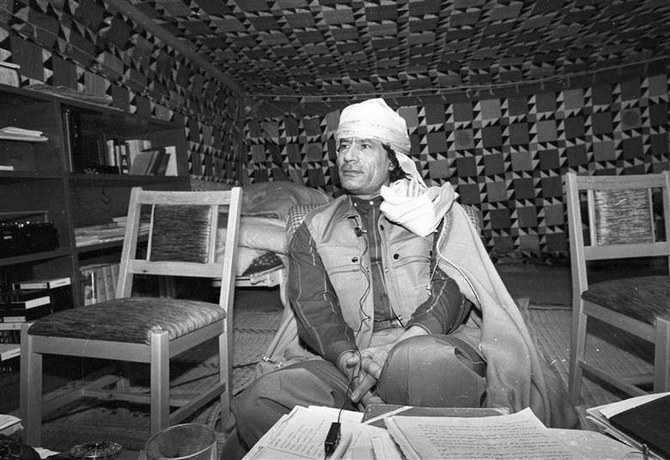
Libyan leader Muammar Gaddafi in his Bedouin tent, January 12, 1986. (Reuters)
Short Url
Updated 18 March 2021
Follow

New revelations show how close Libya came to peaceful transition

  • Norwegian diplomacy led to Gaddafi agreeing to step down, but the deal feel through at the last minute
  • He refused to leave the country, and the UK and France had reservations

LONDON: The late Libyan leader Muammar Gaddafi agreed to step down and leave politics in 2011, in a deal that could have avoided a decade of crisis and bloodshed — but it fell through at the last minute, The Independent reported on Thursday. 

Former Norwegian Foreign Minister Jonas Store told the British newspaper that a draft text was agreed between Gaddafi’s son Saif Al-Islam and senior opposition figure Aly Zeidan, who would later become prime minister of Libya’s National Transitional Council.

Norwegian diplomats hammered out a transition plan, the first line of which stated: “Colonel Gaddafi has decided to leave power and step aside and to end the first phase of the revolution.”

But the fate of the country’s erratic leader, who had been in power for 42 years, remained a sticking point. Specifically, he refused to leave the country after stepping down.

“People very close to Gaddafi, people in the legal apparatus, in his family, supported what was on the table,” said Staale Wiig, a Norwegian biographer of Store who first uncovered the existence of the negotiations years after the war.

“But the final mile was for Gaddafi to say ‘I agree to move into exile’ or where he would live.”

Store said the Libyan leadership was not the only roadblock to a peaceful transition. According to him, the US was keen on the deal but Britain and France had reservations.

“I felt that the mindset in London and Paris didn’t have openings for really reflecting on the diplomatic option. Were (France and Britain) willing to look at something beyond military solutions? The jury is still out,” Store said.

“Had there been in the international community a willingness to pursue this track with some authority and dedication, I believe there could have been an opening to achieve a less dramatic outcome and avoid the collapse of the Libyan state. Had there been a will to do it ... one could have imagined some kind of ceasefire in the military campaign to allow diplomats to move in,” he added.

“But the military operation had already lasted for eight weeks, the dynamic on the ground was changing, and frankly speaking the will to rally behind such a process was not there.”

Libya has been in a state of perpetual conflict since Gaddafi violently suppressed a popular uprising in 2011.

At the time, he pledged to crush the “rats on the streets,” and his threats eventually prompted a UN-backed intervention to prevent him from murdering his own citizens.

The intervention — led by the US, the UK and France — saw 7,000 bombs dropped on Gaddafi’s forces over seven months, and eventually led to his overthrow and death.

Since then, Libya has suffered from incursions from Daesh-affiliated militants, a civil war that has seen extensive involvement from outside powers, and the death of thousands of civilians and combatants.

Earlier this month, a peace deal was agreed between the country’s two warring sides — based in Benghazi and Tripoli — but observers have said Libya remains on the brink of a resumption of conflict.


Three brothers arrested over US embassy blast in Oslo

Updated 7 sec ago
Follow

Three brothers arrested over US embassy blast in Oslo

  • The brothers, who were Norwegian citizens of Iraqi origin, had been arrested in Oslo and police were investigating the motive
  • While none of the brother were previously known to police, Hatlo said investigators were not ruling out links to “criminal networks“

OSLO: Norwegian police said Wednesday three brothers had been arrested on suspicion of a “terrorist bombing” over a weekend explosion at the US embassy in Oslo, which caused minor damage but no injuries.
Police prosecutor Christian Hatlo told a press conference the brothers, who were Norwegian citizens of Iraqi origin, had been arrested in Oslo and that police were investigating the motive.
“We are still working from several hypotheses. One of them is whether this is an order from a government entity,” Hatlo said.
“This is quite natural given the target — the US embassy — and the security situation the world is in today,” he said.
Hatlo said the investigation would seek to clarify exactly what roles the brothers, who were in their 20s, had played.
“We believe that one of them is the person who placed the bomb outside the embassy and that the other two were complicit in the act,” Hatlo told reporters.
Oystein Storrvik, a lawyer for one of the suspects, told broadcaster TV 2 that his client had admitted “to being involved in the case.”
“He admits that he placed the bomb there,” Storrvik told the broadcaster.
Storrvik added that his client had been questioned by police.
“He has explained what happened, and I have no further comments at this time,” he said.

- ‘Proxy actors’ -

While none of the brother were previously known to police, Hatlo said investigators were not ruling out links to “criminal networks.”
In its annual threat assessment, Norwegian security service PST said last month that Iran, which it considers one of the main threats to the country, could rely on “proxy actors,” including “criminal networks,” to commit acts.
On Tuesday, Iran’s ambassador in Oslo denied any involvement by his country in the embassy explosion.
“It is unacceptable that we are being singled out,” Alireza Jahangiri told Norwegian newspaper Verdens Gang.
According to police, the perpetrators of the bombing, described as “powerful,” may also have acted out of their own motives.
US embassies have been placed on high alert in the Middle East due to American strikes on Iran. Several have faced attacks as Tehran responds by targeting industrial and diplomatic facilities.
The blast took place at around 1:00 am (0000 GMT) on Sunday at the entrance to the embassy’s consular section.
On Monday, two images were released from surveillance camera footage showing a suspect dressed in dark clothing with a hood over his head and wearing a backpack.
Roughly at the time the incident occurred, a video had been uploaded to the Google Maps page for the US embassy.
The video, which has since been taken down, appeared to show Iran’s late supreme leader Ayatollah Ali Khamenei, who was killed on the first day of the US-Israeli strikes in Iran.
According to Norwegian public broadcaster NRK, the person who uploaded the video wrote in Persian: “God is great. We are victorious.”
Police have also opened an investigation into this.