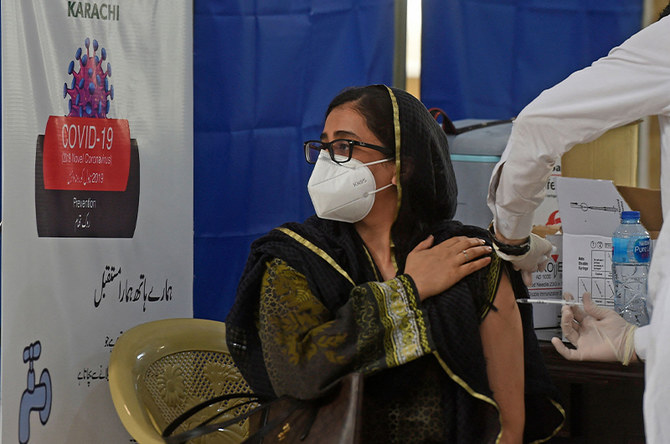
ISLAMABAD: Pakistan has reversed a decision which had allowed uncapped prices for COVID-19 vaccines imported by private firms, Health Minister Faisal Sultan said on Thursday.
The development coincided with arrival of first shipment of privately-imported Russian Sputnik-V vaccines.
“This is the first shipment of 50,000 doses which came last night only,” an official of AG Pharma which imported the vaccine told Reuters. The official spoke on condition of anonymity because he wasn’t officially authorized to release the information.
Pakistan, largely reliant on the GAVI/WHO COVAX initiative for poorer nations, had early February allowed private companies to import coronavirus vaccines and agreed to exempt such imports from price caps.
“Now, however, there is a formula, already in vogue, to determine max price,” Sultan told Reuters. “So yes, there is a price cap that DRAP (Drug Regulatory Authority of Pakistan) will recommend and get approval for,” he said.
The decision to allow commercial imports of the vaccine with an exemption on upper price caps had sparked criticism that it will create inequality.
The government hasn’t decided on the price, the AG Pharma official said. “As soon as government notifies its pricing to us, we will make it available at government registered private sector hospitals,” he said.


Pakistan reverses decision to allow uncapped prices for private imports of COVID-19 vaccines
https://arab.news/nqk3q
Pakistan reverses decision to allow uncapped prices for private imports of COVID-19 vaccines

- Health chief says Drug Regulatory Authority would recommend and get approval for price cap, pharma firm says government hasn’t decided price yet
- Development coincided with arrival of first shipment of privately-imported Russian Sputnik-V vaccines on Wednesday

Pakistan engages Saudi Arabia, China in bid to ease surging Middle East tensions
- Pakistan’s foreign minister stresses need for de-escalation in conversations with Chinese, Saudi counterparts
- Tensions in the Middle East continue to remain high as conflict between US, Israel and Iran intensifies
ISLAMABAD: Pakistan’s Deputy Prime Minister Ishaq Dar spoke to the foreign ministers of Saudi Arabia and China on Tuesday, stressing the importance of diplomatic engagement to de-escalate tensions in the Middle East as the Iran war intensifies.
Pakistan has constantly engaged regional countries in efforts to broker a ceasefire in the Middle East, after the US and Isreal launched coordinated strikes against Iran on Feb. 28.
Iran launched fresh attacks on Gulf countries on Tuesday morning, where it has targeted US military bases in recent weeks. In addition to firing missiles and drones at Israel and American bases in the region, Iran has also been targeting energy infrastructure which, combined with its stranglehold on the Strait of Hormuz, has sent oil prices soaring worldwide.
Dar spoke to Saudi Foreign Minister Prince Faisal bin Farhan to discuss developments in the Middle East and ongoing deliberations at the UN Security Council, Pakistan’s foreign office said in a statement.
“DPM/FM shared Pakistan’s perspective, underscoring the importance of continued coordination and diplomatic engagement to support de-escalation and promote peace and stability across the region and beyond,” the statement said.
Dar, who also serves as Pakistan’s foreign minister, spoke to Chinese foreign minister Wang Yi over the telephone separately. The two discussed the evolving regional situation and broader global developments.
Dar underscored the need to ease tensions in the Middle East and the wider region during the conversation, the foreign office said.
Yi appreciated Pakistan’s constructive efforts aimed at promoting de-escalation and stability in the region, it added.
“The two leaders stressed the importance of de-escalation and emphasized the need to pursue dialogue and diplomacy in accordance with the principles of the UN Charter,” the foreign office’s statement said.
The conflict in the Middle East has hit Pakistan hard as well, forcing Islamabad to hike petrol and diesel prices by Rs55 per liter last Friday.
Pakistan’s government has also announced a set of austerity measures, which include closing schools and cutting down on government expenditures, as it evaluates petrol stocks and looks for alternative supply routes.


