PIA to resume flights to Swat Valley airport after 17 years

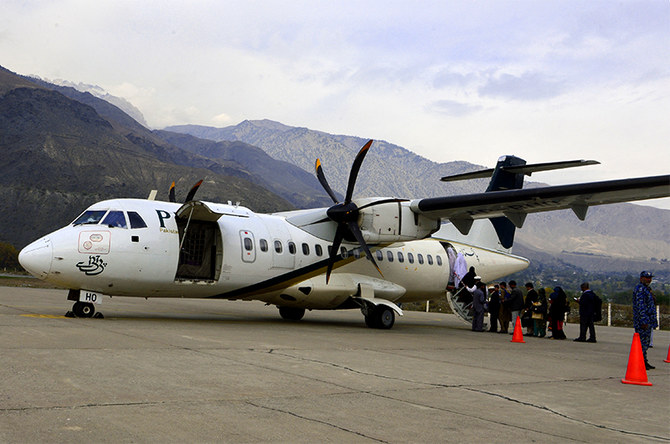
Passengers of Pakistan International Airlines (PIA) wait to board an ATR plane for Islamabad, in Chitral, Pakistan, on November 1, 2015. (AFP/File)
Short Url
Updated 02 August 2021
Follow

PIA to resume flights to Swat Valley airport after 17 years

  • Taliban militants took over Swat during 2007-2009, destroying tourism in the picturesque valley 
  • Operations to clear out militants, improved security in recent years have allowed tourism to re-emerge 

ISLAMABAD: Pakistan’s national carrier, Pakistan International Airlines (PIA), will from next week resume flight operations to the country’s scenic Swat valley after nearly 17 years, a spokesperson for the airline said on Thursday.
Taliban militants took over Swat from 2007-2009, destroying tourism, but army operations to clear out militant safe havens and improved security in recent years have allowed tourism to re-emerge on the Hindu Kush mountain range.
“PIA is going to resume flight operations to Saidu Sharif, Swat, after 17 years,” PIA spokesman Abdullah Hafeez Khan told Arab News, referring to Swat's only airport, closed since 2004 and equipped to handle small ATR-70 aircraft.
The purpose of resuming the flights now, Khan said, was “to encourage tourism in the region.”
“There is huge potential,” the spokesperson added. 
He said there would be two weekly flights from Lahore, with a 15 minute stopover in Islamabad: “Then it [flight] will proceed to Saidu Sharif.”
In January 2019, Pakistan loosened travel restrictions in the hope of reviving tourism by offering visas on arrival to visitors from 50 countries and electronic visas to 175 nationalities. 
Pakistan was last a prominent tourist destination in the 1970s when the “hippie trail” brought Western travelers through the apricot and walnut orchards of the Swat Valley and Kashmir on their way to India and Nepal.
Since then, deteriorating security had chipped away at the number of visitors. Security has since improved dramatically in recent years, with militant attacks down sharply in the mainly Muslim country of 220 million people.
A 2019 Gallup report said tourist traffic at cultural sites in Pakistan had seen an increase of 317 per cent over five years. Tourism has also been helped by a five-day visit to Pakistan in 2019 by British royals Prince William and Kate Middleton.


Pakistan urges world to treat water insecurity as global risk, flags India treaty suspension

Updated 5 sec ago
Follow

Pakistan urges world to treat water insecurity as global risk, flags India treaty suspension

  • Pakistan says it is strengthening water management but national action alone is insufficient
  • India unilaterally suspended Indus Waters Treaty last year, leading to irregular river flows

ISLAMABAD: Pakistan on Tuesday urged the international community to recognize water insecurity as a “systemic global risk,” warning that disruptions in shared river basins threaten food security, livelihoods and regional stability, as it criticized India’s handling of transboundary water flows.

The call comes amid heightened tensions after India’s unilateral decision last year to hold the 1960 Indus Waters Treaty “in abeyance,” a move Islamabad says has undermined predictability in river flows and compounded climate-driven vulnerabilities downstream.

“Across regions, water insecurity has become a systemic risk, affecting food production, energy systems, public health, livelihoods and human security,” Pakistan’s Acting Permanent Representative to the United Nations, Ambassador Usman Jadoon, told a UN policy roundtable on global water stress.

“For Pakistan, this is a lived reality,” he said, describing the country as a climate-vulnerable, lower-riparian state facing floods, droughts, accelerated glacier melt, groundwater depletion and rapid population growth, all of which are placing strain on already stressed water systems.

Jadoon said Pakistan was strengthening water resilience through integrated planning, flood protection, irrigation rehabilitation, groundwater replenishment and ecosystem restoration, including initiatives such as Living Indus and Recharge Pakistan, but warned that domestic measures alone were insufficient.

He noted the Indus River Basin sustains one of the world’s largest contiguous irrigation systems, provides more than 80 percent of Pakistan’s agricultural water needs and supports the livelihoods of over 240 million people.

The Pakistani diplomat said the Indus Waters Treaty had for decades provided a framework for equitable water management, but India’s decision to suspend its operation, followed by unannounced flow disruptions and the withholding of hydrological data, had created an unprecedented challenge for Pakistan’s water security.

Pakistan has said the treaty remains legally binding and does not permit unilateral suspension or modification.

The issue has gained urgency as Pakistan continues to recover from last year’s monsoon floods, which killed more than 1,000 people and devastated farmland in Punjab, the country’s eastern breadbasket, in what officials described as severe riverine flooding.

Last month, Deputy Prime Minister Ishaq Dar said Pakistan had observed abrupt variations in river flows from India, creating uncertainty for farmers in Punjab during critical periods of the agricultural cycle.

“As we move toward the 2026 UN Water Conference, Pakistan believes the process must acknowledge water insecurity as a systemic global risk, place cooperation and respect for international water law at the center of shared water governance, and ensure that commitments translate into real protection for vulnerable downstream communities,” Jadoon said.