

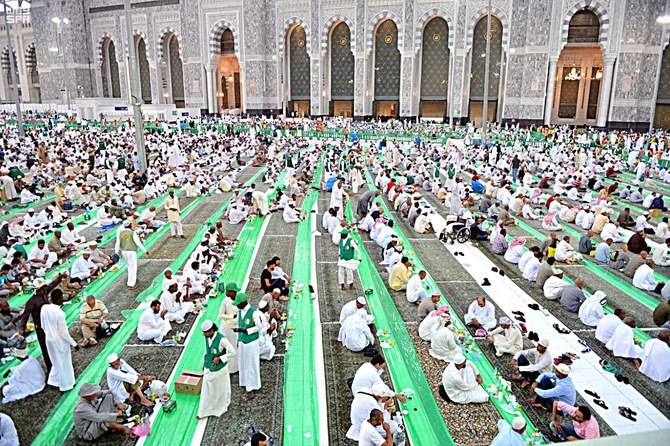

RIYADH: In keeping with the spirit of giving and unity during Ramadan, Muslim worshippers in the Makkah region will soon be able to resume one of the holy month’s most valuable acts of kindness.
The Watering and Relief Committee in Makkah announced the resumption of permits for the Iftar Sayim initiative after the ongoing coronavirus disease (COVID-19) pandemic temporarily halted the application process.
Iftar Sayim generally refers to the charitable practice of providing fasting Muslims with meals to break their fast. Restaurant owners and families provide meals — usually consisting of dates, a drink and a hot dish — that are then distributed to mosques. While mosques across the Kingdom participate in the tradition during Ramadan, the most concentrated efforts are usually seen at the sites of the Two Holy Mosques in Makkah and Madinah.
At these sites, no visiting Muslim during Ramadan ever needs to wonder if he or she will have something to eat when the Maghrib call to prayer is heard. Dedicated workers line the floors of the mosque with plastic coverings, and enough food is laid down to feed all the faithful. Dates — the Prophet Muhammad’s (peace be upon him) recommended first food — laban, water and a hot meal, usually consisting of rice and meat, are all provided for free, donated to the mosque by the holders of these highly sought permits.
HIGHLIGHTS
Iftar Sayim generally refers to the charitable practice of providing fasting Muslims with meals to break their fast.
Restaurant owners and families provide meals — usually consisting of dates, a drink and a hot dish — that are then distributed to mosques.
While the pandemic temporarily put a pause on these efforts, individuals wishing to participate in the initiative can once again apply for permits to help those in need.
This year, products that are authorized for distribution will be limited to dry foods, or items that are pre-packaged in order to minimize the risk of contamination. However, those wishing to distribute hot meals can continue to do so in the residential neighborhoods of the city of Makkah itself. Additionally, interested parties can apply at the official website, https://sr-mkh.org.sa, to distribute food baskets to the underprivileged families of Makkah, containing enough provisions to last throughout the month.
Born and raised in Makkah, Mohammed Al-Dosari told Arab News that he and his family had never missed a year of Iftar Sayim prior to the pandemic.
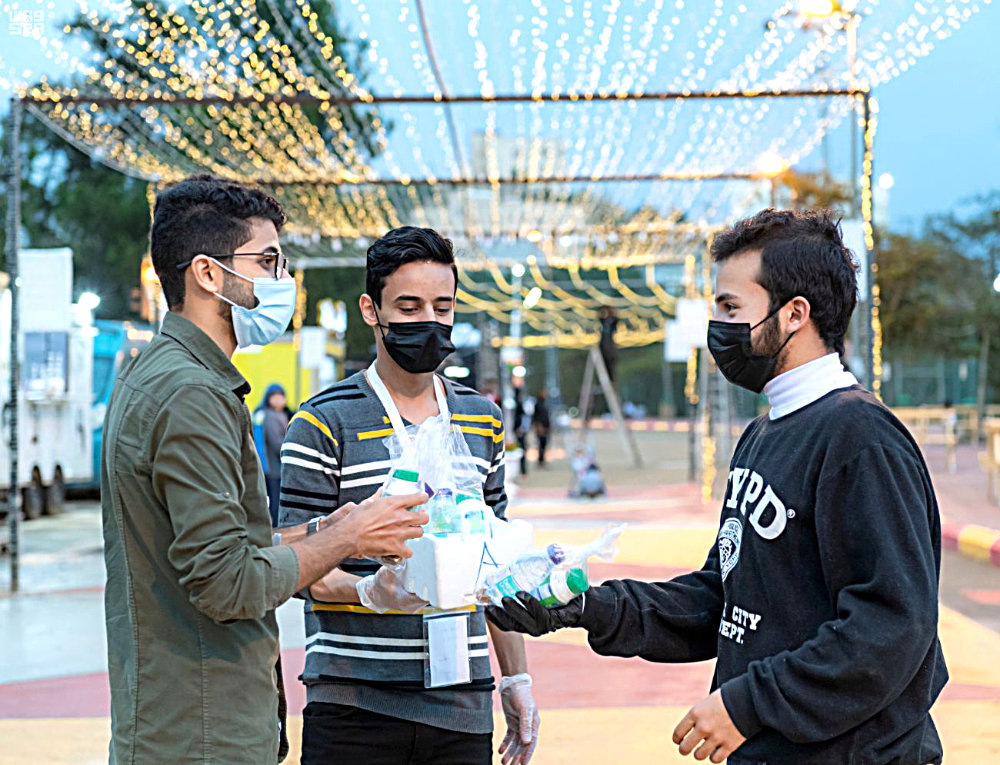
While mosques across the Kingdom participate in the tradition during Ramadan, the most concentrated efforts are usually seen at the sites of the Two Holy Mosques in Makkah and Madinah. (SPA)
“Last Ramadan was hard on all of us because we felt as though we were deprived of the chance to help our community and greet guests of the Holy Mosque. We keenly felt the loss of the opportunity,” he said. “Iftar Sayim is near and dear to our hearts, and we saw it as just one more thing the pandemic had taken away from us.”
The Makkah region was one of the most affected by the pandemic, with 24-hour lockdowns beginning much earlier than the rest of the Kingdom and restrictions being lifted later, only once things had calmed down in other parts of the nation.
“We very much look forward to doing our part this year, and we sincerely hope that the Holy Mosque will be able to accept more of the faithful this Ramadan,” Al-Dosari added, “I think a lot of Muslims, myself included, were very shaken by the images of the mosque being utterly empty last year at the height of the pandemic. We pray that this year we will see the mosque full again and that Allah will keep His pilgrims safe this year.”
The permits are currently only given to residents of the Makkah region, but residents elsewhere hope that their regions will soon allow them to apply also.
Sheikh Yasin Kabli, a long-time resident of Madinah and owner of a number of kitchens in the city, told Arab News that he has been handing out food at the Prophet Mosque’s Mawaed Al-Rahman (“Tables of Charity) for over 20 years now and has “never faced any financial issues offering free meals to people.”
“We can serve over 500 meals a day from the start of Ramadan until the end. Some might think it’s a competition between the kitchens of the city, but it’s our duty and an honor,” he said. “Though I’ve retired from the business and my grandchildren and nephews have taken over, I still went to sit with the thousands of people from all walks of life. Last year, it was hard not to break my fast at the mosque.”
The 78-year-old said that he never missed a Ramadan in Madinah except during his years abroad as a scholarship student in Cairo. He has always kept the tradition alive with his family members.


