ISLAMABAD: The Pakistan government’s central body dealing with the coronavirus pandemic, the National Command and Operation Center (NCOC), on Monday raised alarm over rising coronavirus cases, saying the country’s most populous Punjab province was contributing over fifty percent to the COVID-19 mortality rate.
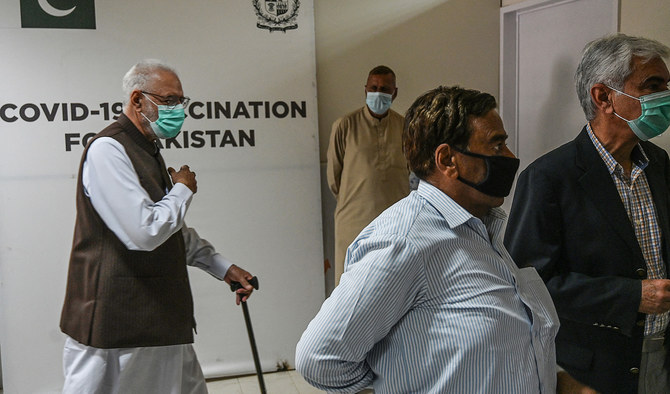
The NCOC also announced that people aged 70 years or older, and who have registered to be vaccinated, could walk into any vaccination centre in Pakistan from tomorrow, Tuesday, and get inoculated against the coronavirus. Citizens previously had to receive a text from authorities informing them of their designated vaccination centre as well as the day and time of their appointment.
Authorities had opened up almost all of sectors of society in previous months but last week reversed a decision to allow large indoor gatherings like cinemas, theaters and marriage halls. Schools will also be closed again for two weeks from March 15, today.
As of Monday, 2,253 people have tested positive for COVID-19 in Pakistan, with 29 deaths reported in the past 24 hours, taking the total death count to 13,537 since February last year, according to the health ministry.
“Concern was shown on rising national positivity,” the NCOC said in a statement. “Moreover, hospital admissions are also on the rise. Punjab is contributing 55% of National Mortality … Provincial Administrations are advised to take strict administrative actions on violators of SOPs [standard operating procedures].”
Punjab Chief Minister Usman Buzdar on Monday warned the public against taking the current wave of the coronavirus pandemic lightly, directing authorities to ensure strict compliance of SOPs across the province.
In a statement, he described the current wave of the virus as "more dangerous" than previous ones as 1,191 cases of coronavirus were reported in Punjab in the last 24 hours, out of 2,253 cases in total reported all over Pakistan.
The Punjab government also reimposed restrictions and enforced smart lockdowns in various cities, and shut down educational institutes in seven cities for two weeks starting Monday, today.
"Due to flagrant violation of COVID-19 SOPs, the number of cases is increasing along with the death toll," Buzdar said.
On Saturday, the NCOC said the national positivity ratio was hovering at around six percent, calling it a “matter of serious concern.”
The Pakistani capital, Islamabad, and Punjab imposed partial lockdowns on Sunday to stop the spread of the coronavirus as the head of the NCOC, planning minister Asad Umar, said there was “no doubt” Pakistan was facing a third wave of the coronavirus.
“More areas are expected to be locked down. New UK variant strain is prevalent in Islamabad,” Islamabad Deputy Commissioner Muhammed Hamza Shafqaat said in a series of tweets, just hours before he announced him and his family had also tested positive for the coronavirus.
The Sindh government on Monday also imposed new restrictions in the province till April 15. These include that all businesses except pharmacies, clinics, petrol pumps, grocery stores and restaurants, would close by 10pm; amusement parks would close by 6pm; only 50% staff would be allowed at public and private sector offices; and no indoor weddings or dining at restaurants would be allowed.


Walk-in vaccinations for elderly from tomorrow, new Pakistan-wide restrictions as COVID-19 rages
https://arab.news/jv43k
Walk-in vaccinations for elderly from tomorrow, new Pakistan-wide restrictions as COVID-19 rages

- Hospital admissions on the rise, Punjab province contributing 55% to COVID-19 mortality rate, government says
- Punjab chief minister says current wave "more dangerous" than previous ones as 1,191 cases reported in Punjab in last 24 hours

In southeast Pakistan, Ramadan brings Hindus and Muslims closer
- In southeastern Mithi city, Hindus arrange iftar for Muslims every year to promote interfaith harmony
- Locals say Mithi’s peaceful religious coexistence can be traced to its remote location in Pakistan’s Sindh province
MITHI, Pakistan: Partab Shivani, a Hindu in Muslim-majority Pakistan, has fasted on and off during Ramadan for years, but this time is different as he practices abstinence for the entire holy month.
Every year, he and his friends in the southeastern city of Mithi arrange iftar, when Muslims break their daily fast, to foster peace and solidarity between the two religions.
“I believe we need to promote interfaith harmony. First, we are humans — religions came later,” Shivani, a 48-year-old social activist, told AFP, adding that he also reads the teachings of the Buddha.
“His message is about peace and ending war. Peace can spread through solidarity and by standing with one another. Distance only widens the gap between people,” he added.
Ninety-six percent of Pakistan’s 240 million people are Muslim. Just two percent are Hindu, most of them living in rural areas of Sindh province where Mithi is located.
In Mithi itself, most of the 60,000 inhabitants are Hindu.
Many of the city’s Hindus also observe Ramadan and iftar has become a social gathering where people from both faiths happily participate.
“This has been a wonderful tradition of ours for a very long time,” said Mir Muhammad Buledi, a 51-year-old Muslim friend who attended Shivani’s iftar gathering.
“It is a beautiful example of harmony between the two communities.”
‘LIKE BROTHERS’
Discrimination against minorities runs deep in Pakistan.
Following the end of British rule in South Asia in 1947, the subcontinent was partitioned into mainly Hindu India and Muslim-majority Pakistan.
That triggered widespread religious bloodshed in which hundreds of thousands were killed and millions displaced.
According to the Human Rights Commission of Pakistan, freedom of religion or belief is under constant threat, with religiously motivated violence and discrimination increasing yearly.
State authorities, often using religious unrest for political gain, have failed to address the crisis, the independent non-profit says.
But such tensions are absent in Mithi.
“I am a Hindu but I keep all the fasts during this month,” said Sushil Malani, a local politician. “I feel happy standing with my Muslim brothers.
“We celebrate Eid together as well. This tradition in the region is very old.”
Restaurants and tea stalls are closed across Pakistan during Ramadan.
Ramesh Kumar, a 52-year-old Hindu man who sells sweets and savory items outside a Muslim shrine, keeps his push cart covered and closed until iftar.
“There is no discrimination among us if someone is Muslim or Hindu. I have been seeing this since my childhood that we all live together like brothers,” he said.
MUSLIM SHRINE, HINDU CARETAKER
Locals say Mithi’s peaceful religious coexistence can be traced to its remote location, emerging from the sand dunes of the Tharparkar desert, which borders the modern Indian state of Rajasthan.
Cows — considered sacred in Hinduism — roam freely in Mithi city, as they do in neighboring India.
At two Sufi Muslim shrines in the middle of the city, Hindu families arrange meals, bringing fruit, meals and juices for their Muslim neighbors to break their fasts.
“We respect Muslims,” said Mohan Lal Malhi, a Hindu caretaker of one of the shrines.
Mohan said his parents and elders taught him to respect people regardless of religion or color, and the traditions pass from one generation to the next.
Local residents said both communities consider their social relationships more important than their religious identity.
“You will see a (Sikh) gurdwara, a mosque, and a shrine standing side by side here,” Mohan said. “The atmosphere of this area teaches humanity.”


