

Pakistan among Asia region's biggest arms importers — report

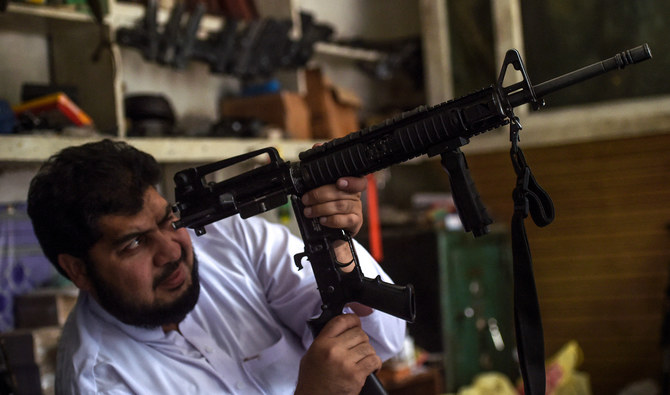
A man checks an assault rifle at a small workshop in the tribal area of Darra Adamkhel, Pakistan, on June 3, 2020. (AFP/File)
Short Url
Updated 15 March 2021
Follow

Pakistan among Asia region's biggest arms importers — report

  • India, Australia, China, South Korea and Pakistan biggest importers in Asia region, SIPRI says in new report
  • Growing perception of China as threat the main driver for arms imports in the region, senior researcher at SIPRI says

STOCKHOLM: Asia and Oceania are the largest importing regions for major arms, receiving 42% of global arms transfers in 2016–20, while India, Australia, China, South Korea and Pakistan were the biggest importers in the region, the Stockholm International Peace Research Institute (SIPRI) said in a report on Monday.

“For many states in Asia and Oceania, a growing perception of China as a threat is the main driver for arms imports,” said Siemon Wezeman, Senior Researcher at SIPRI, said.

The institute said international deliveries of arms were flat in the period 2016-2020, ending more than a decade of increases.
The United States, France and Germany - three of the world’s biggest exporters - increased deliveries, but falls in exports from Russian and China offset the rise, SIPRI said.

It was the first time since 2001–2005 that the volume of deliveries of major arms between countries - an indicator of demand - did not increase from the previous five year period, SIPRI said.

While the pandemic has shut down economies across the world and pushed many countries into deep recessions, SIPRI said it was too early to tell whether the slowdown in arms deliveries was likely to continue.

“The economic impact of the COVID-19 pandemic could see some countries reassessing their arms imports in the coming years,” Pieter Wezeman, senior researcher with the SIPRI Arms and Military Expenditure Programme, said in a statement. “However, at the same time, even at the height of the pandemic in 2020, several countries signed large contracts for major arms.”

The United Arab Emirates, for example, recently signed an agreement with the United States to purchase 50 F-35 jets and up to 18 armed drones as part of a $23 billion package.

Middle Eastern countries accounted for the biggest increase in arms imports, up 25% in 2016–20 from 2011–15.

Saudi Arabia, the world’s biggest arms importer, increased its arms imports by 61% and Qatar by 361%.


Pakistan saw up to 17% drop in cross-border attacks after Afghan border closure — think tank

Updated 5 sec ago
Follow

Pakistan saw up to 17% drop in cross-border attacks after Afghan border closure — think tank

  • CRSS calls 2025 the deadliest year in a decade with 3,417 violence-linked fatalities nationwide
  • Violence remained concentrated in the western provinces as security forces killed 2,060 militants

ISLAMABAD: Pakistan recorded a sharp decline in cross-border militant attacks and violence-linked fatalities in the final months of 2025 after it closed its border with Afghanistan in October, even as the country endured its deadliest year in a decade overall, according to an annual security report released by a local think tank on Wednesday.

Pakistan has frequently accused Afghanistan of sheltering proscribed armed factions, such as the Tehreek-e-Taliban Pakistan (TTP) and the Balochistan Liberation Army (BLA), in the past, while also pointing a finger at the Taliban administration in Kabul for “facilitating” their attacks against Pakistani civilians and security forces.

The Center for Research and Security Studies (CRSS) said in its report that terrorist attacks fell by nearly 17% in December, following a 9% decline in November, after Pakistan shut the border on Oct. 11. It noted that violence-linked fatalities among civilians and security personnel also declined in the final quarter of the year, falling by nearly 4% and 19% respectively in November and December.

“Pakistan recorded a significant drop in cross-border terrorist attacks and violence-linked fatalities after it closed down the border to Afghanistan,” CRSS said.

Despite the late-year decline, the think tank said 2025 “went by as the most violent year for Pakistan in a decade,” with overall violence surging nearly 34% year-on-year.

Fatalities rose from 2,555 in 2024 to 3,417 in 2025 — an increase of 862 deaths — extending a five-year upward trend in violence that coincides with the Taliban’s return to power in Afghanistan in 2021, the report said.

“2025 marked another grim year for Pakistan’s security landscape,” it added, noting that violence has increased every year since 2021, with annual surges of nearly 38% in 2021, over 15% in 2022, 56% in 2023, nearly 67% in 2024 and 34% in 2025. 

REGIONAL CONCENTRATION

Violence remained heavily concentrated in Pakistan’s northwestern Khyber Pakhtunkhwa (KP) and southwestern Balochistan provinces, which together accounted for more than 96% of all fatalities and nearly 93% of violent incidents nationwide.

KP was the worst-hit region, recording 2,331 fatalities in 2025 — a 44% increase from 1,620 deaths in 2024 — accounting for more than 82% of the net national rise in violence.

Balochistan saw fatalities rise from 787 to 956, an increase of nearly 22%.

In contrast, Punjab and Sindh recorded relatively low levels of violence, together accounting for less than 3% of total casualties, which CRSS said pointed to “relative containment of violence despite the provinces’ large populations.”

The report also flagged the spread of violence into previously calmer regions, with Azad Jammu and Kashmir recording 15 fatalities in 2025 after reporting no violence a year earlier.

MILITANT DEATH TOLL

CRSS said 2025 was also the deadliest year in a decade for militant groups, with outlaws accounting for more than 60% of all fatalities.

“2025 turned out to be the deadliest year for outlaws in a decade,” the report said, with 2,060 militants killed during at least 392 security operations, surpassing the combined fatalities of civilians and security personnel.

Security forces, however, remained the primary targets of militant groups.

The army and Frontier Corps recorded 374 fatalities, including 22 officers, while police suffered 216 casualties.

The TTP claimed responsibility for the largest share of attacks on security personnel, followed by the BLA, the Baloch Liberation Front (BLF) and Daesh’s regional chapter.