In northwestern Pakistan, domestic violence up by 45% during coronavirus lockdowns

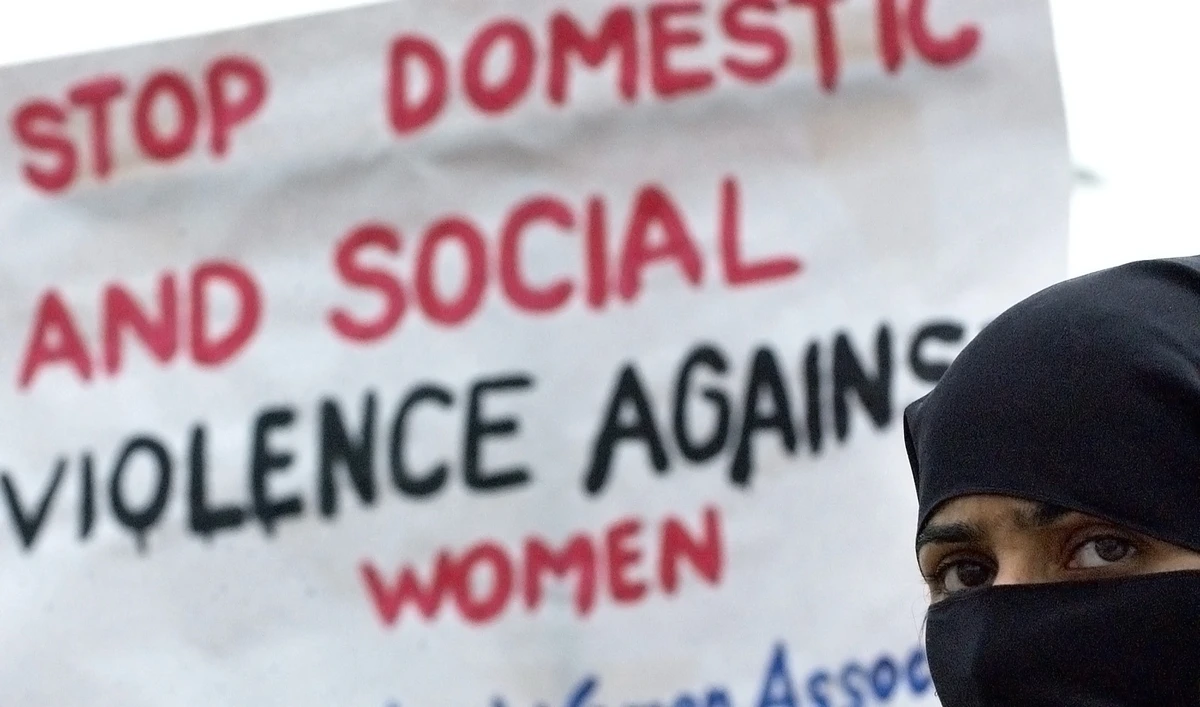
A Pakistani woman holds a placard as she marches with other activists of the Progressive Women's Association (PWA) during a demonstration near The Parliament House in Islamabad, Pakistan, on March 9, 2004. (AFP/File)
Short Url
Updated 15 March 2021
Follow

In northwestern Pakistan, domestic violence up by 45% during coronavirus lockdowns

  • Khyber Pakhtunkhwa passed its long-delayed bill to prevent domestic violence in January
  • Unofficial estimates suggest the increase in violence may be even higher than 45 percent

PESHAWAR: A rise of 45 percent in domestic violence has been observed in Pakistan's northwestern Khyber Pakhtunkhwa province during lockdowns to curb the spread of coronavirus, officials said on Sunday.

The province has long been struggling with gender-based violence and only in January this year passed a bill to prevent domestic violence, under which perpetrators face imprisonment of up to five years.

The government of Khyber Pakhtunkhwa operates six shelters for women who escape domestic abuse. Each of the women's shelters, according to Khyber Pakhtunkhwa Social Welfare Department data, hosts 70 women. The province's population is estimated at over 35.5 million.

While it is feared that domestic abuse, especially against women, has risen across Pakistan during the pandemic, Khyber Pakhtunkhwa is the first region to report numerical data.
 
"During lockdowns, starting from March 2020 to December 2020, the ratio of violence increased by 45 percent in KP," Sahar Khan from the social welfare department told Arab News.

Khan is a project director of the social welfare department's Bolo Helpline, which was introduced in 2016 for women to report abuse in six districts of the province — Peshawar, Swat, Nowshera, Swabi, Mardan, and Abbottabad.

Since 2016, the helpline's psychologists and the department's officials have responded to at least 892 cases of violence reported by women. Over a third of the cases was reported between March and December last year.

"More than 350 women have benefited from the Bolo Helpline service within six months with their cases processed and resolved," Khan said, adding that the government is planning to expand the service to cover other districts as another wave of the coronavirus is expected.

Most of the cases registered were physical, sexual, mental, economic and social abuse, but Khan added that incidents of acid attacks and cyber harassment were also recorded.

Since only six districts are facilitated by Bolo Helpline, the actual rise in abuse across the province may be much higher.

Huma Khan of the Khyber Pakhtunkhwa Commission on the Status of Women told Arab News that in the wake of coronavirus restrictions, it is estimated that a 60 percent increase in domestic violence was witnessed across the province.

Activists fear that despite the new law and presence of the helpline, another lockdown might lead to a further increase in violence if curbs on economic activity leave people unemployed. 

"Men have to feed their families and the lockdowns left a negative impact on their income," Naila Altaf, a social activist from Kurram tribal district, said. "(Increased) violence against women was a result of their frustration."

Pakistan bank enables Shariah-compliant digital payment facility for passengers at Islamabad airport

Updated 23 February 2026
Follow

Pakistan bank enables Shariah-compliant digital payment facility for passengers at Islamabad airport

  • Pakistan is a cash-dominated market where a significant portion of transactions in the informal sector are made without any taxes, officials say
  • The move comes amid Pakistan’s efforts to introduce a cashless model at airports under which only digital service providers can provide services

KARACHI: Aik, Pakistan’s first Islamic digital bank, has enabled fully digital payments at Islamabad International Airport to offer travelers and passengers secure, Shariah compliant digital transaction facility.

The development comes amid Pakistan’s efforts to introduce a cashless model at airports across the country, under which only digital service providers can provide services to customers.

Aik, a subsidiary of Bank Islami, said it has onboarded merchants across the Islamabad airport and integrated QR code deployments at key touchpoints to allow passengers and visitors to make secure, seamless, and Shariah-compliant digital transactions at all counters, retail outlets, and service points.

It said the implementation complies with the regulations and framework set by the State Bank of Pakistan (SBP) and is a working model for a large-scale adoption of cashless systems in public infrastructure.

“This deployment reflects our commitment to building practical digital infrastructure that improves everyday transactions,” Aik Chief Officer Ashfaque Ahmed said in a statement.

“By enabling a fully cashless environment at a major national gateway, we are supporting efficiency, transparency, and financial inclusion at scale. This is not only a project; it is a foundation for Pakistan’s cashless future.”

Pakistan is a cash-dominated market where a significant portion of transactions, particularly in the informal sector, are conducted in cash. Officials say many of these transactions are aimed at avoiding taxes.

In recent years, the SBP has taken steps to ensure a transition toward a more cashless economy so that transactions are more traceable, reducing chances of tax evasion and corruption.

By digitizing Islamabad airport, aik said it continues to invest in secure and accessible financial solutions that “expand digital participation and support national economic modernization.”