



RIYADH: To all intents and purposes, Yemen’s Houthi militia just burnt alive possibly up to 500 African migrants. But where is the outrage among the heavy hitters of human-rights advocacy or the liberal commentariat? This is no rhetorical question but rather one asked in earnest.
To be sure, selective global outrage is nothing new; it has been around since the birth of the international community and the early days of the human rights movement. But the deafening silence of those who claim the role of international moral arbiters over the latest Houthi outrage is a scandal in itself.
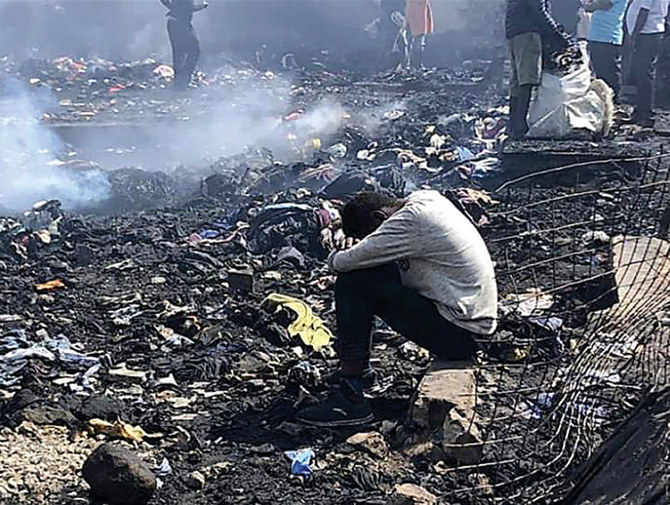
Even by the standards of Houthi disregard for civilian safety, what happened on March 7 in a detention center in Sanaa was despicable. The militia used force to end a strike by migrants who were protesting against cruel treatment, extortion and poor conditions inside the facility, the Geneva-based SAM Organization for Rights and Liberties said on the basis of interviews with some survivors.
Its conclusion left no room for whataboutery by the usual suspects: “The Houthis were directly and consistently responsible for the killing and injury of approximately 450, mostly Ethiopian, migrants in a detention center, on 7 March, 2021, in a fire caused by bombs apparently fired by Houthi forces.”
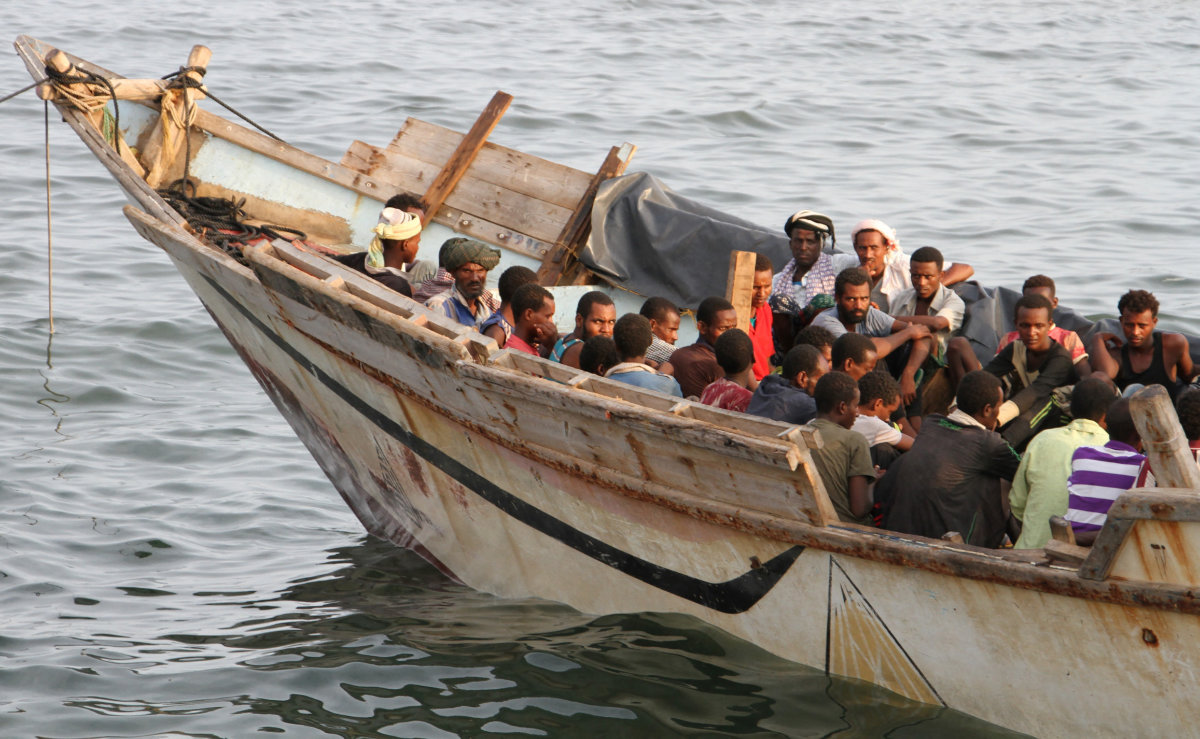
Rights groups say migrants are routinely abused and threatened by Houthi militants and forced to endure squalid conditions. (AFP)
A number of local independent groups have concurred with the finding. Mwatana, a leading Yemeni human rights organization, blamed the Houthis for the fire and accused them of arbitrarily detaining survivors and relatives of the victims in order to stop them from talking about the incident.
“The Ansar Allah (Houthi) group caused the death and injury of scores of African migrants by starting a deadly fire in an overcrowded detention facility in Sanaa on March 7,” Mwatana said in a statement.
Separately, Women Solidarity Network accused the Houthis of using live bullets and explosive devices to suppress migrant protests and demanded the UN protect survivors from such intimidation.
“We urge international organizations, including the United Nations, to provide protection to the migrants who have been hospitalized,” said the group.
“Our sources raised the alarm that the Houthis were promising migrants in hospitals the issuance of cards in return for their silence. As per information collected from witnesses, Houthis rounded up illegal African migrants, including children, from their homes to force them into recruitment as fighters to send them to conflict fronts.”
Muammar Al-Eryani, information minister of the internationally recognized Yemeni government, said the Houthis have been intimidating survivors and their families to influence their accounts to the media or any international probe in the future.
Pointing out that that survivors and other witnesses would not give fair testimonies if they remained inside Houthi-controlled areas, he called on the UN migration agency, IOM, to evacuate them to other locations, away from Houthi pressure.
Abdurrahman Barman, a Yemeni human rights advocate and director of the American Center for Justice, said his organization had interviewed some survivors who blamed the Houthis for the tragedy, accusing them of squeezing hundreds of Ethiopians into the detention center which led to overcrowding.
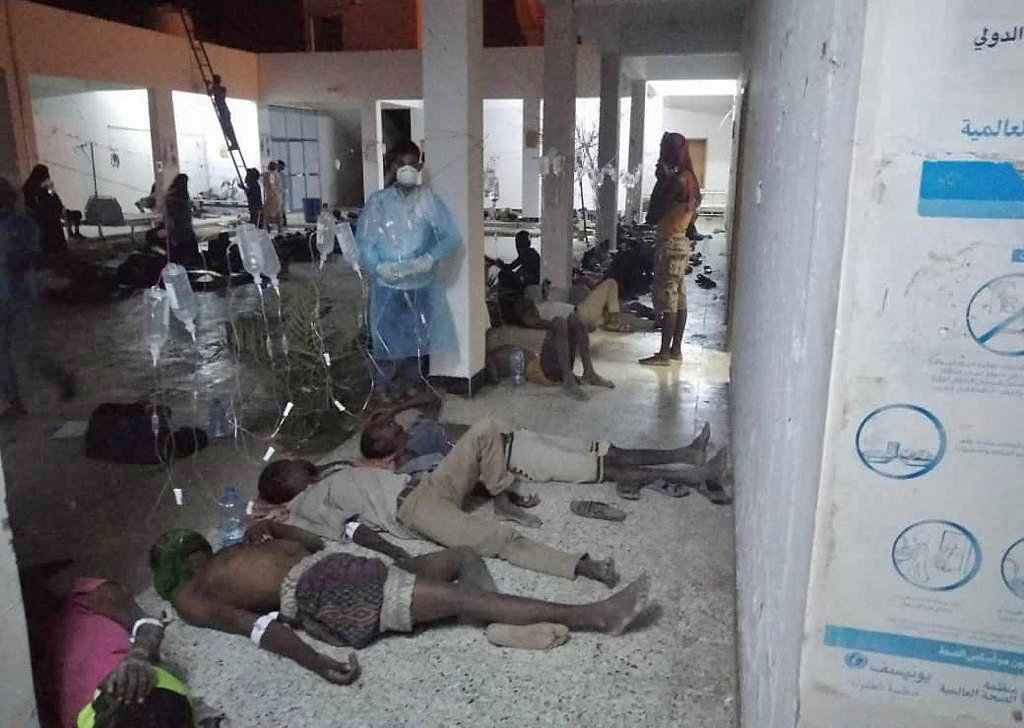
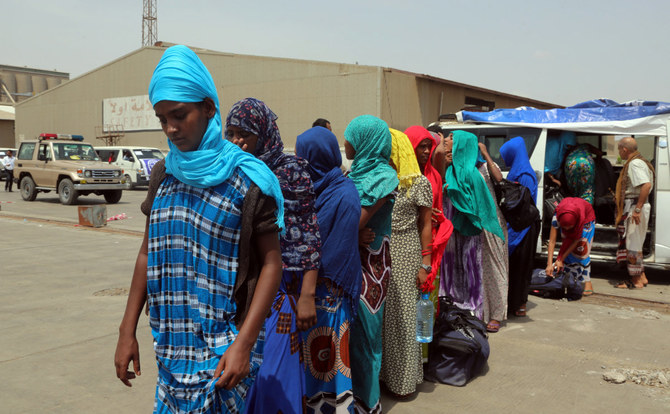
These African migrants in Yemen are lucky enough to receive treatment at a hospital in the southern city of Lahj. Many others are living under "inhumane conditions". (IOM photo via AFP)
He said the Houthis had prevented monitors of the American Center for Justice from visiting survivors at Sanaa hospitals, adding that survivors’ accounts indicate that the death toll was between 200 and 300.
In a deeply ironic twist, the Sanaa slaughter happened around the same time as the US city of Minneapolis agreed to pay $27 million to settle a civil lawsuit over the death last year of a single black man, George Floyd, in police custody.
The Minneapolis City Council settlement — the largest pretrial civil rights settlement ever in America — has been described as a powerful message that black lives do matter and police brutality against people of color must end.
“The death of George Floyd ignited an incandescent social movement,” wrote Derrick Johnson, president and CEO of the National Association for the Advancement of Colored People, in an oped in The Guardian in June last year. “In every state and around the world, people of all colors, genders, and ages are coming together to march in fury and in hope, to renounce the past and redeem the future.”
Unfortunately, if history is any guide “people of all colors, genders and ages” are unlikely to come ”together to march in fury and in hope” over the loss of hundreds of Ethiopian lives in Yemen. Never mind that a hashtag #HouthiHolocaust has been trending on Arabic-language Twitter, reflecting the depth of public outrage across the Middle East.
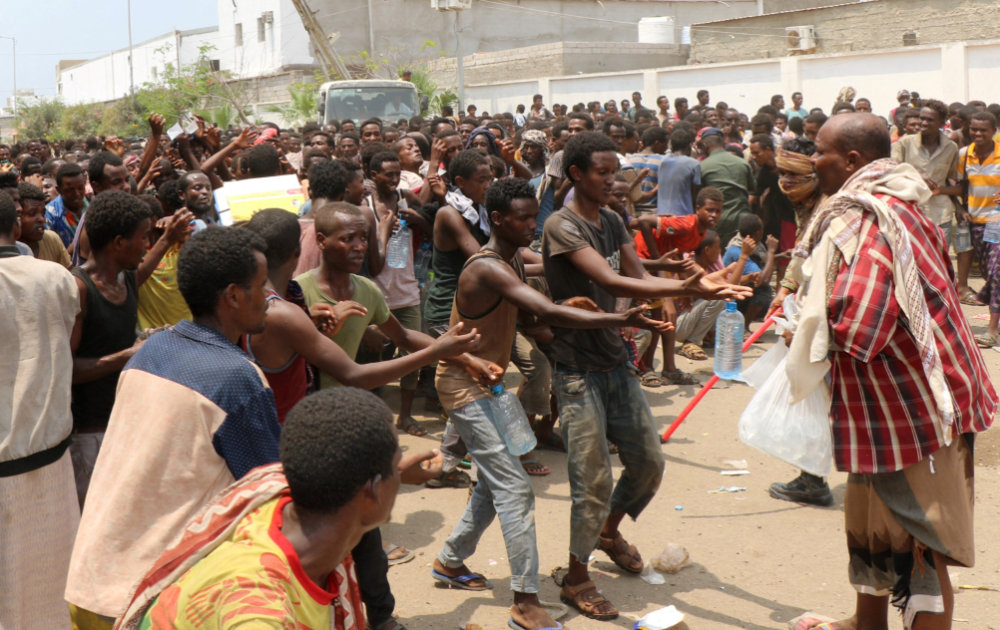
city of Aden in Yemen plead for food and water. (IOM Photo via AFP)
To his credit, Michael Aron, UK’s ambassador to Yemen, has strongly condemned the deaths and called for an immediate and objective probe and unhindered access to the injured migrants.
“Appalled by fire at Houthi-controlled migrant center in Sanaa,” he said on Twitter on Friday. “OHCHR & humanitarian agencies need immediate, unrestricted access to site & those injured. A credible, transparent, independent investigation must be carried out, including a full account of those killed & injured.”
Aron did not quibble over who or what was to blame for the fire and loss of life. “It is the Houthis inhumane treatment of migrants — including the creation of overcrowded conditions at the center — that led to this terrible loss in human life,” he said.
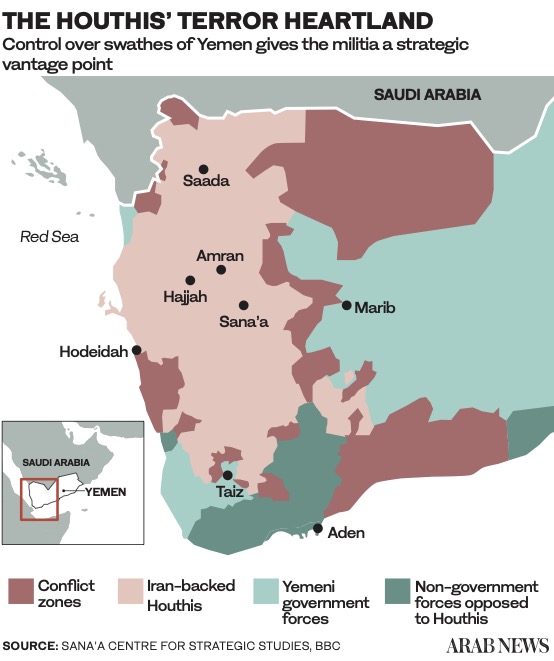
Speaking to Arab News, Badr Al-Qahtani, the Yemen editor of Asharq Al-Awsat newspaper, put the muted outrage of international organizations in the context of Yemen’s political realities. Whether it is death of migrants or kidnapping of civilians, the problem for the UN and other organizations doing humanitarian work in large swathes of the country is the same: the Houthis’ ability to create trouble.
“They live in fear of the Houthis because the militia can make their lives more difficult. The tactic works. They deal with the militia with safety as their primary concern,” Al-Qahtani said, referring to humanitarian groups.
“With they interact with sovereign governments, such as Saudi Arabia or the UAE, or similar entities, they have a different relationship unlike their approach to the Houthis as they do not have to deal with any threats of violence.”
Elaborating on this point, Al-Qahtani said: “International organizations are always careful when dealing with any issues in areas controlled by Houthis in order to achieve their humanitarian goals. Their reactions to the deadly incident in Sanaa are proof of that.
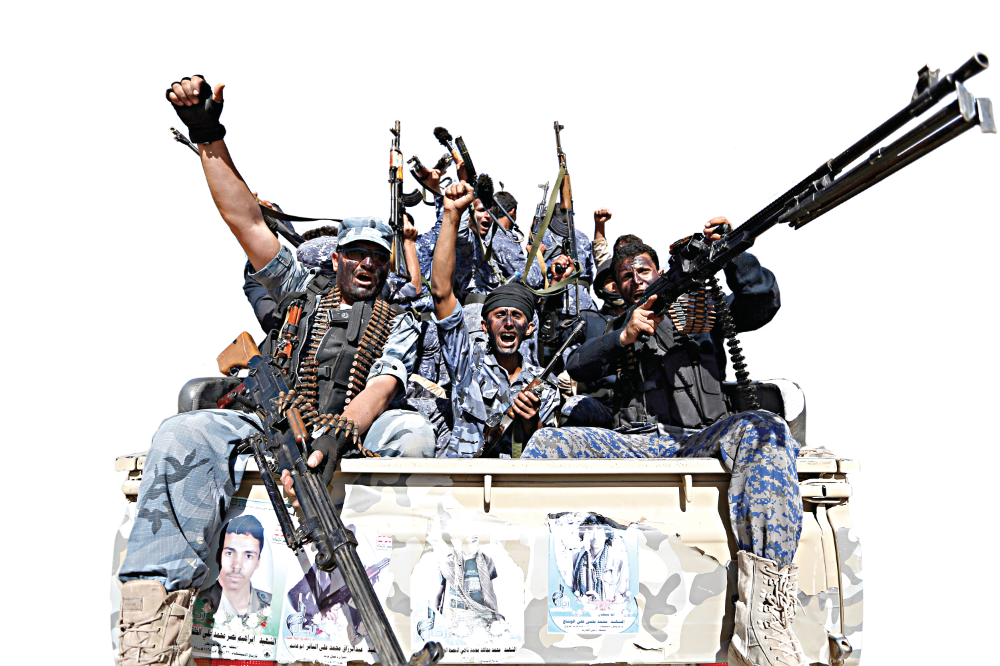
Iran-backed Houthi militia members have been running berserk in Yeme. since the past few years. (AFP file photo)
“Compare this incident with other issues involving some of the same groups and the UN-recognized Yemeni government. In Aden, for instance, an issue arose concerning migrants from Africa. The same organizations and activists adopted a tough stance against the government and made all kinds of demands.
“The government dealt with these organizations in view of their international stature and reputation, and complied with their demands. These organizations always work with the government and deal with it directly, without any problems or apprehensions.”
By contrast, the Houthis will not hesitate to use strong-arm tactics. “They can delay your papers either at the airport, or transportation or work. Therefore, organizations prefer not to confront them. They may leak some information, but they can’t raise their voice,” Al-Qahtani said.
“You need to realize there is a Houthi body established recently whose purpose is to fully control international organizations. Even foreign governments sometimes take this factor into account. When the British ambassador speaks out openly on a matter, you can be sure about extent of the challenge.”
Barman, of the American Center for Justice, was blunt in his criticism of international organizations as well as the international community for conveniently turning a blind eye to the Houthis’ actions.
“This is a heinous crime,” he told Arab News, referring to the deaths in Sanaa. “The world would have made a scene if the burnt migrants were white. And if the perpetrators were not the Houthis, the Security Council would have convened immediately.”

keywords


