

Lebanon approves World Bank rescue plan for needy families

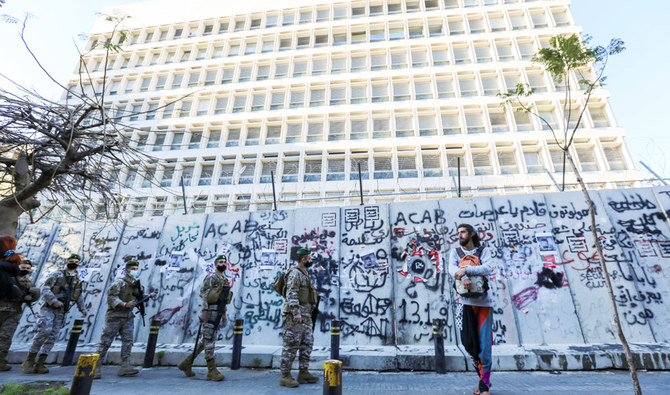
Lebanese army soldiers stand guard during a protest against the fall in Lebanese pound currency and mounting economic hardships, in Beirut, Lebanon March 12, 2021. (REUTERS)
Short Url
Updated 13 March 2021
Follow

Lebanon approves World Bank rescue plan for needy families

  • Interior minister sounds alarm on ‘diminishing security situation’

BEIRUT: The Lebanese parliament on Friday approved a $246 million World Bank emergency assistance plan to support struggling families and strengthen the social safety net amid the country’s worst economic and health crisis in decades.

Under the relief plan, 161,251 families classified as the poorest in Lebanon will receive 800,000 Lebanese pounds ($80) per month per family for one year.

The aid program will be implemented under the supervision of the World Bank.

The emergency package is expected to reduce mounting resentment against the country’s political leadership, which is widely blamed for the economic collapse and parliamentary stalemate.

Mohammed Fahmy, the caretaker interior minister, warned of “a diminishing security situation,” adding that “security is a product of politics, and all the country’s systems have diminished.”

He said: “We are part of the people and we are hungry. The political forces must resolve the obstacles to form a rescue government as soon as possible.

“We can no longer take it. The situation is very bad, the country is exposed, and I am sounding the alarm.”

French Foreign Minister Jean-Yves Le Drian warned on Thursday that “time is running out to prevent the collapse of Lebanon, and we do not see any indication that Lebanese politicians are doing what they can to save their country.”

The approval of aid follows growing protests against the economic meltdown.

Protesters attempted to march on the UNESCO Palace in Beirut while a parliamentary session took place, but tight security measures stopped them from reaching the venue.

Meanwhile, the dollar exchange rate on the black market in some regions reached new highs of 11,000 Lebanese pounds.

As the dollar exchange rate soars, the price of essential materials and commodities is increasing, while the value of people’s wages continues to decline.

The minimum wage, once equivalent to $450, has fallen below $62. As a result, public and private sector salaries have lost their value.

In its plenary session on Friday, parliament authorized the government to amend the housing loan ceilings for the Banque de L’habitat from 300 million to 450 million Lebanese pounds, and from 400 million to 600 million pounds.

Parliament also approved an agreement with the World Bank to allocate $5.5 million to support small and medium enterprises.

MP Hadi Abu Al-Hassan objected to financial aid for families, saying that people need to understand “the pain will continue and the loan will not achieve the desired goal.”

Parliament retracted proposals to support the military and security services with 1 million Lebanese pounds per month for each soldier.

The Ministry of Energy’s proposal to give an advance of 1,500 billion Lebanese pounds to Electricite du Liban (EDL) was referred to the joint committees that will meet next Tuesday.

The proposal to give aid to the military and security forces alone in the private sector was met with widespread objections, with activists and some politicians describing it as a bribe for security services.

Public administration employees, who went on strike on Friday, also objected to the plan.

The proposal was rejected by Army Command, which said it had not discussed the proposal, adding: “The military establishment is not concerned with it.”

It stressed that “the citizens have the right to demonstrate to demand their rights.”

MP Bilal Al-Abdallah said that the handling of the economic and social crisis “is a stop-gap, and we are begging for money from abroad.”

Al-Abdallah told Arab News: “We need government formation and reforms. Otherwise, the treatment is temporary.

“I objected during the session to giving the families this aid in Lebanese pounds instead of dollars.

“The Banque du Liban and the banks have made this decision because they want to keep their dollars, and people will not receive the full value in dollars as it will be calculated less than its exchange rate in the market.”

The Supreme Judicial Council on Friday approved the resignation of two judges and rejected applications for deposit submitted by other judges.


Saudi Arabia’s approach to AI transformation delivering business value: Publicis Sapient CEO

Updated 22 January 2026
Follow

Saudi Arabia’s approach to AI transformation delivering business value: Publicis Sapient CEO

  • Nigel Vaz: We’re reimagining how, in the case of tourism, we transform Saudi Arabia into a destination that is actually relevant and attractive for people to explore
  • Vaz: Our Slingshot platform handles everything from design to deployment, allowing legacy modernization and new digital apps to be built

DAVOS: As 2026 emerges as a tipping point for artificial intelligence, executives across the Middle East are moving from experimentation to scaling AI in ways that can deliver real business value, according to Nigel Vaz, CEO of Publicis Sapient.

Speaking to Arab News at the World Economic Forum in Davos, Vaz highlighted Saudi Arabia’s proactive approach to integrating technology into national and sectoral strategies.

“I was in meetings with the minister for tourism in Saudi Arabia (Ahmed Al-Khateeb), where we do a lot of work for them, and meetings with (Communications) Minister Abdullah Alswaha,” he said.

“What you realize is technology is incredibly critical, but it’s critical to the extent that we’re reimagining how, in the case of tourism, we transform Saudi Arabia into a destination that is actually relevant and attractive for people to explore.”

Vaz also highlighted applications of AI beyond tourism, including energy and healthcare.

“You’re thinking about how it can enable a greener approach to energy, which is a big goal for their government,” he said.

“And in healthcare, predictive and preventative approaches allow trends to be addressed before they occur, which is a significant cost saving for the government,” he added.

The shift in mindset around AI reflects a broader trend globally.

“Last year there was a lot of excitement about AI, but most work was at a proof-of-concept stage,” Vaz said. “What’s tipped this year is the recognition that AI is only valuable if it drives real business outcomes.”

This involves moving beyond automating individual tasks to enabling entire workflows or decision sets that produce superior results.

“Individual tasks being automated by AI don’t create business benefit,” he said. “Entire workflows or decision sets need to be enabled by AI, and they must deliver better outcomes than are currently possible today.”

Vaz underscored the importance of integrating people and AI rather than treating technology as a replacement, adding: “Unless you’re a technology nerd, you’re not really caring about the technology for its own sake.”

Geopolitical tensions further heighten the importance of AI for real-time, intelligent decision-making. Vaz explained that Publicis Sapient has developed platforms such as Slingshot, Bodhi and SustainAI to deliver enterprise-grade AI solutions with measurable business impact.

“Our Slingshot platform handles everything from design to deployment, allowing legacy modernization and new digital apps to be built two to three times faster and 30 to 40 percent cheaper,” he said.

Bodhi leverages industry expertise to create agentic capabilities for autonomous decision-making, while Sustain transforms IT service management, using AI to monitor systems, self-heal, and reduce manual workload, he explained

“All of this is not to sell software; it’s to deliver outcomes to clients. That’s what we care about,” Vaz added.

He offered guidance for leaders navigating the AI era.

“An AI North Star is focusing on an area of the business where untapped value can be unlocked,” he said. “Focus on how that value will drive growth, reduce costs, or improve experiences for customers or employees, and use AI to achieve those outcomes, rather than experimenting in small pockets.”

For Vaz, 2026 represents a year when enterprises, particularly in forward-looking Middle Eastern economies like Saudi Arabia, are moving from theory to practice, scaling AI to deliver tangible impact and measurable outcomes for businesses, governments, and citizens alike.