Tunisia’s parliament speaker urges dialogue to end political crisis

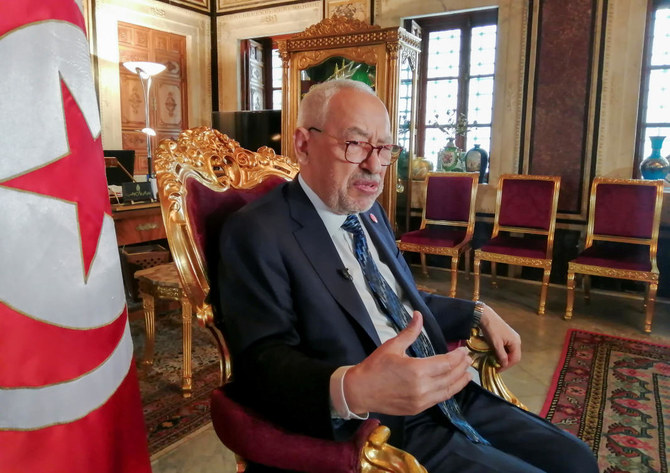
Parliament Speaker Rached Ghannouchi, head of the moderate Islamist Ennahda, speaks during an interview with Reuters in his office, in Tunis, Tunisia, March 9, 2021. (Reuters)
Short Url
Updated 11 March 2021
Follow

Tunisia’s parliament speaker urges dialogue to end political crisis

  • Ghannouchi has been one of Tunisia's main political players since the 2011 revolution that ended autocratic rule
  • "We support a small cabinet like this one that can carry out the necessary reforms," he added

TUNIS: The speaker of Tunisia's parliament, Rached Ghannouchi, said he backs calls for a new national dialogue to address the country's political standoff and constant disputes over the constitution.
Speaking to Reuters in an interview, Ghannouchi, head of the moderate Islamist Ennahda party, reaffirmed his preference for a parliamentary political system and said the standoff was endangering urgent economic reforms.
"There is a state of crisis that imposes dialogue... There needs to be a political dialogue on the constitution. And an economic and social dialogue on the mode of development," he said in the interview late on Tuesday.
Ghannouchi has been one of Tunisia's main political players since the 2011 revolution that ended autocratic rule and ushered in democracy but only stood for public office for the first time in 2019 when he entered parliament and became speaker.
That election returned a deeply fragmented parliament in which Ennahda, as the biggest party, secured only a quarter of seats. A separate presidential election the same month was won by Kais Saied, an independent.
The result has been 18 months of political turmoil, while Tunisia's public debt has soared and little progress has been made on economic reforms sought by foreign lenders whose funds are critical to financing the deficit.
"The constitution needs to be amended towards becoming either a completely presidential or parliamentary system. We support a parliamentary system," said Ghannouchi.
He also called for an amended electoral law that would make it easier for big parties to win more seats and ensure greater stability.
A dialogue has already been proposed by Tunisia's powerful labour union, which has a million members and was part of a civil society grouping that won a Nobel peace prize in 2015 for helping to end an earlier political crisis.
However, the idea, initially embraced by Saied, has made little headway. Ghannouchi had already called for a national dialogue on economic reforms but has not previously backed the idea of inclusive talks on the political system.
The latest crisis was triggered by Prime Minister Hichem Mechichi's decision to sack four cabinet members allied to Saied, who has in turn refused to swear in their replacements.
Ghannouchi rejected calls to replace Mechichi and start afresh with a new cabinet, saying this would further delay economic reforms.
"We support a small cabinet like this one that can carry out the necessary reforms," he added.
The dispute echoes other clashes between presidents and prime ministers since the adoption of the 2014 constitution that shared power between the two branches of state.
Disputes were meant to be resolved through a constitutional court of 12 judges appointed by parliament, the president and a judicial committee, but it has yet to be formed due to disagreements.
Ghannouchi said he hoped to bring together party leaders this week for another attempt at choosing members of the court: "It is a way out of the crisis."


Ramadan brings a season of grief after an Israeli strike wiped out most of a Gaza family

Updated 4 sec ago
Follow

Ramadan brings a season of grief after an Israeli strike wiped out most of a Gaza family

  • In the Gaza Strip, Ramadan has become a season when wartime losses hit especially deep for the many families grieving loved ones killed by Israeli forces
GAZA CITY, Gaza Strip: As the sun sets, Saddam Al-Yazji, his wife and their daughter sip a noodle soup, breaking their daily Ramadan fast in Gaza City. They sit around a folding table set up in the dirt at the foot of a towering pile of rubble, twisted metal and concrete slabs that was once their home.
Buried under the debris are the bodies of much of their family.
The three are virtually the family’s only survivors. Al-Yazji’s parents, his three brothers and his sister, along with most of their children, and his wife’s parents and siblings — 40 relatives in total — were all killed in a single strike when Israeli forces bombed the house in December 2023.
The Islamic holy month of Ramadan is traditionally a time for family, with large, festive gatherings for iftar, the sunset meal that ends the daily fast. In the Gaza Strip, it has become a season when wartime losses hit especially deep for the many families grieving loved ones killed by Israeli forces, which have been fighting Hamas for more than two years.
“I look at photos of our gatherings in Ramadan and cry,” the 35-year-old Al-Yazji said. “Where is my family? All are wiped out.”
“It’s the third Ramadan without them.”
Family once had large Ramadan meals
During Ramadans before the war, Al-Yazji’s father, Kamel Al-Yazji, brought all his children and grandchildren together for iftar around a large table piled with meat and rice and other dishes, recalled Saddam’s wife, Heba Al-Yazji.
Ramadan, when Muslims fast from dawn to dusk, is a month dedicated to religious reflection and worship. It also builds community, with the giving of charity.
The elder Al-Yazji was a former judge with the Palestinian Authority and a well-known sports figure in Gaza, serving as chairman of the Palestinian Athletics Federation. Saddam Al-Yazji earned a living running a supermarket on the ground floor of the four-story family home in Gaza City’s Rimal neighborhood.
The airstrike came only a few months into the ferocious Israeli bombardment that was launched after the Hamas-led attack on southern Israel in October 2023. The house was leveled on top of everyone inside.
“We were in the same house, in other part of the house,” Saddam Al-Yazji said. “We survived miraculously.”
The only other survivors were the daughter and the pregnant wife of one of his brothers. Among the dead were 22 children.
Some of the bodies were retrieved at the time. One of Al-Yazji’s brothers is buried in a grave marked with sticks at the foot of the destroyed house. Around 20 relatives remain buried under the rubble.
After the strike, the couple and their daughter, 11-year-old Maryam, lived in a tent elsewhere in Gaza City for much of the war. During the previous two Ramadans, they tried as much as possible to come visit the rubble of their home and have iftar there.
When a ceasefire deal came into effect in October, the three moved to a tent next to their old home.
“Life is empty,” Heba Al-Yazji said. “The war took everything from me. We wish we had died with them rather than remain alone.”
Most families feel a loss
Throughout the war, Israel has struck homes and tent camps sheltering Palestinians, often killing large numbers of families at once. Israel says it targets Hamas militants, though it rarely says who were the specific targets.
Israel’s campaign has killed more than 72,000 people, nearly half of them women and children, according to the Gaza Health Ministry. The ministry, which is part of the Hamas-led government, maintains detailed casualty records seen as generally reliable by UN agencies and independent experts, though it does not give a breakdown of civilians and militants.
Around 8,000 more are still buried under the rubble of destroyed homes, according to the ministry. Retrieving most of those bodies was out of the question when airstrikes and ground assaults were raging. Under the ceasefire, recovery efforts have increased, though they are still hampered by a lack of heavy equipment.
The Israeli campaign was triggered by the Hamas attack that killed some 1,200 people in Israel and took more than 250 others hostage. The hostages have been released, mostly as part of ceasefire agreements.
Almost everyone in Gaza has lost at least extended family members. Nearly the entire population of 2.1 million is homeless, with most living in vast tent camps. More than 80 percent of the strip’s buildings have been damaged or destroyed.
A landscape of rubble that was once the Rimal district extended all around the small Ramadan table where the three surviving Al-Yazjis ate their meal.
Saddam Al-Yazji recalled the “great dining table” of his family’s past Ramadan gatherings and how they all looked forward to it every year.
“I feel like I have betrayed them by being alive,” he said.