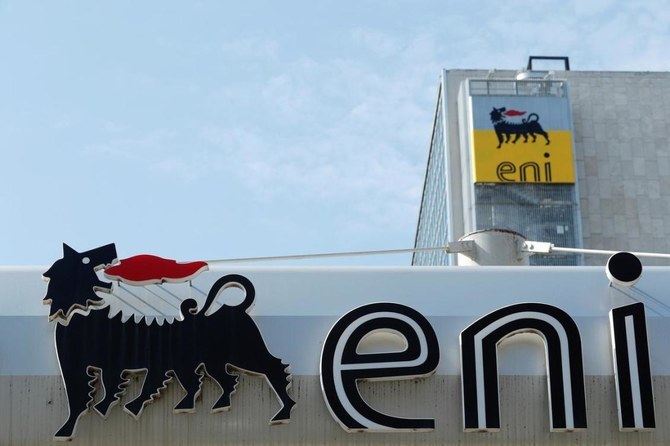
KARACHI: Italian oil and gas group ENI, in a push to exit Pakistan after 20 years, has sold its assets to a joint venture comprising its local employee and the Hub Power Company Limited (HUBCO), the company said this week.
The move by ENI, which supplied three million cubic meters of natural gas a day to Pakistan in 2018, underlines the chronic problems facing the country, where a deep energy crisis has hampered economic development for years.
HUBCO and ENI could not be reached for comment, but in a material disclosure on the Pakistan Stock Exchange, HUBCO said: “We hereby inform you that Hub Power Holdings Limited (“Company”), a wholly owned subsidiary of The Hub Power Company Limited (“HUBCO”) together with ENI’s local employees (in a 50:50 joint venture) has executed definitive agreements to acquire all the upstream operations in Pakistan of ENI and renewable energy assets owned by ENI in Pakistan.”
The ENI website says the company has been in Pakistan since 2000 in the exploration and production, and gas and power sectors, but its local development support in the country began in the 1970s.
ENI, one of seven “supermajor” oil companies in the world, is also one of the largest gas producers in Pakistan, actively engaged in the Bhit, Badhra and Kadanwari oil and gas exploration fields which generate 75 percent of its revenue in Pakistan.
Though officially the amount of the deal, to be finalized in three months, has not yet been disclosed, industry insiders say it is likely to fall between $160-$189 million.
It was reported in 2020 that ENI was divesting its upstream business in Pakistan, which is currently being conducted through three entities: ENI Pakistan Limited, ENI AEP limited and ENI Pakistan M limited. Insiders say the listed exploration and production companies (E&Ps) may opt to buy these assets.
ENI is currently reviewing its exploration and production portfolio and leaving or downsizing operations in countries where it has a small presence with few opportunities to grow or where development is too long and complicated.
It is working to sell assets in Australia where it aims to keep control of its solar business as it looks to meet aggressive renewable energy targets.
Last year, ENI unveiled one of the most ambitious clean-up drives in the oil industry when it pledged to slash its greenhouse gas emissions by 80%.
Apart from its global consolidation plan, analysts believe setbacks in offshore exploration may be one reason for ENI’s exit from Pakistan.
“The failure to discover oil and gas reserves in the Arabian Sea was a setback to the companies involved and it could also be one of the reasons that ENI is departing from Pakistan,” Samiullah Tariq, director research at Pakistan Kuwait Investment, said. “Usually when foreign companies exit, locals get relatively favorable valuations.”


![]()

Italian oil giant ENI to exit Pakistan after 20 years
Short Url
https://arab.news/5sxny
Italian oil giant ENI to exit Pakistan after 20 years
- Reasons for exit are global consolidation plan and setbacks in offshore exploration, analysts say
- Industry insiders say exit deal amount likely to fall between $160-$189 million
Latest updates





© 2026 SAUDI RESEARCH & PUBLISHING COMPANY, All Rights Reserved And subject to Terms of Use Agreement.