

US says Russian-backed outlets spread COVID-19 vaccine ‘disinformation’

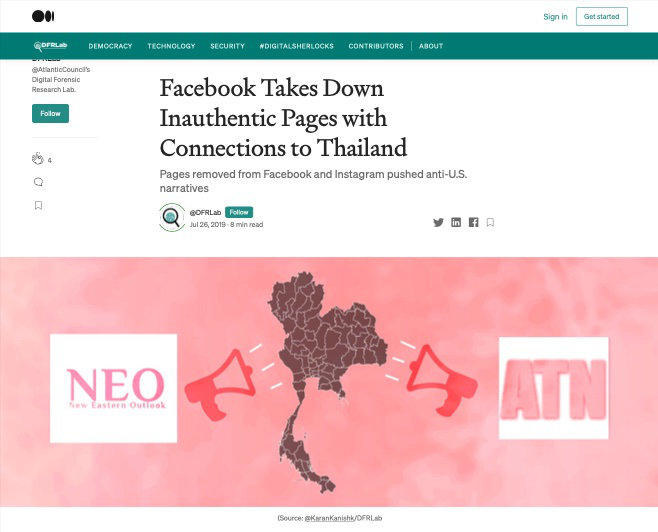
A screengrab of a Digital Forensic Research Lab page tells about a New Eastern Outlook page being taken down by Facebook for carrying fake news targetting the US. 
Short Url
Updated 08 March 2021
Follow

US says Russian-backed outlets spread COVID-19 vaccine ‘disinformation’

  • US State Department identified the three outlets as News Front, New Eastern Outlook and Oriental Review

WASHINGTON: The United States has identified three online publications directed by Russia’s intelligence services that it says are seeking to undermine COVID-19 vaccines produced by Pfizer and Moderna , a State Department spokeswoman said on Sunday.
The outlets “spread many types of disinformation, including about both the Pfizer and Moderna vaccines, as well as international organizations, military conflicts, protests, and any divisive issue that they can exploit,” the spokeswoman said.
The Wall Street Journal (WSJ) first reported on the identification of the alleged campaign on Sunday. A Kremlin spokesman denied the US claim Russia was spreading false information about vaccines to the WSJ.
Russia’s embassy in Washington did not immediately respond to a request for comment.
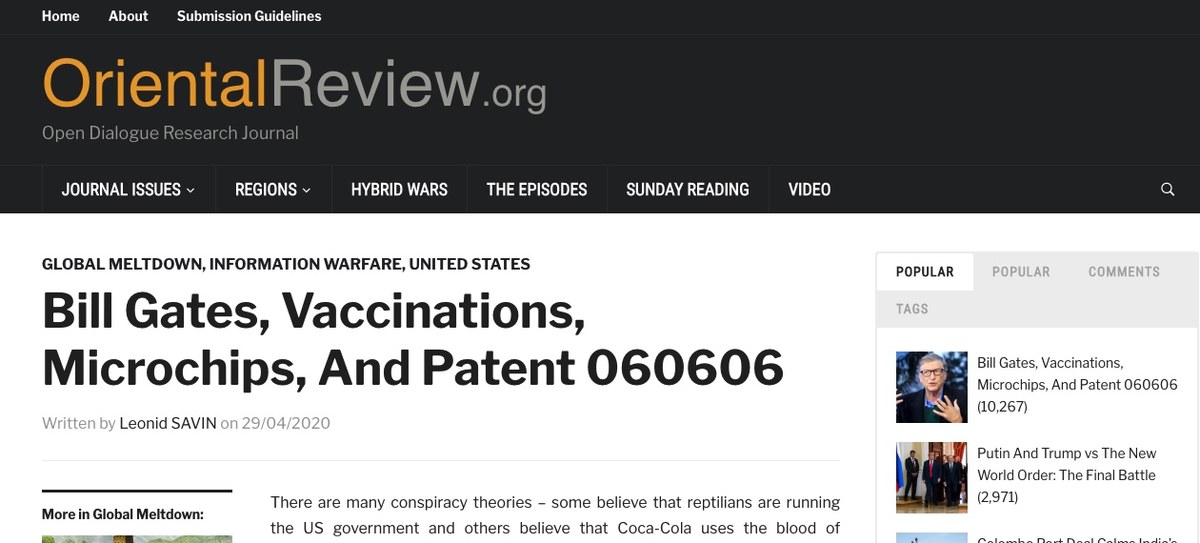


A sample article from the OrientalReview.org talking about a plot by Bill Gates and Microsoft to dominate the world using vaccines and microchips, with a patent ominously carrying the numbers 666. 

Russia approved its Sputnik V vaccine in August, before a large-scale trial had begun, saying it was the first country to do so for a COVID-19 shot. Peer-reviewed trials months later proved it was almost 92% effective in fighting the virus.
Pfizer, headquartered in New York, and Germany’s BioNTech, produced the first vaccine that was authorized in the US, which regulators approved in December. The second, made by Moderna, headquartered in Massachusetts, was authorized later that month.
The State Department’s Global Engagement Center, set up to counter propaganda and disinformation campaigns, identified the three outlets, the spokeswoman said.
News Front is controlled by Russia’s federal security service, the center found. New Eastern Outlook and Oriental Review are directed and controlled by the Russian foreign intelligence service.
A fourth outlet, Rebel Inside, controlled by the Russian army, was also named by the center but is largely dormant, the spokeswoman said.
“The Department will continue to expose Russia’s nefarious activities online,” she added. “We will also continue to work closely with our allies and partners to provide a global response to countering disinformation.”


Philippines seeks to regain Chinese visitors as arrivals lag behind regional rivals

Updated 8 sec ago
Follow

Philippines seeks to regain Chinese visitors as arrivals lag behind regional rivals

  • 262,000 Chinese tourists visited Philippines in 2025, compared to 1.7m in 2019
  • Vietnam is top destination for Chinese travelers, with about 4.8m visitors this year

MANILLA: The Philippines is trailing behind other countries in Southeast Asia in winning back Chinese tourists, with arrivals well below a quarter of pre-pandemic levels so far this year, latest data showed.

Known for its white sandy beaches, famous diving spots and diverse culture, the Philippines was welcoming an increasing number of Chinese tourists in the period before the pandemic, with the number peaking at over 1.7 million in 2019, when it was the second-largest source market after South Korea. 

But the post-pandemic rebound has been slow, with China ranking sixth among international arrivals and the number of Chinese visitors reaching only 262,000 as of Dec. 20, according to data from the Philippine Department of Tourism.

“China remains one of the country’s largest and most important source markets,” the tourism department said earlier this week.

Chinese arrivals this year are equivalent to only around 15 percent of the numbers in 2019 and there is stiff competition with regional rivals like Vietnam, Thailand, Malaysia, Singapore and Indonesia each welcoming at least 1 million tourists from China in 2025.

Vietnam has become Chinese travelers’ top travel destination in Southeast Asia with around 4.8 million visitors so far this year, followed by Thailand, which has recorded about 4.36 million.

China is Singapore’s top source market, with nearly 3 million visitors as of November.

To attract more visitors from China, the Philippines reintroduced electronic visas for Chinese travelers in November, after suspending the system for two years.

“The eVisa resumption is a critical step forward and a clear signal that the Philippines is open, ready, and eager to welcome our Chinese friends,” said Ireneo Reyes, the tourism attache to China.

“While the timing meant that its full benefits could not be felt within the peak booking periods of 2025, we expect a more visible impact beginning the first quarter of 2026.” 

The Philippine tourism department said that “recovery has also been constrained by reduced flight capacity, with China-Philippines routes operating at only about 45 percent of pre-pandemic levels,” adding that officials were working closely with relevant stakeholders to “rebuild connectivity and confidence.”

Tourism is an important sector in the Philippine economy, according to a report by the ASEAN+3 Macroeconomic Research Office, accounting for about 13.2 percent of the country’s gross domestic product last year and making up around 13.8 percent of its labor force.