Train derails killing 1, injuring 40 in southern Pakistan

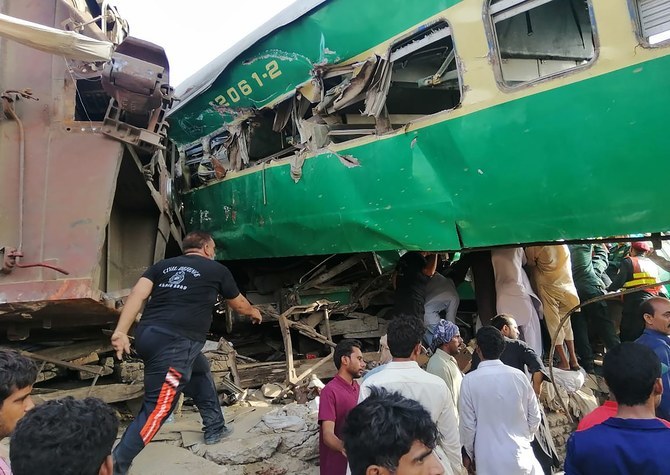
Pakistani rescuers and local residents gather around the wreckage of carriages at the site of train accident in Rahim Yar Khan district in Punjab province on July 11, 2019. (AFP/ File)
Short Url
Updated 07 March 2021
Follow

Train derails killing 1, injuring 40 in southern Pakistan

  • Accident took place between the Rohri and Sangi stations in southern Sindh province
  • Eight cars of the 18-car train from Karachi to Lahore derailed and six fell into a shallow ditch

MULTAN: Eight cars of a Lahore-bound train derailed in southern Pakistan early Sunday, killing at least one passenger and injuring 40 others, officials said.

The accident took place between the Rohri and Sangi stations in southern Sindh province and caused a temporary suspension of railway traffic in both directions, said Kamran Lashari, a railway official.

It wasn’t immediately clear what caused the derailment. Train accidents are common in Pakistan, where successive governments have paid little attention to improving the poorly maintained signal system and aging tracks.

Lashari said eight cars of the 18-car train that departed from Karachi for the eastern city of Lahore derailed and six fell into a shallow ditch.

Rescue official Muhammad Arshad said darkness and the remote location of the derailment hampered rescue efforts. He said the body of the woman who died and 40 injured passengers were taken to hospitals in nearby towns. It wasn’t immediately clear how many passengers were on the train.

Railway Minister Azam Sawati told a local television station that the accident was being investigated and the government would provide financial compensation to the heirs of deceased woman and all the injured.


Pakistan, other Muslim states raise alarm over Gaza situation after heavy flooding

Updated 8 sec ago
Follow

Pakistan, other Muslim states raise alarm over Gaza situation after heavy flooding

  • Cold winter rains have repeatedly lashed the sprawling tent cities, turning Gaza’s dirt roads into mud and causing damaged buildings to collapse
  • The situation has been compounded by lack of sufficient humanitarian access, acute shortages of essential life-saving supplies and materials

ISLAMABAD: Foreign ministers of Pakistan, Saudi Arabia and other Muslim nations on Friday voiced concern over the situation in Gaza, following severe flooding triggered by heavy rains in the territory.

As 2026 begins, the shaky 12-week-old ceasefire between Israel and Hamas has largely ended large-scale Israeli bombardment of Gaza. But Palestinians are still being killed almost daily by Israeli fire, and the humanitarian crisis shows no signs of abating.

Cold winter rains have repeatedly lashed the sprawling tent cities over past weeks, turning Gaza’s dirt roads into mud and causing buildings damaged in Israeli bombardment to collapse. UNICEF says at least six children have now died of weather-related causes.

In a joint message, foreign ministers of Pakistan, Saudi Arabia, Egypt, Indonesia, Jordan, Qatar, Türkiye, the United Arab Emirates, expressed their “deepest concern” over the situation, compounded by lack of sufficient humanitarian access, acute shortages of essential life-saving supplies, and the slow pace of the entry of essential materials required for the rehabilitation of basic services.

“The ministers highlighted that the severe weather has laid bare the fragility of existing humanitarian conditions, particularly for almost 1.9 million people and displaced families living in inadequate shelters,” the Pakistani foreign ministry said in a joint statement.

“Flooded camps, damaged tents, the collapse of damaged buildings, and exposure to cold temperatures coupled with malnutrition, have significantly heightened risks to civilian lives, including due to disease outbreaks, especially among children, women, the elderly, and individuals with medical vulnerabilities.”

The statement came a day after UNICEF said a 7-year-old, Ata Mai, had drowned Saturday in severe flooding that engulfed his tent camp in Gaza City. Mai had been living with his younger siblings and family in a camp of around 40 tents.

They lost their mother earlier in the war, according to the UN agency.

Video from Civil Defense teams, shown on Al Jazeera, showed rescue workers trying to get Mai’s body out of what appeared to be a pit filled with muddy water surrounded by wreckage of bombed buildings. The men waded into the water, pulling at the boy’s ankle, the only part of his body visible. Later, the body is shown wrapped in a muddy cloth being loaded into an ambulance.

Foreign minister of Pakistan, Saudi Arabia and other states appreciated the efforts of all United Nations (UN) organizations and agencies as well as non-government organizations (NGOs) in continuing to assist Palestinian civilians and deliver humanitarian assistance under extremely difficult and complex circumstances.

“They demanded that Israel ensure the UN and international NGOs are able to operate in Gaza and the West Bank in a sustained, predictable, and unrestricted manner, given their integral role in the humanitarian response in the Strip. Any attempt to impede their ability to operate is unacceptable,” the statement read.

The foreign ministers reaffirmed support to President Donald Trump’s plan for Gaza, with a view to ensuring the sustainability of the ceasefire, bringing an end to the war in Gaza, to secure a dignified life for the Palestinian people who have endured prolonged humanitarian suffering, and leading to a credible pathway to Palestinian self-determination and statehood.

“In this context, they stressed the urgent need to immediately initiate and scale up early recovery efforts, including the provision of durable and dignified shelter to protect the population from the severe winter conditions,” the statement read further.

“The ministers called on the international community to uphold its legal and moral responsibilities and to pressure Israel, as the occupying power, to immediately lift constraints on the entry and distribution of essential supplies including tents, shelter materials, medical assistance, clean water, fuel, and sanitation support.”