Top Shiite cleric Al-Sistani: Christians in Iraq should live in ‘peace, security’

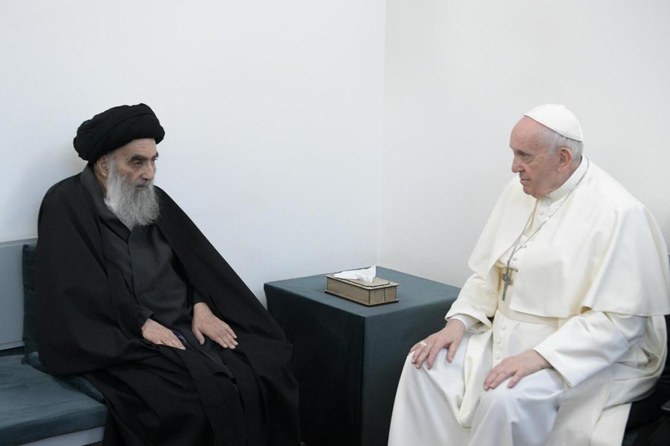
Shiite cleric, Ali Al-Sistani, met the Pope at his home in Najaf, the seat of the Iraqi Shiite clergy, on the second day of the pontiff’s historic tour of Iraq. (Office of Shiite cleric, Ali Al-Sistani)
Short Url
Updated 06 March 2021
Follow

Top Shiite cleric Al-Sistani: Christians in Iraq should live in ‘peace, security’

  • Pope met with top Shiite cleric in latter’s home in Najaf for 50 minutes
  • Francis: ‘Hostility, extremism, violence have nothing to do with faith — they are betrayals of religion’

ROME: Christians in Iraq should live in “peace and security,” Grand Ayatollah Ali Al-Sistani, one of Shiite Islam’s top clerics, told Pope Francis in a historic meeting on the second day of the first-ever papal visit to the country.

The 84-year-old pope and 90-year-old Al-Sistani spoke for 50 minutes at the latter’s home in Najaf, the third-holiest city for Shiite Muslims after Makkah and Madinah — a landmark moment in modern religious history, and a milestone in the pope’s efforts to deepen interfaith dialogue, Vatican sources told Arab News while expressing satisfaction with the meeting.

Al-Sistani, according to a statement issued by his office, was grateful to the pope for his visit, and “affirmed … that Christian citizens should live like all Iraqis in peace and security, and with their full constitutional rights.”

Vatican spokesman Matteo Bruni said the pope “stressed the importance of cooperation and friendship between religious communities in contributing, through the cultivation of mutual respect and dialogue, to the good of Iraq, the region and the entire human family.”

Bruni added that the meeting was an occasion for the pope to thank Al-Sistani “for speaking up, together with the Shiite community, in defense of those most vulnerable and persecuted amid the violence and great hardships of recent years, and for affirming the sacredness of human life and the importance of the unity of the Iraqi people.”

The pope, said Bruni, “stated that he continues to pray that God, the Creator of all, will grant a future of peace and fraternity for the beloved land of Iraq, for the Middle East and for the whole world.”

After the meeting, the pope flew to the city of Nassiriya. He then traveled by car to the Plain of Ur, where Abraham is believed to have been born, for a meeting with representatives of Iraq’s religious communities, including Christians, Sunnis, Shiites, Yazidis, Mandeans, Kakais, Bahais and Zoroastrians, each wearing their traditional religious garb.

Freedom of conscience and religion are “fundamental rights” that should be respected everywhere, said the pope.

“We believers cannot be silent when terrorism abuses religion and sows hatred,” he added, in a message of solidarity with minorities persecuted by Daesh.

He also called for “unity,” adding: “Let us ask for this in praying for the whole Middle East. Here I think especially of neighboring war-torn Syria.”

He said: “The most blasphemous offense is to profane God’s name by hating our brothers. Hostility, extremism and violence have nothing to do with faith — they are betrayals of religion.”

The pope then celebrated his first Mass in Iraq in the Chaldean Cathedral of St. Joseph in central Baghdad.

Only a small crowd was allowed in the church in order to guarantee social distancing due to the coronavirus pandemic.

On Sunday, the pope will celebrate Mass in Erbil, capital of the autonomous region of Iraqi Kurdistan, where 10,000 faithful will be allowed.


Hundreds flee to government-held areas in north Syria ahead of possible offensive

Updated 16 January 2026
Follow

Hundreds flee to government-held areas in north Syria ahead of possible offensive

  • Many of the civilians who fled used side roads to reach government-held areas
  • Men, women and children arrived in cars and pickup trucks that were packed with bags of clothes

DEIR HAFER, Syria: Scores of people carrying their belongings arrived in government-held areas in northern Syria on Friday ahead a possible attack by Syrian troops on territory held by Kurdish-led fighters east of the city of Aleppo.
Many of the civilians who fled used side roads to reach government-held areas because the main highway was blocked with barriers at a checkpoint that previously was controlled by the Kurdish-led and US-backed Syrian Democratic Forces, Associated Press journalists observed.
The Syrian army said late Wednesday that civilians would be able to evacuate through the “humanitarian corridor” from 9 a.m. to 5 p.m. Thursday. The announcement appeared to signal plans for an offensive against the SDF in the area east of Aleppo.
There were limited exchanges of fire between the two sides.
Men, women and children arrived in cars and pickup trucks that were packed with bags of clothes, mattresses and other belongings. They were met by local officials who directed them to shelters.
In other areas, people crossed canals on small boats and crossed a heavily damaged pedestrian bridge to reach the side held by government forces.
The SDF closed the main highway but about 4,000 people were still able to reach government-held areas on other roads, Syrian state TV reported.
A US military convoy arrived in Deir Hafer in the early afternoon but it was not immediately clear whether those personnel will remain. The US has good relations with both sides and has urged calm.
Inside Deir Hafer, many shops were closed and people stayed home.
“When I saw people leaving I came here,” said Umm Talal, who arrived in the government-held area with her husband and children. She added that the road appeared safe and her husband plans to return to their home.
Abu Mohammed said he came from the town of Maskana after hearing the government had opened a safe corridor, “only to be surprised when we arrived at Deir Hafer and found it closed.”
SDF fighters were preventing people from crossing through Syria’s main east-west highway and forcing them to take a side road, he said.
The tensions in the Deir Hafer area come after several days of intense clashes last week in Aleppo, previously Syria’s largest city and commercial center, that ended with the evacuation of Kurdish fighters from three neighborhoods north of the city that were then taken over by government forces.
The fighting broke out as negotiations stalled between Damascus and the SDF over an agreement reached in March to integrate their forces and for the central government to take control of institutions including border crossings and oil fields in the northeast.
The US special envoy to Syria, Tom Barrack, posted on X Friday that Washington remains in close contact with all parties in Syria, “working around the clock to lower the temperature, prevent escalation, and return to integration talks between the Syrian government and the SDF.”
The SDF for years has been the main US partner in Syria in fighting against the Daesh group, but Turkiye considers the SDF a terrorist organization because of its association with Kurdish separatist insurgents in Turkiye.