YANGON: Security forces in Myanmar have been increasingly targeting paramedics who treat injured anti-coup protesters, rescuers say, as police and soldiers this week started to indiscriminately fire live rounds at demonstrators.
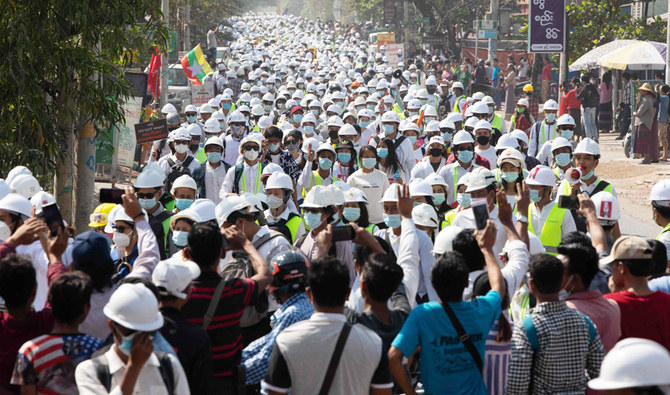
Hundreds of thousands of people have been demonstrating in towns and cities across the country in the aftermath of the military’s overthrow of the civilian government of Aung San Suu Kyi.
At least 50 protesters have been killed since the beginning of the civil disobedience movement, 38 of them on Wednesday as security forces opened fire with live rounds. More than 1,200 people have been arrested, including rescuers.
Video footage that went viral on social media after the crackdown showed members of a Yangon-based volunteer group, Mon Myat Seik Htar (MMSH), being beaten by police.
“Police stopped the ambulance and ordered them to step out. A few moments later, police started beating them with batons,” one of the group’s leaders, who requested anonymity, told Arab News on Thursday.
“Police used the stock of the gun to beat them, and one team member was severely injured after his safety helmet was broken.” All four of them, the MMSH leader said, were taken to the notorious Insein prison.
Two members from We Love North Okalapa (WENO), a rescue team in Yangon’s North Okalapa township, were detained on the same day but later released.
A WENO volunteer said that one of them was the group’s chairman.
“The chairman was severely injured by batons while another was shot by police in thigh,” he told Arab News. The ambulances of MMSH and WENO were destroyed by security forces.
Troops also raided the office of Free Funeral Service Society (FFSS) in North Okalapa in search of its founder Kyaw Thu, one of the most vocal social activists in the country.
After the increase in violence, the group, which is present in all parts of the country, refused to provide services to persons related to the military.


![]()

Myanmar paramedics face bullets for treating injured protesters
Short Url
https://arab.news/bwny9
Myanmar paramedics face bullets for treating injured protesters
- Video footage showing police battering rescuers and destroying their ambulance went viral earlier this week


Latest updates


© 2026 SAUDI RESEARCH & PUBLISHING COMPANY, All Rights Reserved And subject to Terms of Use Agreement.