

In a first, police in Khyber Pakhtunkhwa appoint transgender person to dispute resolution council

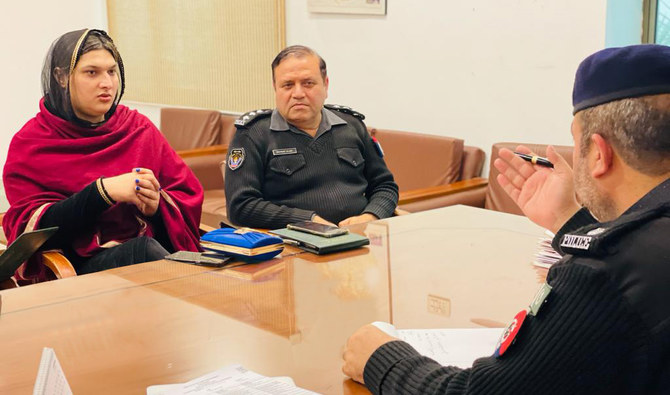
This undated file photo shows Sobia Khan, the first transgender member of a dispute resolution council in Khyber Pakhtunkhwa, with police officials in Peshawar. (Photo courtesy: Sobia Khan)
Short Url
Updated 06 March 2021
Follow

In a first, police in Khyber Pakhtunkhwa appoint transgender person to dispute resolution council

  • Sobia Khan says she wants to help other transgender community members who are forced to live on social peripheries
  • Activists say more than 80 transgender people in Khyber Pakhtunkhwa have been killed in targeted attacks since 2015

PESHAWAR: A transgender person who was recently appointed by Khyber Pakhtunkhwa (KP) Police to its dispute resolution council (DRC) in Peshawar said on Friday she would do her best to address the problems faced by her "ostracized community" in the province.

"I commend the police for allowing representation to a marginalized community. I will represent transgender people in relevant cases," Sobia Khan told Arab News while commenting on her inclusion in the council that was established in 2014 to institutionalize alternative dispute resolution mechanism in the province.

Khyber Pakhtunkhwa's transgender community has frequently faced sexual abuse, physical torture and killings, and the perpetrators of these crimes have often been unpunished.

Discussing Khan's appointment to the DRC, KP's Inspector General Police Dr. Sanaullah Abbasi told Arab News that his department was striving to protect marginalized people in the province.

"The system of alternative dispute resolution is based on active engagement among victims, offenders and the rest of the community in pursuit of reconciliation by adapting a balanced approach that caters to the needs of all three through a process that preserves everyone's safety and dignity," he said. 

Khan said that transgender persons faced serious issues related to education, health and employment in government institutions. She added that many of them were also forced into prostitution.

In 2018, Pakistan's parliament tried to address such challenges by enacting Transgender Persons (Protection of Rights) Act to recognize their legal equality and safeguard their rights.

The legislation prohibits any discrimination against them in education institutions, medical centers and public transportation facilities. It also makes it possible for them to apply for passports, driver's licenses and other official documents by using their gender identity.

Qamar Naseem, a program coordinator with Blue Veins that works for the protection of women and transgender people, told Arab News that the DRC could help people on social peripheries and reduce pressure on local courts since many contentious issues could be amicably resolved by its members.

He said that there were about 50,000 transgender people in Khyber Pakhtunkhwa province, adding that at least 83 of them had been killed since 2015 in targeted attacks.

"Transgender people are even disowned by their parents in our society and hated by a large majority of those around us," Naseem continued. "With some representation in the DRC, their grievances may be addressed."

Arzoo Khan, president the provincial transgender association, said the inclusion of one of her community members in the council was a good initiative, though she added that such representation should not be limited to a single district.

The inspector general police informed Arab News he had already issued directives to ensure transgender representation in DRCs across the province.

"Transgender people face problems in hospitals, schools and other places due to their gender identity," Naseem said. "The government should launch a campaign to sensitize members of our society to own such marginalized communities."


Pakistan calls for new global cricket body, says ICC ‘hostage to Indian politics’

Updated 5 sec ago
Follow

Pakistan calls for new global cricket body, says ICC ‘hostage to Indian politics’

  • Pakistan’s government has barred its team from playing against India in World Cup fixture on Feb.15
  • India generates largest share of cricket’s commercial revenue, enjoying overarching influence in the sport

ISLAMABAD: Pakistan’s Defense Minister Khawaja Asif called for a new global cricket governing body on Tuesday, saying that the International Cricket Council (ICC) has become hostage to Indian political interests amid a fresh row between the neighbors ahead of the T20 World Cup 2026. 

Pakistan’s government announced earlier this week that it has cleared its national men’s team to play the upcoming World Cup, scheduled to be held in India and Sri Lanka from Feb. 7. However, Islamabad said the national team will boycott its upcoming fixture against India on Feb. 15 without mentioning a reason. The ICC responded by saying that Pakistan’s decision was “not in the interest of the global game or the welfare of fans worldwide, including millions in Pakistan.”

Pakistan’s dispute with the ICC can be traced back to it expressing displeasure recently at the cricket body’s decision to replace Bangladesh with Scotland for the World Cup. Bangladesh had requested the global governing body shift its matches to any another venue outside India owing to security concerns, as political tensions surge Delhi and Dhaka surge. 

“A new international organization of cricket is needed to keep the spirit of the gentleman’s game alive,” Asif wrote on social media platform X. “ICC has become hostage to Indian political interests in South Asia.”

India generates the largest share of cricket’s commercial revenue and hence enjoys overarching influence over the sport. Critics argue that this financial contribution translates into decisive leverage within the ICC. 

A large part of that revenue comes from the Indian Premier League (IPL), the sport’s most lucrative T20 cricket competition, which is run by the Board of Control for Cricket in India (BCCI). Between 2024 and 2027, the IPL is projected to earn $1.15 billion, nearly 39 percent of the ICC’s total annual revenue, according to international media reports. 

The ICC is headed by Jay Shah, the son of Indian Home Minister Amit Shah. The ICC chair is expected to be independent from any cricket board and hence take impartial decisions.

India and Pakistan engaged in a military confrontation that lasted for four days in May last year before Washington brokered a ceasefire. Militaries of the two countries pounded each other with drones, missiles, fighter jets and exchanged artillery fire in what was the worst fighting between them since 1999. 

These bilateral tensions have made their way to cricket, with India refusing to shake hands with Pakistani cricketers during the September 2025 Asia Cup tournament between both sides. The two teams met for three matches, all of which India won, and did not shake hands before or after the fixtures. 

The two countries have not played a full bilateral series since 2012–13 due to political tensions. They meet largely at neutral venues.