

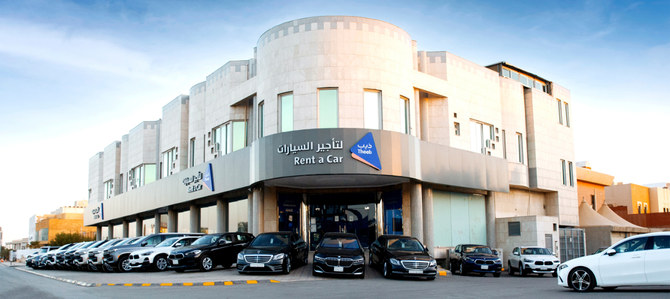
Theeb Rent-a-Car to list 30% of shares in IPO this month

The company’s strategy is to continue seeking growth in the car rental services sector by opening new branches. (Theeb Rent-a-Car)
Short Url
Updated 03 March 2021
Follow

Theeb Rent-a-Car to list 30% of shares in IPO this month

RIYADH: Theeb Rent-a-Car, a Riyadh-based car rental company, plans to float 30 percent of its share capital in an initial public offering (IPO) later this month.

The company issued an IPO prospectus last month to the Saudi Stock Exchange (Tadawul), in which it outlined the many factors that enable it to compete with its current and potential competitors and the factors it sees for its future growth.

The Saudi Capital Market Authority (CMA) last October approved Theeb’s request to offer a 30 percent stake as part of its IPO, representing 12.90 million shares on Tadawul.

The company’s strategy is to continue seeking growth in the car rental services sector by opening new branches, whether at airports, inside cities, or in new mega projects in which the need for car rental is likely to increase.

According to Argaam, Theeb Rent a Car reported a net profit of SR41.9 million ($3.97 million) for the first nine months of 2020, an increase of 8 percent on the same period in 2019.

Short-term leasing accounted for 44.8 percent of revenue, followed by long-term leasing (30.2 percent) and used car sales (25 percent).

Offering daily, weekly and monthly rental services, it operates through 48 outlets across the Kingdom. With 264,131 customers as of March 2020 – a 3 percent year-on-year increase – Theeb has an 8.8 percent share of the short-term car leasing market. It competes with the likes of Al WAFAQ, with a 6.9 percent market share, followed by Budget Saudi (6.9 percent), Arabian Hala (4.6 percent), Key Car Rental (3.5 percent) and SEERA (3.2 percent).


Kuwait to boost Islamic finance with sukuk regulation

Updated 05 February 2026
Follow

Kuwait to boost Islamic finance with sukuk regulation

  • The move supports sustainable financing and is part of Kuwait’s efforts to diversify its oil-dependent economy

RIYADH: Kuwait is planning to introduce legislation to regulate the issuance of sukuk, or Islamic bonds, both domestically and internationally, as part of efforts to support more sustainable financing for the oil-rich Gulf nation, Prime Minister Sheikh Ahmad Abdullah Al-Ahmad Al-Sabah said on Wednesday.

Speaking at the World Governments Summit in Dubai, Al-Sabah highlighted that Kuwait is exploring a variety of debt instruments to diversify its economy. The country has been implementing fiscal reforms aimed at stimulating growth and controlling its budget deficit amid persistently low oil prices. Hydrocarbons continue to dominate Kuwait’s revenue stream, accounting for nearly 90 percent of government income in 2024.

The Gulf Cooperation Council’s debt capital market is projected to exceed $1.25 trillion by 2026, driven by project funding and government initiatives, representing a 13.6 percent expansion, according to Fitch Ratings.

The region is expected to remain one of the largest sources of US dollar-denominated debt and sukuk issuance among emerging markets. Fitch also noted that cross-sector economic diversification, refinancing needs, and deficit funding are key factors behind this growth.

“We are about to approve the first legislation regulating issuance of government sukuk locally and internationally, in accordance with Islamic laws,” Al-Sabah said.

“This enables us to deal with financial challenges flexibly and responsibly, and to plan for medium and long-term finances.”

Kuwait returned to global debt markets last year with strong results, raising $11.25 billion through a three-part bond sale — the country’s first US dollar issuance since 2017 — drawing substantial investor demand. In March, a new public debt law raised the borrowing ceiling to 30 billion dinars ($98 billion) from 10 billion dinars, enabling longer-term borrowing.

The Gulf’s debt capital markets, which totaled $1.1 trillion at the end of the third quarter of 2025, have evolved from primarily sovereign funding tools into increasingly sophisticated instruments serving governments, banks, and corporates alike. As diversification efforts accelerate and refinancing cycles intensify, regional issuers have become regular participants in global debt markets, reinforcing the GCC’s role in emerging-market capital flows.

In 2025, GCC countries accounted for 35 percent of all emerging-market US dollar debt issuance, excluding China, with growth in US dollar sukuk issuance notably outpacing conventional bonds. The region’s total outstanding debt capital markets grew more than 14 percent year on year, reaching $1.1 trillion.