

Coronavirus variants could be dealt with via single jab: UK scientist

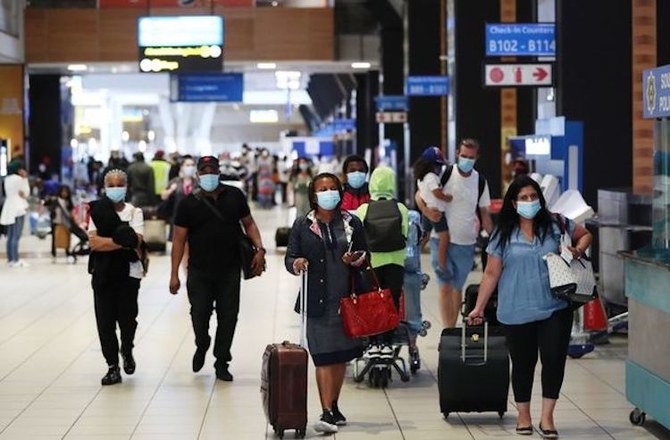
Passengers wearing protective masks walk to the check-in counters at O.R. Tambo International Airport in Johannesburg, South Africa, December 22, 2020. (Reuters)
Short Url
Updated 02 March 2021
Follow

Coronavirus variants could be dealt with via single jab: UK scientist

  • Prof. Andrew Pollard said his team is working on an inoculation that will act as a catch-all for a number of emergent variants
  • Prof. Andrew Pollard: The work at the moment is partly to understand whether a vaccine for one of them, Brazilian and South African variants, might actually protect against both

LONDON: A single booster jab may be enough in future to protect people from the Brazilian and South African variants of coronavirus, a leading British scientist has suggested.

Prof. Andrew Pollard, head of the Oxford University group that developed a vaccine in partnership with AstraZeneca, said his team is working on an inoculation that will act as a catch-all for a number of emergent variants, rather than on a case-by-case basis, by targeting similarities in their mutations.

Three main variants — the UK, South African and Brazilian ones — have been identified in recent months, all known to carry the N501Y mutation, which affects transmissibility.

The latter two are known to have a further mutation known as E484K, which makes the virus more resistant to antibodies. 

These mutations have raised fears that current vaccines might prove inefficient against new variants.

But Pollard said the world needs to move on from its “obsession” with variants as they emerge, and with the right amount of research, a new booster could be available by the autumn. 

“There’s some similarities between the Brazil variant and the South African variant, and so the work at the moment is partly to understand whether a vaccine for one of them might actually protect against both,” he told The Times. “New designs of vaccines can be made as and when they’re needed.”

Pollard said both the Oxford and Pfizer vaccines had produced “stunning” results so far, reducing the risk of hospitalization by as much as 80 percent with just a single jab.


China protests over Philippine coast guard’s Xi images

Updated 4 sec ago
Follow

China protests over Philippine coast guard’s Xi images

MANILA: The Chinese Embassy in Manila said Friday it has filed a diplomatic protest against a Philippine Coast Guard spokesman over a social media post that included cartoonish images of President Xi Jinping.
Coast Guard spokesman Jay Tarriela and an embassy official had been trading barbs since last week over issues concerning the disputed South China Sea.
The crucial waterway, which Beijing claims historic rights to despite an international ruling that its assertion has no legal basis, has been the site of repeated clashes between Chinese and Philippine vessels.
Tarriela’s Facebook post on Wednesday included a photo of him giving a speech, with a background featuring a compilation of comical images of Xi under the banner “Why China remains to be bully?“
On Friday, the embassy slammed the post for “attacking and smearing Chinese leaders” in a statement it released.
The move “constitutes a serious violation of China’s political dignity,” the embassy said adding that it is a “blatant political provocation, which has crossed the red line.”
The embassy expressed “strong indignation” to the presidential palace, foreign affairs department and coast guard demanding an explanation for Tarriela’s “malicious provocations.”
In response, Tarriela Friday branded the protest “an attempt to deflect from the core issue: China’s repeated aggressive and illegal actions in the West Philippine Sea,” using the Filipino term for the waters immediately west of the country.
“If the Chinese Embassy objects to images or expressions that highlight these violations — often through legitimate public discourse or even satire — it only underscores discomfort with the truth being exposed,” Tarriela said, calling the response an “effort to intimidate.”
Manila’s presidential palace and Department of Foreign Affairs have yet to answer AFP’s request for comment.