NEW YORK: A high-level donor conference on Monday to raise money for Yemen had barely finished before UN Secretary-General Antonio Guterres took to Twitter to describe the outcome as “disappointing.”
A total of $1.7 billion was pledged, less than half the $3.85 billion the UN said it needs for the humanitarian response in Yemen.
It even even falls short of the amount experts said is required simply to avoid a famine this year in the war-ravaged country. World Food Program chief David Beasley said $1.9 billion is needed to ensure 13 million vulnerable Yemenis are fed.
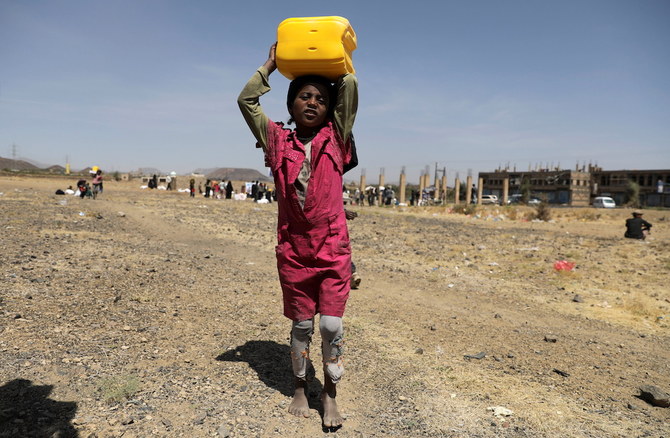
The UN Office for the Coordination of Humanitarian Affairs has warned that more than 16 million people in Yemen will go hungry this year, with half a million already living in famine-like conditions.
Monday’s donor conference was co-hosted by Switzerland and Sweden. It was the fifth such event for Yemen since the conflict began in 2015. The outcome was disheartening given that delegates had listened to gruesome stories of life amid war and hunger in a country where many people are forced to use “the floor as mattress, and the sky as blanket.”
“The people of Yemen have exhausted their coping mechanisms,” said one representative of civil society who helped to brief the conference.
Perhaps the most poignant moment came when Jan Egeland, secretary general of the Norwegian Refugee Council, addressed the conference from Yemen via video link.
Grasping for words, he repeated many times how “heartbroken” he is about the plight of the Yemeni people. He highlighted young people in particular, saying: “Because we haven’t been able to feed them properly for a year, children are now dying.”
He also described the “subhuman” existence of millions of Yemenis who desperately search for food each day in dumpsters in Sanaa even though “there isn’t food left in the garbage anymore.”
After the conference ended, Egeland said: “The shortfall in humanitarian aid will be measured in lives lost.”
David Gressly, the UN’s humanitarian coordinator for Yemen, had also called on donors to be generous and help restore the faith of the Yemeni people that the world is not just standing by and watching them suffer.
“If you’re not feeding the people, you’re feeding the war,” he said.
After the conference Guterres said: “Cutting aid is a death sentence. The best that can be said about today is that it represents a down payment.”
Thanking those nations that “did pledge generously,” he called on others to reconsider what they can do to help stave off the “worst famine seen in decades.” Saudi Arabia announced it will donate $430 million in aid for Yemen this year, by far the largest amount pledged by any one country. It will be channeled through the UN and international organizations, as well as local and regional nongovernmental organizations.
“Saudi Arabia has played a pioneering role in its commitment to the noble people of Yemen,” said Abdullah Al-Rabeeah, head of the King Salman Humanitarian Aid and Relief Center (KSRelief). “And we have been providing assistance to communities in need without any discrimination.”
Speakers at the conference condemned the recent escalation of violence by the Houthis, who were described by Yemeni Prime Minister Maeen Abdulmalik Saeed as “a militia consummate at killing and torture.”
The terror group was urged to end its offensive in Marib — where the fighting has displaced about 11,000 Yemenis in just three weeks — and halt the increasing cross-border attacks on targets in Saudi Arabia.
“Money is not the only thing Yemenis need,” said David Miliband, president and CEO of the International Rescue Committee. “They need an end to attacks on civilians; they need a ceasefire; they need an end to bureaucratic and political blockages on aid flows.”
The UAE pledged $230 million in aid. Reem Al-Hashimy, the Emirati minister of state for international cooperation, told the conference that had the terms of the December 2018 Stockholm Agreement been respected “we would not be here today.”
Condemning the targeting of civilians in Saudi Arabia and recent attacks in Southern Yemen, which she said indicate the Houthis’ “lack of desire for a peaceful solution.”
The UAE has provided $6 billion in humanitarian aid to Yemen since 2015, in addition to 122,000 tons of medical supplies.
Kuwaiti Foreign Minister Sheikh Ahmed Nasser Al-Mohammed Al-Sabah, whose country is donating $20 million to Yemen over two years, thanked Saudi Arabia for hosting a similar conference last year, and announced that Gulf Cooperation Council countries are preparing an international reconstruction conference for Yemen to restore the nation’s economy “after Yemeni parties agree on the desired solution.”
US Secretary of State Antony Blinken said Washington will donate $191 million to Yemen this year, a decrease of about $35 million from the amount pledged during last year’s conference.
He called for a ceasefire in the country, and for warring factions to stop interfering in humanitarian aid operations and “allow assistance to reach the innocent women, children, and men.”
He added: “We can only end the humanitarian crisis in Yemen by ending the war in Yemen. And so the United States is reinvigorating our diplomatic efforts to end the war.”
Blinken said Saudi Arabia and the government of Yemen are “committed and eager” in their efforts to find a way to end the war in Yemen and urged the Houthis to do the same.
“We call on the Houthis to match this commitment,”he added. “A necessary first step is to stop their offensive against Marib.”
Other major pledges came from Germany ($241 million), the UK ($123 million) and the European Union ($116 million).


![]()

UN chief laments ‘disappointing’ $1.7bn of aid pledges for Yemen
Short Url
https://arab.news/6quw5
UN chief laments ‘disappointing’ $1.7bn of aid pledges for Yemen
- Total is less than half the $3.85bn experts say is needed to avoid a humanitarian disaster
- Saudi Arabia tops the list at donor conference with promise of $430 million in aid


Latest updates


© 2026 SAUDI RESEARCH & PUBLISHING COMPANY, All Rights Reserved And subject to Terms of Use Agreement.