Saudi PIF’s developer to hand over Riyadh homes in 2022

1 / 2
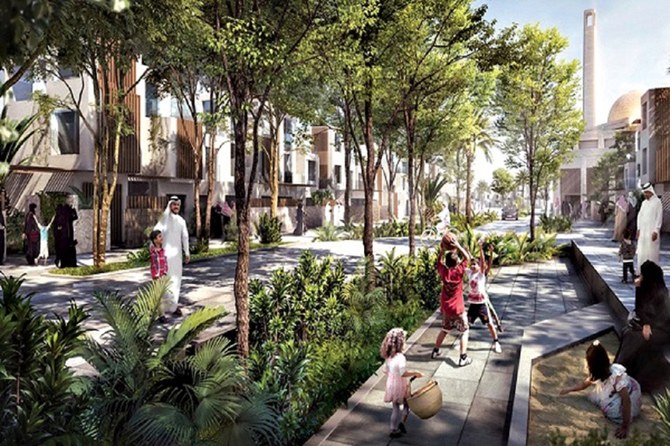
The Kingdom’s state-owned Public Investment Fund (PIF) launched Roshn as a real estate company last year. (Supplied)
2 / 2
“In due course, we will be providing detailed information on how citizens can apply for a home, in addition to all available financing options,” Roshn’s Group CEO David Grover told Arab News.
Short Url
Updated 28 February 2021
Follow

Saudi PIF’s developer to hand over Riyadh homes in 2022

  • The Kingdom’s state-owned Public Investment Fund (PIF) launched Roshn as a real estate company last year
  • Roshn announced the signing of $930 million worth of construction contracts earlier this year

RIYADH: Roshn, Saudi Arabia’s national community developer, is planning to start off-plan sales at its flagship project in Riyadh later this year, with the handover of the first homes to tenants likely in early 2022, a senior executive said.

The Kingdom’s state-owned Public Investment Fund (PIF) launched Roshn as a real estate company last year. 

The developer’s master project in the Saudi capital will extend over an area of more than 20 million square meters and will include more than 30,000 homes. The project’s first phase involves 4,000 homes that will become available for sale by the middle of this year.

“In due course, we will be providing detailed information on how citizens can apply for a home, in addition to all available financing options,” Roshn’s Group CEO David Grover told Arab News.

“Our communities are entirely inclusive, with homes to suit all tastes and budgets. Our aim is to provide a modern, aspirational living experience while giving residents the freedom to interpret what this means to them in their own unique way. Our communities have been designed to inspire a strong sense of neighborly spirit and genuine connection between residents.”

Roshn announced the signing of $930 million worth of construction contracts earlier this year. Grover said the developer partnered with Rezaik Abdallah Al-Gedrawy & Co. as the main contractor for the first phase of the flagship development and have also awarded contracts to Posco E&C, AWJ International and Zuheir Ahmad Al Zahran and Company.

In relation to the timeline for their existing projects, Grover said: “Roshn’s customer experience center is expected to be ready in Q1 2021, while the handover process of homes will start in early 2022. Construction is planned to be completed by Q4 2023.”

With facilities such as mosques, schools, cafes, restaurants, healthcare, leisure and entertainment options, the community aims to cater to the needs of future residents and act as a self-contained “city within a city,” he added.

Roshn was launched in August 2020 by the PIF to deliver high-quality residential neighborhoods to Saudi nationals. The company is committed to supporting the Kingdom’s Vision 2030 goal of increasing the rate of homeownership in the country to 70 percent.

“Saudi Arabia is home to a number of world-class developers, and we are consistently looking to collaborate and partner with highly ambitious local firms to deliver on our mandate,” he said.

Despite the coronavirus (COVID-19) pandemic, Grover said Roshn has hit more than 90 percent of its 2020 business targets.

“Roshn will work closely with the mortgage industry to help meet the needs of each individual buyer’s personal circumstances and financial situation,” the CEO said of his immediate priorities for 2021.


Saudi Arabia, Japan trade rises 38% between 2016 and 2024, minister says

Updated 11 January 2026
Follow

Saudi Arabia, Japan trade rises 38% between 2016 and 2024, minister says

RIYADH: Trade between Saudi Arabia and Japan has increased by 38 percent between 2016 and 2024 to reach SR138 billion ($36 billion), the Kingdom’s investment minister revealed.

Speaking at the Saudi-Japanese Ministerial Investment Forum 2026, Khalid Al-Falih explained that this makes the Asian country the Kingdom’s third-largest trading partner, according to Asharq Bloomberg.

This falls in line with the fact that Saudi Arabia has been a very important country for Japan from the viewpoint of its energy security, having been a stable supplier of crude oil for many years.

It also aligns well with how Japan is fully committed to supporting Vision 2030 by sharing its knowledge and advanced technologies.

“This trade is dominated by the Kingdom's exports of energy products, specifically oil, gas, and their derivatives. We certainly look forward to the Saudi private sector increasing trade with Japan, particularly in high-tech Japanese products,” Al-Falih said.

He added: “As for investment, Japanese investment in the Kingdom is good and strong, but we look forward to raising the level of Japanese investments in the Kingdom. Today, the Kingdom offers promising opportunities for Japanese companies in several fields, including the traditional sector that links the two economies: energy.”

The minister went on to note that additional sectors that both countries can also collaborate in include green and blue hydrogen, investments in advanced industries, health, food security, innovation, entrepreneurship, among others.

During his speech, Al-Falih shed light on how the Kingdom’s pavilion at Expo 2025 in Osaka achieved remarkable success, with the exhibition receiving more than 3 million visitors, reflecting the Japanese public’s interest in Saudi Arabia.

“The pavilion also organized approximately 700 new business events, several each day, including 88 major investment events led by the Ministry of Investment. Today, as we prepare for the upcoming Expo 2030, we look forward to building upon Japan’s achievements,” he said.

The minister added: “During our visit to Japan, we agreed to establish a partnership to transfer the remarkable Japanese experience from Expo Osaka 2025 to Expo Riyadh 2030. I am certain that the Japanese pavilion at Expo Riyadh will rival the Saudi pavilion at Expo Osaka in terms of organization, innovation, and visitor turnout.”

Al-Falih also shed light on how Saudi-Japanese relations celebrated their 70th anniversary last year, and today marks the 71st year of these relations as well as how they have flourished over the decades, moving from one strategic level to an even higher one.