Philippines to receive first COVID-19 vaccines, start inoculations next week

The vaccination program will be crucial for Philippine efforts to revive its economy. (Reuters)
Short Url
Updated 25 February 2021
Follow

Philippines to receive first COVID-19 vaccines, start inoculations next week

  • The Philippines will be the last Southeast Asian country to receive its initial set of vaccines
  • Vaccination program will be crucial for Philippine efforts to revive its economy

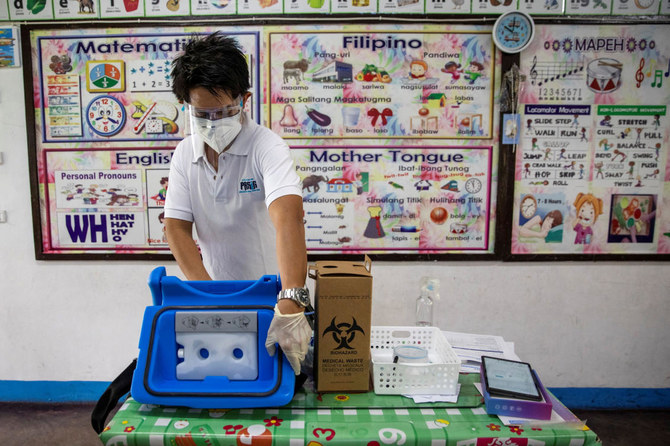
MANILA: The Philippines will take delivery of its first COVID-19 vaccines at the weekend, allowing it to kick off its inoculation program from next week, a senior official said on Thursday.
Despite having among the highest number of coronavirus cases and deaths in Asia, the Philippines will be the last Southeast Asian country to receive its initial set of vaccines.
The delivery of 600,000 doses Sinovac Biotech’s vaccines, donated by China, will arrive on Sunday, said Harry Roque, spokesman for President Rodrigo Duterte.
“It rolls out on Monday because our countrymen are excited,” he said of the vaccination program.
Among the first to be inoculated will be an official from a hospital who lost both parents to the coronavirus, plus a tricycle driver, Roque said.
The Philippines has ordered 25 million doses from Sinovac and was supposed to receive its first batch on Feb. 23. That was delayed emergency use authorization was only given this week.
Aside from Sinovac, 10,000 doses of a vaccine developed by China’s Sinopharm will arrive soon, under a “compassionate use” for Duterte’s security detail. Doses from AstraZeneca will arrive in March, Roque said.
“I have to admit, if we insisted on Western brands, we will still wait for its arrival,” he added.
Duterte, who has pursued warmer ties with China and has a strained relationship with many Western countries, has previously said he wanted to procure COVID-19 vaccines from China or Russia.
The vaccination program will be crucial for Philippine efforts to revive its economy, which suffered a record 9.5 percent slump last year due to strict and lengthy lockdowns that hit consumer spending and saw big job losses.


Columbia student detained by ICE is abruptly released after Mamdani meets with Trump

Updated 3 sec ago
Follow

Columbia student detained by ICE is abruptly released after Mamdani meets with Trump

NEW YORK: Federal immigration authorities arrested a Columbia University student early Thursday, triggering protests on campus along with allegations that agents had entered the university-owned residence under false pretenses.
Just hours after detaining student Ellie Aghayeva, though, the federal government abruptly reversed course, permitting her to walk free after an apparent intervention by President Donald Trump.
In a social media post Thursday afternoon, Mayor Zohran Mamdani said he expressed concerns about the arrest during an unrelated meeting with Trump, who then agreed to release her immediately.
“I am safe and okay,” Aghayeva wrote on Instagram, minutes after Mamdani’s post, adding she was in “complete shock” from the experience.
The head-spinning series of events marked the latest development to emerge from the Republican president’s unlikely relationship with a democratic socialist mayor he once threatened to have deported.
On Thursday, while pitching Trump on a massive housing project, Mamdani also called on the president to drop cases against several other current and former students facing deportation for their roles in protests against Israel.
Aghayeva, a senior from Azerbaijan studying neuroscience and politics, hasn’t been publicly linked to any of the pro-Palestinian demonstrations that roiled Columbia’s campus. A self-described content creator, she has amassed a large social media following by sharing day-in-the-life videos and tips for navigating college as an immigrant.
Early Thursday, federal agents gained entry to her apartment by claiming they were searching for a missing person, according to a petition from her lawyers and a statement released by Columbia. She quickly dashed off a message to her more than 100,000 followers on Instagram: “DHS illegally arrested me. Please help.” A photo accompanying the post appeared to show her legs in the backseat of a vehicle.
A Department of Homeland Security spokesperson said Aghayeva’s student visa had been terminated in 2016 for failing to attend classes. Inquiries to Columbia about her visa status and how long she had been enrolled in the university were not returned.
In their petition, attorneys for Aghayeva said she had entered the country on a visa in or around 2016. They declined to provide additional comment, including details about her immigration status.
A spokesperson for DHS, Tricia McLaughlin, denied allegations levied by some state officials that agents had gained entry to her apartment by posing as New York City police officers. She didn’t respond to questions about whether they had claimed to be seeking a missing person.
The use of disguises or other misrepresentations by immigration authorities has drawn attention in recent months, after federal agents were seen posing as utility workers and other service employees in Minneapolis and elsewhere.
The practice is legal, in most cases. But immigration attorneys say such ruses are becoming increasingly common, adding to concerns about the Trump administration’s dramatic reshaping of immigration enforcement tactics nationwide.
In recent weeks, Trump has once again intensified his attacks on several universities, including Harvard and UCLA. The arrest would seem to mark the first federal enforcement action against at Columbia since the university agreed to pay more than $220 million to the administration over the summer.
“It’s a horrifying sign that the roving eye of the administration is turning back to Columbia,” said Michael Thaddeus, a mathematics professor at Columbia and vice president of the university’s chapter of the American Association of University Professors, which has sued Trump. “The idea that secret police would abduct and imprison students in our midst is something we’d expect from an authoritarian regime.”
Many students and faculty called on Columbia to increase protections for international students following the arrest last March of Mahmoud Khalil, a former graduate student and pro-Palestinian activist, whose deportation case remains ongoing.
In an email to the Columbia community Thursday, acting president Claire Shipman said that residential staff had been reminded not to allow federal law enforcement into university buildings without a subpoena or warrant.
“If you encounter or observe DHS/ICE agents conducting enforcement activities on or near campus, immediately contact Public Safety,” Shipman wrote. “Do not allow them to enter non-public areas or accept service of a warrant or subpoena.”