

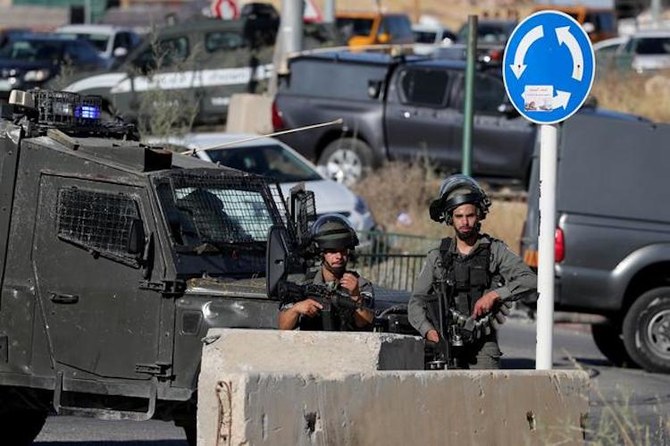

LONDON: An investigation into the shooting of a Palestinian man whose car hit a checkpoint has uncovered major discrepancies with Israel’s version of events.
On June 23, 2020, Ahmad Erekat was shot and killed by Israeli authorities after his car hit a checkpoint between Jerusalem and Bethlehem.
Border police officers opened fire seconds after the collision. Israeli authorities claimed that Erekat had conducted an intentional ramming attack.
But new findings published by Forensic Architecture — a London-based investigative group that specializes in human rights violations — reveal that he was shot while posing no threat to life or property, and was not given any first aid treatment following the shooting, even though there were signs of life.
It also found, contrary to Israel’s claims, that Erekat did not accelerate toward the police officers at the checkpoint, but instead that evidence showed signs of braking before impact.
Also contrary to Israeli military claims, Forensic Architecture discovered that Erekat did not approach the police officers at the checkpoint.
After the incident, just a single CCTV capture was released by the authorities. In its investigation, Forensic Architecture managed to source several alternative pieces of footage to paint a broader picture of the event.
It found that the car maintained a constant speed of 15 km per hour before the impact, and that Erekat was shot while walking away from the checkpoint with his hands in the air.
This contradicts the military’s claim that his behavior after exiting the vehicle gave border police good reason to fire.
“There was an urgency for us to report on this because the Israeli authorities didn’t open a formal investigation,” Forensic Architecture’s lead Israel / Palestine researcher, who requested anonymity, told Arab News.
“With a dozen cameras at the site, they only released one clip, a handheld mobile phone recording of one piece of CCTV footage, which was grainy and unclear. They didn’t release an autopsy report. They didn’t examine the vehicle’s black box. There are questions that could be answered with an investigation, so we conducted one,” the researcher said.
“With our investigation, we’ve raised enough doubts in the army’s official claim. Contrary to what they claim, Erekat left the car appearing to raise his arms, standing 4 meters from the nearest soldier. He was shot six times in two seconds, and his body position remained unchanged for at least 45 minutes when the Israeli ambulance arrived and left, which means any serious medical treatment couldn’t have been provided. There are a dozen security cameras at this checkpoint. If the army provided medical care, they should release footage of this.”
The researcher called for “accountability from the army to acknowledge that there are major holes in their claims. There are enough questions now to warrant an investigation.”
Erekat’s body remains in Israeli custody. “We hope they’ll return his body to his family for a proper burial,” said the researcher.
“Erekat isn’t alone. There are 70 other bodies being held by Israeli authorities after killings. They’re kept as potential bargaining chips or as tools of collective punishment, exaggerating the pain that families feel after killings.”


