Pakistan Arts Council plans artistic collaborations with Saudi Arabia

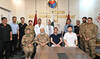
President of the Arts Council of Pakistan, Ahmed Shah, talks to Arab News in Karachi on Thursday, February 18, 2021. (AN Photo)
Short Url
Updated 20 February 2021
Follow

Pakistan Arts Council plans artistic collaborations with Saudi Arabia

  • Arts council president hopes to institutionalize an exchange program of artists between the two countries
  • Says the kingdom is opening up under dynamic leadership of the Saudi crown prince

KARACHI: The Arts Council of Pakistan, a globally recognized non-profit organization striving to promote the cultural life and activities of the South Asian country, said it wanted to collaborate with likeminded groups and associations in Saudi Arabia on Thursday. 

The council has become an internationally recognized body in recent years since collaborations with countries like the United States, Germany, Portugal, China and Japan. 

“Under the leadership of the crown prince, the kingdom understands the future — whether it’s the future of the region or the future of the world," I think he has the vision to make his country very prosperous and progressive,” the council’s president, Ahmed Shah, told Arab News and added he would love to invite Saudi painters, musicians, dancers and artists to show their skills to a Pakistani audience. 

During his 12 years with the council, Shah has turned it into a leading hub of arts, culture and literature.

He established training academies under the auspices of the organization to promote music, dance and theater. These training facilities also provide free education to more than a thousand underprivileged students annually.

Shah said his next aim was to collaborate with Saudi Arabia which is setting up galleries, working on music and undertaking entertainment megaprojects by building places like Qiddiya.

“And I want to take Pakistani artists to Saudi Arabia," he said. "I'm writing to Saudi officials responsible for arts and culture to request them to bring their artists to Pakistan. I think we can further come closer together through people-to-people contact since it will allow both sides to understand each other better,” he said.

“I was very happy to know that the Kingdom is opening up under the able and dynamic leadership of Crown Prince Mohamed bin Salman and encouraging the promotion of arts and culture,” he continued.

Last year, popular Pakistani drama Dhoop Kinare was dubbed in Arabic and screened in the kingdom. Its television production was written by Haseena Moin who is also associated with the council as vice president. 

“I want that more Pakistani dramas and films are dubbed in Arabic and sent to Saudi Arabia,” Shah said.


Pakistan remembers Benazir Bhutto, first woman PM in Muslim world, on death anniversary

Updated 5 sec ago
Follow

Pakistan remembers Benazir Bhutto, first woman PM in Muslim world, on death anniversary

  • Bhutto was daughter of ex-PM Zulfikar Ali Bhutto who was hanged during reign of former military ruler Gen. Zia-ul-Haq
  • Year before assassination in 2007, Bhutto signed landmark deal with rival Nawaz Sharif to prevent army interventions

ISLAMABAD: Prime Minister Shehbaz Sharif and other Pakistani leaders on Saturday paid tribute to Benazir Bhutto, the first woman prime minister in the Muslim world who was assassinated 18 years ago in a gun and bomb attack after a rally in the city of Rawalpindi.

Born on Jun. 21, 1953, Bhutto was elected premier for the first time in 1988 at the age of 35. She was deposed in 1990, re-elected in 1993, and ousted again in 1996, amid allegations of corruption and mismanagement which she denied as being politically motivated.

Bhutto only entered politics after her father was hanged in 1979 during military ruler Gen. Zia-ul-Haq’s reign. Throughout her political career, she had a complex and often adversarial relationship with the now ruling Sharif family, but despite the differences signed a ‘Charter of Democracy’ in 2006 with three-time former PM Nawaz Sharif, pledging to strengthen democratic institutions and prevent military interventions in Pakistan in the future.

She was assassinated a year and a half later.

“Mohtarma Benazir Bhutto took exemplary steps to strengthen the role of women, protect the rights of minorities, and make Pakistan a peaceful, progressive, and democratic state,” PM Shehbaz Sharif, younger brother of ex-PM Nawaz Sharif, said in a statement on Saturday.

“Her sacrifices and services are a beacon of light for the nation.”

President Asif Ali Zardari, Bhutto’s widower, said Bhutto believed in an inclusive Pakistan, rejected sectarianism, bigotry and intolerance, and consistently spoke for the protection of minorities.

“Her vision was of a federation where citizens of all faiths could live with dignity and equal rights,” he said. “For the youth of Pakistan, her life offers a clear lesson: speak up for justice, organize peacefully and do not surrender hope in the face of adversity.”

Powerful families like the Bhuttos and the Sharifs of Pakistan to the Gandhis of India and the Bandaranaike family of Sri Lanka have long dominated politics in this diverse region since independence from British colonial rule. But none have escaped tragedy at the hands of rebels, militants or ambitious military leaders.

It was Zulfikar Ali Bhutto, Bhutto’s father, who founded the troubled Bhutto dynasty, becoming the country’s first popularly elected prime minister before being toppled by the army in 1977 and later hanged. Both his sons died in mysterious circumstances.

Before her assassination on Dec. 27, 2007, Bhutto survived another suicide attack on her motorcade that killed nearly 150 people as she returned to Pakistan after eight years in exile in October 2007.

Bhutto’s Oxford-educated son, Bilawal Bhutto-Zardari, now leads her Pakistan Peoples Party, founded by her father, and was foreign minister in the last administration of PM Shehbaz Sharif.

Aseefa Bhutto Zardari, Bhutto’s daughter who is currently the first lady of Pakistan, said her mother lived with courage and led with compassion in life.

“Her strength lives on in every voice that refuses injustice,” she said on X.

Pakistan has been ruled by military regimes for almost half its history since independence from Britain in 1947. Both former premiers Imran Khan and the elder Sharif, Nawaz, have alleged that they were ousted by the military after they fell out with the generals. The army says it does not interfere in politics.