Watchdog slams Iran’s suppression of journalists

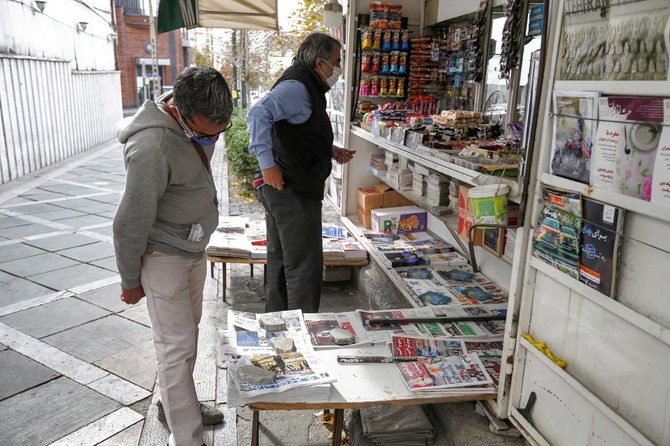
Rights groups and international bodies have repeatedly spoken out against the Iranian regime’s dismal treatment of journalists. (AFP)
Short Url
Updated 19 February 2021
Follow

Watchdog slams Iran’s suppression of journalists

  • Latest condemnation follows jail term for theater photographer
  • CPJ: ‘Iran has created a revolving cell door policy with regards to imprisoning journalists’

LONDON: The Committee to Protect Journalists (CPJ) has condemned the Iranian regime’s use of “baseless charges” to suppress journalists in the country following the arrest and sentencing of a theater and cinema photographer.

“Instead of trying to rehabilitate its international image, Iran has instead created a revolving cell door policy with regards to imprisoning journalists,” said Justin Shilad, senior Middle East and North Africa researcher at the CPJ.

The latest condemnation follows the arrest of cultural reporter and theater photographer Nooshin Jafari.

She was sentenced to a total of four years in prison for “spreading anti-establishment propaganda” and “insulting sanctities,” in a case that remained in appeal until Feb. 13.

The CPJ reported that her appeals had been rejected by the Iranian judiciary, and that she has now been taken to Qarchak prison — notorious for being a hive of extrajudicial killings, torture and human rights abuses.

“Iranian authorities must free Nooshin Jafari immediately and stop imprisoning the country’s journalists on baseless charges,” Shilad said.

The CPJ derided her arrest in 2019 as “outrageous.” It also drew widespread condemnation from rights groups and Iranians inside the country — including from celebrities.

Other rights groups and international bodies have repeatedly spoken out against the regime’s dismal treatment of journalists, with female reporters finding themselves at the sharp end of Tehran’s repression.

Last year, a group of UN human rights experts said: “Reports also indicate a pattern of gender-based harassment, targeting women journalists since 2009.”

That harassment, they said, involves “the dissemination of false stories, spreading of rumours and slander, usually with highly misogynistic contents and threats of sexual violence.”


Aid agencies in South Sudan decry restricted access as government and opposition troops fight

Updated 6 sec ago
Follow

Aid agencies in South Sudan decry restricted access as government and opposition troops fight

  • The World Food Program, a Rome-based UN agency, has warned that escalating violence threatens to cut off food assistance to hundreds of thousands of people

JUBA, South Sudan: Humanitarian organizations in South Sudan said Monday that restricted access to the conflict-hit eastern state of Jonglei has left thousands of people in need of lifesaving medical care and food assistance at risk, as the United Nations raises concern over a growing number of displaced people.
The International Rescue Committee’s country director for South Sudan, Richard Orengo, said that “intensified fighting and the militarization of key areas have forced the suspension of services.”
Medical organization Doctors Without Borders, also known by its French name Médecins Sans Frontières, or MSF, said that the government has suspended all humanitarian flights, cutting off medical supplies, staff movement and emergency evacuations. At least 23 critically ill patients, including children and pregnant women, urgently require evacuation, MSF said.
The World Food Program, a Rome-based UN agency, has warned that escalating violence threatens to cut off food assistance to hundreds of thousands of people, as nearly 60 percent of Jonglei’s population is expected to face crisis-level hunger during the upcoming rainy season. The rains typically cut off access roads, and the violence has prevented the early delivery of aid.
Civilians are bearing the brunt of the escalating fighting in South Sudan’s Jonglei State, which is pushing one of the country’s most fragile regions toward collapse and raising fears of a slide back into full-scale war after an eight-year peace deal, the United Nations and aid groups said.
Homes have been destroyed, civilians killed in the crossfire, and families repeatedly forced to flee as fighting between government forces and opposition fighters loyal to the Sudan People’s Liberation Army–In Opposition, or SPLA-IO, spreads.
Forces loyal to opposition leader Riek Machar, alongside allied “White Army” fighters, have recently made gains against government troops.
The UN and human rights groups have also expressed alarm over inflammatory rhetoric by a senior army commander, who urged troops advancing in Jonglei to “spare no lives.”
The UN Commission on Human Rights in South Sudan expressed “grave alarm” at developments that it said “significantly heighten the risk of mass violence against civilians.”
The opposition said that the commander’s words were an “early indicator of genocidal intent.”
Speaking to The Associated Press, government spokesman Ateny Wek Ateny called the comments “uncalled for” and “a slip of the tongue.”
UN Secretary-General António Guterres has called on all parties to halt the fighting, protect civilians and ensure safe humanitarian access, saying that South Sudan’s crisis requires a political, not military, solution.
The renewed clashes have displaced more than 230,000 people since December, according to the UN Office for the Coordination of Humanitarian Affairs, or OCHA.
The renewed conflict has placed South Sudan’s fragile 2018 peace agreement under severe strain and intensified political tensions before the country’s first general election scheduled for December.