India police: 3 police, 3 rebels killed in Kashmir fighting

1 / 2
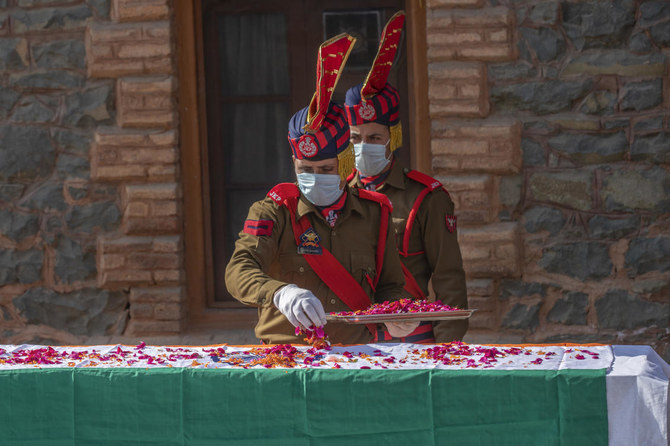
A policeman showers flower petals on the coffin of a colleague during a wreath laying ceremony in Srinagar, Indian controlled Kashmir, Friday, Feb. 19, 2021. (AP Photo)
2 / 2
Police arrive near the site of a shootout in Srinagar on Feb. 19, 2021 after unidentified gunmen killed two police personnel. (AFP)
Short Url
Updated 19 February 2021
Follow

India police: 3 police, 3 rebels killed in Kashmir fighting

  • The violence came a day after diplomats from more than 20 countries stationed in India’s capital concluded a two-day visit to the region
  • Many Muslim Kashmiris support the rebel goal that the territory be united either under Pakistani rule or as an independent country

SRINAGAR, India: Anti-India rebels in Indian-controlled Kashmir killed two police officers in an attack Friday in the disputed region’s main city, officials said. Elsewhere in the Himalayan region, three suspected rebels and a policeman were killed in two gunbattles.
The violence came a day after diplomats from more than 20 countries stationed in India’s capital concluded a two-day visit to the region.
Police said militants sprayed bullets at two policemen near a police station in Srinagar city. Both died later at a hospital.
A short video of the attack circulated on social media shows a man in a pheran, a Kashmiri tunic worn during the winter, taking out what appears to be an automatic rifle and shooting at the policemen. He then quickly runs away.
Police and soldiers searched the area and later detained a young man for questioning.
No rebel group immediately claimed responsibility for the attack.
In a separate incident, a gunfight erupted shortly after scores of counterinsurgency police and soldiers launched an operation late Thursday in a village in southern Shopian district following a tip that three militants were there, Inspector-General Vijay Kumar said.
All three were killed in an exchange of gunfire early Friday, Kumar said. He said police recovered two rifles and a pistol.
Residents said government forces used explosives to blast a civilian house during the fighting, a common tactic by Indian troops in Kashmir.
In another gunbattle, militants killed a policeman and injured another in western Beerwah area early Friday, Kumar said.
Both India and Pakistan claim the divided territory of Kashmir in its entirety. Many Muslim Kashmiris support the rebel goal that the territory be united either under Pakistani rule or as an independent country.
New Delhi describes the Kashmir militancy as Pakistan-sponsored terrorism. Pakistan denies the charge, and most Kashmiris consider it a legitimate freedom struggle.
Tens of thousands of civilians, rebels and government forces have been killed in the conflict.


Palestinian family living in Gaza tent denied evacuation to UK despite appeal by academic father

Updated 4 sec ago
Follow

Palestinian family living in Gaza tent denied evacuation to UK despite appeal by academic father

  • Bassem Abudagga, studying for a PhD in York, was told his wife and children’s case not ‘compelling’ enough
  • Family must give biometric data for their visas despite no facilities providing the service in Gaza

LONDON: The UK Home Office has told a Palestinian academic studying in Britain that his wife and children would not be brought to the UK from Gaza as their case is not “sufficiently compelling” for evacuation.

In a letter, the department told Bassem Abudagga his family would need to attend a visa application center in Gaza to provide biometric data before traveling, despite there being no such facility in the enclave.

Abudagga, studying on a scholarship for a doctorate at York St John University, has not seen his family since September 2023, three weeks before the Hamas-led attack on Israel that sparked a regional war. His wife Marim, son Karim, aged 6, and daughter Talya, 10, are living in a tent after their house was destroyed.

On receiving the Home Office letter, Abudagga told The Guardian: “I felt my final hope of being reunited with my wife and children after more than three years had been lost. It was very, very hard.”

He added that his wife “kept saying to me when I called, ‘It seems we will never meet again. Don’t make any more efforts to bring us to the UK because it seems the UK will never get us there. Just keep concentrating on your studies.’”

The letter added that Abudagga’s family’s situation had also been measured against “the interests of national and border security.”

Abudagga said: “When I read that they link bringing my family to the UK with UK security, and suggest the children are better off in Gaza, I simply could not believe in British values and norms anymore. I expected the British government cared about family life, about human rights.”

He had asked the Home Office to give a decision in principle on whether his family’s visa applications would be accepted before requiring his wife to give biometric data. This would have allowed the family to appeal to be evacuated to a third country with a VAC in order to speed up their application. The request was denied.

The Home Office said it was “not satisfied that (the family’s) circumstances are sufficiently compelling for (us) to be able to deviate from our normal policy that requires your clients to attend a VAC prior to consideration of their applications.”

It added that, as Abudagga claimed he eventually wished to return to Gaza, his UK stay was only temporary.

“Consequently it is appropriate for your minor clients to remain with their primary carer, their mother, until circumstances change,” the Home Office said.

The letter said that “circumstances in Gaza are difficult and that due to displacement it may be more difficult to access certain necessities,” but continued that the department was “not satisfied” there was enough evidence to prove the family needed to be evacuated before “it is safe to visit a VAC.”

While trapped in Gaza, Marim has also had to contend with the death of her father two weeks ago.

“My wife is trying to do the daily duties of bringing food, securing the tent from the weather — it is very cold, very windy, very rainy — when her father passed away two weeks ago,” Abudagga said. “The details are very, very hard.”

Another student in the UK was recently permitted to bring her family from Gaza after they were approved to perform biometric checks in Jordan.

“This lady was allowed to get her fingerprints done in Jordan and the Home Office later allowed her family to join. The case is the same as mine,” Abudagga told The Guardian.

Rebecca Long-Bailey, Abudagga’s local MP, wrote to Shabana Mahmood, the home secretary, to ask the Home Office to reconsider the case, but the decision was upheld. Abudagga has since begun the process of legally challenging it.

Sarah Crowe, a lawyer at law firm Leigh Day representing the family, told The Guardian: “We will be writing to the Home Office to set out why their decision-making in this case is plainly unlawful. In line with the Home Office’s own policy, Bassem’s family should have their applications predetermined, which is an important step in reuniting the family.”