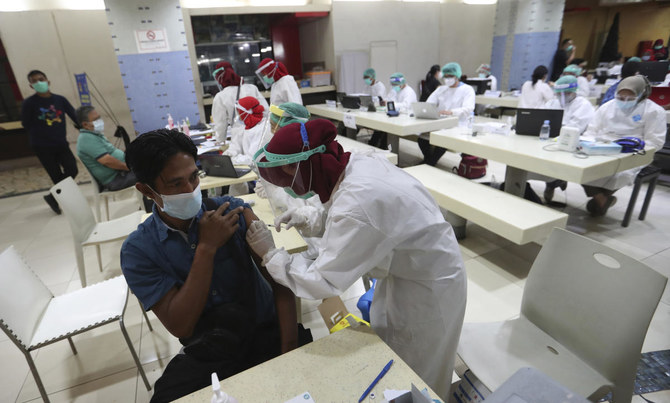
JAKARTA: Indonesia’s capital Jakarta is threatening residents with fines of up to $356.89 (5 million rupiah) for refusing COVID-19 vaccines, an unusually stiff penalty aimed at ensuring compliance with a new regulation making inoculations mandatory.
Deputy Jakarta governor Ahmad Riza Patria said city authorities were merely following rules and such sanctions were a last resort in Jakarta, which accounts for about a quarter of the archipelago nation’s more than 1.2 million coronavirus infections.
“If you reject it, there are two things, social aid will not be given, (and a) fine,” Riza told reporters.
Indonesia is fighting one of Asia’s biggest and most stubborn coronavirus epidemics and aims to inoculate 181.5 million of its 270 million population within 15 months under a vaccination program that started last month.
Nearly 34,000 Indonesians are known to have died from the virus.
Indonesia announced a presidential order earlier this month stipulating anyone who refuses vaccines could be denied social assistance or government services or made to pay a fine.
The penalty would be determined by regional health agencies or by local governments.
“Sanctions are our last effort to encourage people’s participation,” Health ministry official Siti Nadia Tarmizi said. “The target of 181.5 million people is huge.”
The new regulation follows months of public skepticism and lingering doubts about whether coronavirus vaccines are safe, effective and halal, or permissible by Islam.
Public health experts say public jitters about the vaccine could be a stumbling block, while health agencies in West Java, Indonesia’s most populous province, and West Nusa Tenggara have told Reuters they had no plans to enforce sanctions.
A December survey by pollster Saiful Mujani Research and Consulting showed only 37 percent of 1,202 respondents were willing to be vaccinated, 40 percent were undecided and 17 percent would refuse.
Usman Hamid, a director at Amnesty International Indonesia, said enforcing vaccinations were not the answer.
“A blanket mandate on vaccination, especially one that includes criminal penalties, is a clear violation of human rights,” Hamid said.

Indonesia capital warns of big fines for refusing COVID-19 vaccine
Short Url
https://arab.news/rac5u
Indonesia capital warns of big fines for refusing COVID-19 vaccine
- ‘Sanctions are our last effort to encourage people’s participation’
- A December survey showed only 37 percent respondents were willing to be vaccinated
Trump Maritime Action Plan eyes levies on China goods to resurrect US shipbuilding
- Maritime prosperity zones proposed to boost investment and workforce training
- Maritime Security Trust Fund to finance shipyard revitalization
WASHINGTON: The Trump administration on Friday released its plan to rebuild US shipbuilding and other maritime businesses, paid for in part by port fees on cargo delivered to the United States on ships made in China — levies the US and China agreed to pause for one year.
The Maritime Action Plan offers a road map for the revival of US shipbuilding, which has shrunk since World War Two and now severely lags China and other nations.
Coming in at more than 30 pages, the plan calls for establishing maritime prosperity zones to bolster investment, reforming workforce training and education, expanding the fleet of US-built and US-flagged commercial ships, establishing a dedicated funding stream through a Maritime Security Trust Fund and reducing regulations.
The Trump administration early last year announced plans to levy fees on China-linked ships to loosen the country’s grip on the global maritime industry and help pay for a US shipbuilding renaissance. The so-called Section 301 penalties followed a US probe that concluded China uses unfair policies and practices to dominate global shipping.
The fees, which sparked intense pushback from the global shipping industry and intensified tensions between the world’s two largest economies, hit on October 14 and were expected to generate an estimated $3.2 billion annually from Chinese-built vessels sailing to US ports.
But China retaliated with its own port fees on US-linked ships and the tit-for-tat fees disrupted global shipping. Soon after, the two sides struck a deal to put the levies on hold for 12 months.
On Friday, Shipyard owners, investors and the bipartisan sponsors of the Shipbuilding and Harbor Infrastructure for Prosperity and Security (SHIPS) for America Act welcomed President Donald Trump’s maritime plan, which landed months later than hoped.
US Senator Todd Young, a Republican from Indiana, said there is substantial overlap between Trump’s vision and the plan in that proposed law, which he reintroduced last year with Democratic Senator Mark Kelly of Arizona and other lawmakers.
Importantly, the SHIPS Act would establish a Maritime Security Trust Fund to reinvest port fee proceeds into maritime security and infrastructure projects such as shipyard revitalization. It has rare backing from both Democratic and Republican lawmakers in Washington, but has not made swift progress.
“The announcement today should serve as a wake-up call for Congress to act quickly on this bill in order to provide the legal authorities and resources necessary to make this plan a reality,” Young said. “It’s time to make American ships again.”
The Maritime Action Plan offers a road map for the revival of US shipbuilding, which has shrunk since World War Two and now severely lags China and other nations.
Coming in at more than 30 pages, the plan calls for establishing maritime prosperity zones to bolster investment, reforming workforce training and education, expanding the fleet of US-built and US-flagged commercial ships, establishing a dedicated funding stream through a Maritime Security Trust Fund and reducing regulations.
The Trump administration early last year announced plans to levy fees on China-linked ships to loosen the country’s grip on the global maritime industry and help pay for a US shipbuilding renaissance. The so-called Section 301 penalties followed a US probe that concluded China uses unfair policies and practices to dominate global shipping.
The fees, which sparked intense pushback from the global shipping industry and intensified tensions between the world’s two largest economies, hit on October 14 and were expected to generate an estimated $3.2 billion annually from Chinese-built vessels sailing to US ports.
But China retaliated with its own port fees on US-linked ships and the tit-for-tat fees disrupted global shipping. Soon after, the two sides struck a deal to put the levies on hold for 12 months.
On Friday, Shipyard owners, investors and the bipartisan sponsors of the Shipbuilding and Harbor Infrastructure for Prosperity and Security (SHIPS) for America Act welcomed President Donald Trump’s maritime plan, which landed months later than hoped.
US Senator Todd Young, a Republican from Indiana, said there is substantial overlap between Trump’s vision and the plan in that proposed law, which he reintroduced last year with Democratic Senator Mark Kelly of Arizona and other lawmakers.
Importantly, the SHIPS Act would establish a Maritime Security Trust Fund to reinvest port fee proceeds into maritime security and infrastructure projects such as shipyard revitalization. It has rare backing from both Democratic and Republican lawmakers in Washington, but has not made swift progress.
“The announcement today should serve as a wake-up call for Congress to act quickly on this bill in order to provide the legal authorities and resources necessary to make this plan a reality,” Young said. “It’s time to make American ships again.”
© 2026 SAUDI RESEARCH & PUBLISHING COMPANY, All Rights Reserved And subject to Terms of Use Agreement.


