

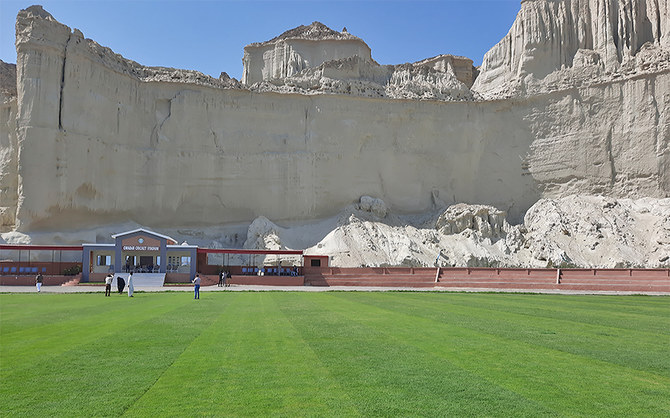

GWADAR: Pakistan hopes it can host international matches at Balochistan’s Gwadar Cricket Stadium, which the International Cricket Council (ICC) has recently described as one of the most picturesque sports venues, officials in the southwestern Pakistani province say.
Senator Muhammad Ishaq Baloch Cricket Stadium in the district of Gwadar, on which work started in 1998, has been built by the military and local government and was inaugurated in November 2020. Grass to cover the venue and tons of soil for the pitch were brought to Gwadar from Punjab.
The lush green site surrounded by mountains attracted international attention after the ICC shared its photos in a social media post in late January, challenging followers to show them a more scenic location.
Show us a more picturesque sports venue than the Gwadar cricket stadium in Balochistan.
We'll wait...
@falamb3 pic.twitter.com/lz6nUGr9HH
— ICC (@ICC) January 31, 2021
The ICC spotlight has triggered authorities to seek approval from the Pakistan Cricket Board (PCB) to expand the venue to meet international standards.
“We have approached PCB for expansion of the stadium. They know the technicalities required to meet international standards,” Gwadar Development Authority (GDA) director general Shahzeb Khan Kakar told Arab News earlier this week.
According to Hajji Hanif Hussain, former president of the Gwadar Cricket Association, the stadium measures around 66 meters, which is too small for international games that are usually held at venues that are between 137 meters and 150 meters long.
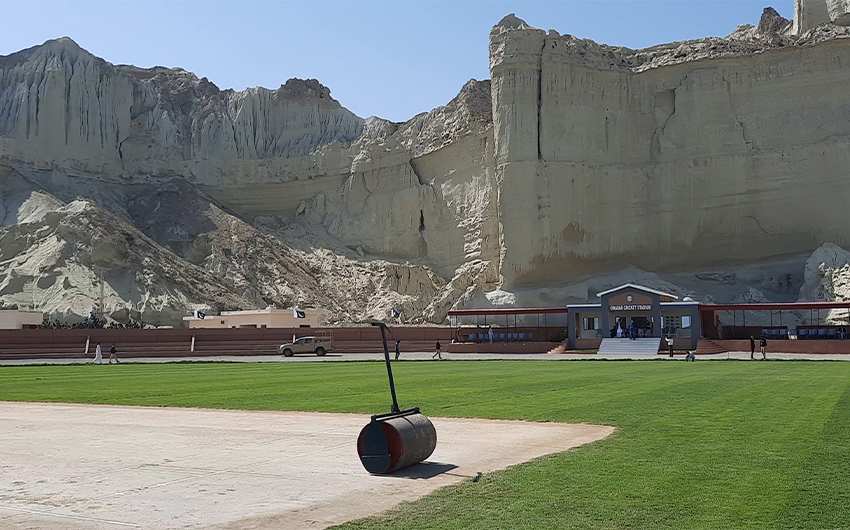
The Senator Muhammad Ishaq Baloch Cricket Stadium in Gwadar district, Balochistan, on February 15, 2021. (AN photo by Khurshid Ahmed)
However, as it is fit for cricketing at the national or local level, the stadium is gearing up to host district leagues matches by the end of February and the Gwadar Premier League (GPL) in August.
“We are planning for Gwadar Premier League in August of September this year where teams from across Pakistan would be invited,” Zahid Saeed, chairman of the Gwadar Cricket Association, told Arab News.
“Before GPL we are planning first Gwadar District League (GDL) at this ground by the end of this month where around 60 local teams would compete for the title,” he said. “It would be a display of Gwadar’s talent.”
While hopes have sprung in Gwadar following the ICC tweet, experts of international cricket say bringing foreign teams to the stadium would need more than just expanding the pitch.
The restive and underdeveloped province which borders Afghanistan and Iran has been the scene of a low-level insurgency for decades. Although authorities often say they have quelled the militancy in Balochistan, violent attacks have continued there.
“The basic requirement is the provision of security to the players and organizers as well as the spectators,” Qamar Ahmed, senior sports analyst, told Arab News. “Besides, the pitch should be approved by the ICC and the stadium should be equipped with floodlights.”
Local businessmen argue, however, that Gwadar district was safe. As one of the main sites of the China Pakistan Economic Corridor (CPEC), with numerous Chinese-funded infrastructure projects in progress, the area has been heavily protected.
“We are freely roaming in the area in a peaceful environment,” Chaudhry Liaquat, member of Gwadar Business Club, said.


