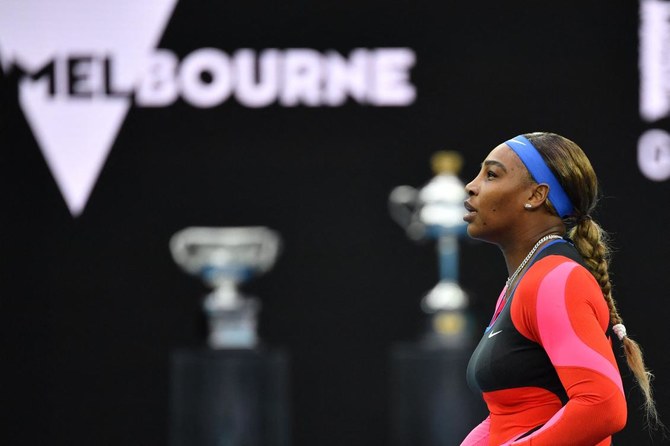
MELBOURNE: As well as she played at the start of her Australian Open quarterfinal, Serena Williams suddenly was struggling early in the second set.
After one mistake against No. 2 seed Simona Halep – who won the last time they played each other – Williams pointed at her racket strings and made a sour face, as if to make clear it wasn’t truly her own fault. After another, Williams looked up at her guest box with palms up and asked, “What is happening?”
That dismay did not last long. Williams recalibrated her shots, claimed the last five games and overcame 33 unforced errors to beat Halep 6-3, 6-3 on Tuesday to return to the final four at Melbourne Park for the first time since she won the tournament in 2017 for her most recent Grand Slam title.
“I just realized I was making a lot of unforced errors in those games that I lost. And I knew that I had an opportunity to play better,” said Williams, now two wins away from claiming her record-tying 24th major singles championship. “So I was just like, ‘Just stay in there. You just can keep going.’ And that’s what I just did.”
She set up a showdown against No. 3 Naomi Osaka, a three-time Slam champ who will carry a 19-match winning streak into Thursday’s semifinals.
“She’s Serena,” Osaka said. “I feel really intimidated when I see her on the other side of the court.”
This will be their fourth career matchup – all on hard courts – and Osaka leads 2-1, the most memorable encounter, of course, coming in the final of the 2018 US Open.
On that night, Williams got into an argument with the chair umpire after her coach, Patrick Mouratoglou, was caught trying to relay a signal – that’s not allowed in Grand Slam play – and wound up being docked a game. Osaka’s victory, which earned her first major title, closed with thousands of fans filling Arthur Ashe Stadium with boos and both of the athletes were in tears during the trophy ceremony.
There were no spectators Tuesday in Rod Laver Arena, because they’ve been banned from the tournament during a five-day government lockdown in response to a local rise in COVID-19 cases (the applause and other crowd noise TV viewers are hearing is being added to the broadcast feed and isn’t actually happening in the stadium).
Displaying the improved footwork that Mouratoglou says has been a point of emphasis, the 39-year-old Williams would swing at balls while they were still on the rise, trying to jump on shots and take time away from Halep.
“I know that, throughout my career, speed has been one thing that’s been super good in my game,” Williams said.
On the forehand side, especially, Williams struck point-ending strokes or put on pressure that prevented Halep from managing to do the same.
By the end of the opening set, Williams held a whopping 14-4 edge in winners. Indeed, she was at her best in just about every possible way – for that set, anyway.
The serves at up to 124 mph (200 kph). The returns that included a cross-court forehand winner on Halep’s very first service point, a stinging shot about which Williams said with a chuckle: “I just saw it, and it looked like a donut, and I went for it.”
She won the point on each of her first six trips to the net.
But then things went awry for Williams in just about every possible way – for a few games, anyway.
She fell behind 2-0 in the second set with 10 unforced errors in that span alone. A double-fault here. A wild volley there. Then Halep led 3-1.
That’s when Williams put a stop to her slide. A key game came at 3-all, when Williams converted her sixth break chance on a 13-stroke exchange in which she ran wide of the double alley on her forehand side to extend the point, eventually winning it when Halep dumped a forehand into the net.
“The best match I’ve played this tournament, for sure,” said Williams, who let out a big smile when it ended.


![]()

Serena Williams beats Simona Halep at Australian Open
Short Url
https://arab.news/vd2dq
Serena Williams beats Simona Halep at Australian Open
- She sets up a showdown against No. 3 Naomi Osaka, a three-time Slam champ


Latest updates


Recommended


© 2026 SAUDI RESEARCH & PUBLISHING COMPANY, All Rights Reserved And subject to Terms of Use Agreement.