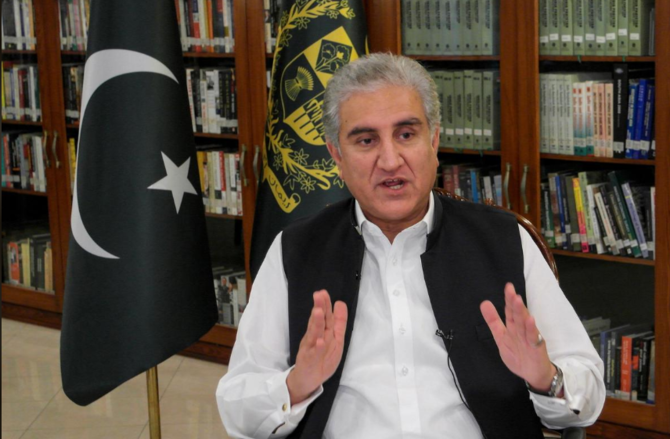
ISLAMABAD: Pakistani Foreign Minister Shah Mahmood Qureshi said on Tuesday Islamabad wanted to “re-engage” with Egypt as it was an important nation in the Muslim Ummah.
Qureshi’s remarks came as he left on a two-day visit to Egypt on the invitation of his Egyptian counterpart Sameh Hassan Shoukry.
Egypt is an “important” country in the Muslim Ummah and also often called the gateway to Africa, Qureshi said in a recorded video message before he departed for Cairo.
“The [Egyptian] foreign minister has invited me and on that invitation I am going to Egypt so we can re-engage with this important country,” the foreign minister said. “It is our administration’s policy to strengthen our relations with the African continent since we believe we have not fully explored its markets yet. It is extremely important for our economic diplomacy to engage with markets in Africa.”
“There are plenty of opportunities for both countries,” Qureshi added. “We can get into defense cooperation with each other. Pakistan can also expand its economic base by constructively engaging with Egypt.”
While in Egypt, the foreign minister will meet Egyptian media and the business community and also visit Al-Azhar University in Cairo, Egypt’s oldest degree-granting university and renowned as one of the most prestigious universities for Islamic learning.
Qureshi’s visit comes less than two weeks after Pakistani Prime Minister Imran Khan reaffirmed Islamabad’s commitment to expand Pakistan-Egypt ties, particularly in the areas of trade, education and culture, in a meeting with the ambassador of Egypt to Pakistan, Tarek Dahroug.
Khan has also met Egyptian President Abdel Fattah El-Sisi twice since he became PM: first, on the sidelines of the Organization of Islamic Cooperation Makkah Summit in 2019, and then on the sidelines of the 74th UN General Assembly in New York in 2019.
Last year, Khan also spoke with the Egyptian president over the phone regarding the PM’s ‘Global Initiative on Debt Relief’ for developing countries during the coronavirus pandemic, which was supported by Egypt.


Islamabad wants to ‘re-engage’ Egypt to enhance economic diplomacy — Pakistani foreign minister
https://arab.news/8sfgk
Islamabad wants to ‘re-engage’ Egypt to enhance economic diplomacy — Pakistani foreign minister

- Shah Mahmood Qureshi leaves for Egypt on two-day visit, will meet top leaders, media, business community
- Says important to enhance ties with African continent, find opportunities to enhance defense and trade relations

Curfew extended in Gilgit-Baltistan, probe ordered after deadly Khamenei protests
- At least 15 people were killed in clashes with law enforcement agencies over the weekend in Gilgit-Baltistan
- Government also announces a de-weaponization campaign, crackdown on hate speech and cybercrime in region
ISLAMABAD: The government in Pakistan’s Gilgit-Baltistan (GB) region on Tuesday extended a curfew in Gilgit district and ordered a judicial probe into violent protests over the killing of Iranian Supreme Leader Ali Khamenei in US-Israeli strikes last week, an official said.
At least 15 people were killed in clashes with law enforcement agencies over the weekend in GB, where protesters torched and vandalized several buildings, including United Nations regional offices, an army-run school, software technology park and a local charity building.
The violence prompted regional authorities to impose curfew in Gilgit and Skardu districts on March 2-4 as officials urged people to stay indoors and cooperate with law enforcers, amid widespread anger in Pakistan, particularly among members of the Shiite minority, over Khamenei’s killing.
On Tuesday, the GB government convened to review the situation and announced the extension of curfew in Gilgit among a number of security measures as well as ordered the establishment of a judicial commission to investigate the weekend violence in the region.
“The government has made it clear that the law will strictly take its course against elements involved in vandalism at government institutions, private properties and incidents of vandalism in Gilgit and Skardu and no kind of mischief will be tolerated,” Shabbir Mir, a GB government spokesperson, said in a statement.
“In view of the security situation, curfew will remain in force in Gilgit, while the decision to extend the curfew in Skardu will be taken keeping the ground realities and the changing situation in view.”
The statement did not specify how long the curfew will remain in place in Gilgit.
Besides the formation of the judicial commission to investigate the violent clashes, the government also decided to launch a large-scale de-weaponization campaign in the entire Gilgit district, for which relevant institutions have been directed to immediately complete all necessary arrangements, according to Mir.
In addition, a crackdown has been ordered on hate speech, spread of fake news and cybercrime.
“The aim of these decisions is to ensure the rule of law, protect the lives and property of citizens and crack down on miscreants,” he said. “Approval has also been given to immediately survey the affected infrastructure and start their restoration work on priority basis.”
Demonstrators in Pakistan’s southern port city of Karachi also stormed the US Consulate on Sunday, smashing windows and attempting to burn the building. Police responded with batons, tear gas, and gunfire, leaving 10 people dead and more than 50 injured.
Pakistani authorities have since beefed up security at US diplomatic missions across the country, including around the US consulate building in Peshawar, to avoid any further violence.


